
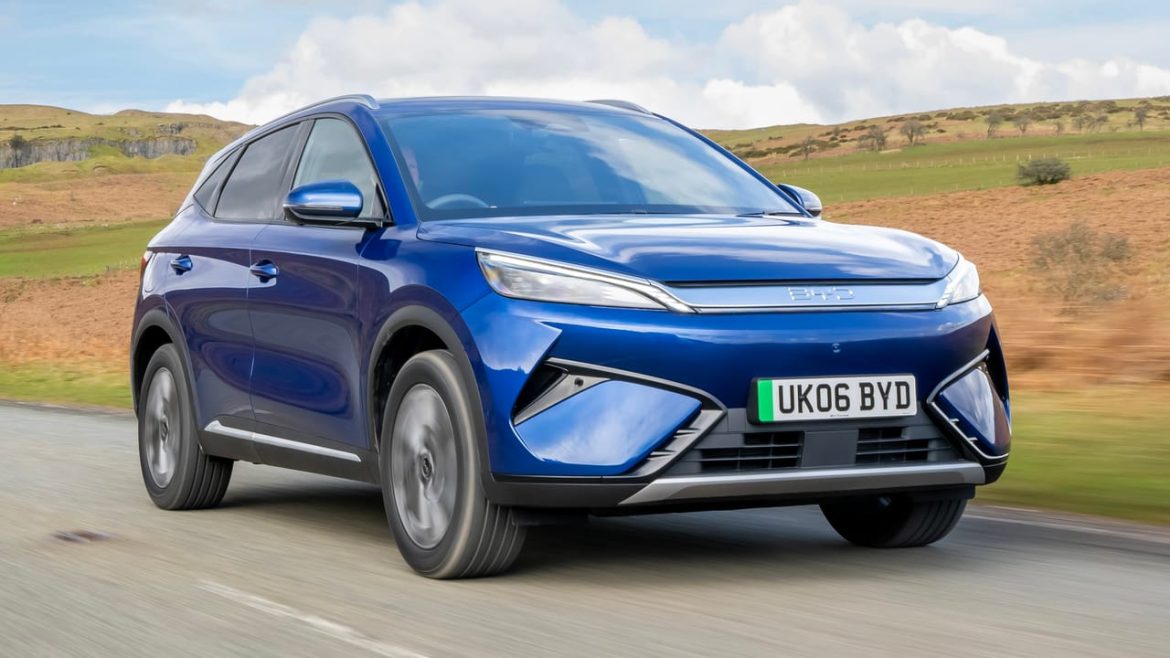
A small-to-medium electric crossover from the world’s biggest seller of EVs. It was BYD’s first UK offering back in 2023, and it’s now received a comprehensive update giving it more power, a bigger battery, longer range and faster charging. More on all that in a bit.
Size wise, think Hyundai Kona Electric. A bit smaller than a VW ID.4 or Skoda Enyaq or Toyota bZ4X, bigger than a Peugeot e-2008. It’s notably taller than an MG4 or VW ID.3 or Renault Megane E-Tech Electric. And those are just a few of its many rivals – heavily congested waters, these.
Advertisement – Page continues below
BYD who?
BYD is one of the world’s biggest battery makers. It builds electric trains, buses (hundreds of them running in London), grid storage units, cars, and batteries for all the above as well as for electronic gadgets. It employs around one million people, of which a slightly staggering 100,000 are engineers.
One staff member you might have heard of is BYD’s design boss, Wolfgang Egger. He did the Alfa 8C Competizione and 156 during his time as head designer there, and then went to Audi and produced the Q2.
When the Atto 3 first arrived it was relatively unambitious as a first step: FWD, 400V, and a 60kWh battery. Now, it’s available in rear- or all-wheel drive, sits on an 800V platform (meaning it can handle more power and charge faster), and gets a bigger 74.8kWh battery. This is no half-measure facelift.
And that name: Atto is an SI prefix, like kilo, mega, milli and micro. It means 18 zeros after the decimal point. BYD wants you to think of an attosecond: a timeframe so rapid it can’t be measured. Whatever. This updated model gains ‘Evo’ at the end for good measure (not to be confused with the legendary Mitsubishi).
Advertisement – Page continues below
What about the looks?
The exterior is neatly executed but no one’s going to be swooning. Even with the subtle updates, which you have to squint to notice. It talks familiar languages. The full width front and rear lighting, blanked out grille and metallic rear side panels say ‘EV’. The tall proportions, roof rails, and lower cladding speak ‘crossover’.
Inside though, things get a lot bolder. The shapes are swoopy, details somewhere between playful and cheesy. Your kids will love it, and if that stops them getting sick or complaining they’re not there yet, it’s worth it. The cabin is also decently roomy for the size of car. For more on all that, click the Interior tab of this review.
And to drive?
Acceleration is smooth, the suspension softly sprung, and it avoids the gallumphingly heavy feel of an ID.4. It’s an easy car to get along with, with nothing so alien that it’ll scare people off. So far, so family EV crossover.
It isn’t perfect though; there’s very little driver engagement; the ride becomes unsettled at higher speeds; the brakes are soggy; the driver assist systems are annoying (but that’s far from unique). Full details on the Driving tab.
Range is, at least, up on the 260 miles of old. On paper it’s now 317 miles WLTP in the rear-drive variant, and 292 miles in the AWD Atto 3. But a standard heat pump means it should perform robustly all year round.
And as mentioned, it’ll now also charge quicker. Previously it only supported a peak charging of 88kW, but now it’ll rejuice at 220kW on a DC fast charger. That translates into a 10 to 80 per cent charge in 25 minutes.
Give me something to impress my friends with…
BYD’s latest cars, including the Atto 3, use a cell-to-pack battery. Standard electric-car batteries bind their cells into modules, and their modules into the pack. Cell-to-pack puts the cells directly into the main case rather than into intermediate modules. BYD is calling it a ‘blade battery’. It means 50 per cent more of the overall pack size consists of the meaningful bit, the cells that drive you along.
This means the Atto 3 can get away with a less energy-dense chemistry. Its cells have electrodes of lithium, iron and phosphate (LFP). Most rivals need more energy-dense lithium manganese cobalt (LMC) electrodes. LFP are cheaper, more durable, and less fragile in high-temperature rapid charging. And they don’t use cobalt, an element that has been too often got from war zones.
There’s another significant first here. The Atto 3’s motor, power electronics, charger, AC-DC inverter, DC-DC converter, and battery management system are all packaged into one unit. This saves weight and space, and improves efficiency.
What’ll one of these cost me?
Prices start at £38,990. That’s for the base Design rear-drive version. The Excellence all-wheel-drive model is £42,730.
There are no options to choose from, other than paint and interior colour schemes (black or beige). Click through to the Buying tab for the full lowdown.
Our choice from the range
BYD
230kW Design 75kWh 5dr Auto
£38,925
What’s the verdict?
“Another identikit small-to-medium sized crossover that fails to tug on the heartstrings… do you care?”
The BYD Atto 3 is yet another identikit small-to-medium sized crossover that fails to tug on the heartstrings. The outside is completely uninspiring to look at, and while the cabin impresses on first impression with its big screen, glass roof, and interesting design, technophobes will struggle.
Still, this latest version does at least address some of its flaws. The battery capacity and max range are significant improvements, the standard heat pump means you shouldn’t see that range fall off a cliff in winter, and it now charges faster too. All big pluses.
Its handling still falls short compared to its competitors though – while it’s largely comfortable in town, it doesn’t cope quite so well beyond the city walls. Do you care? No, you’re probably more interested in the pages-long kit list… where do your priorities lie?
