
Getting your audio player ready…
A large-scale archaeological investigation ahead of a wind farm project in Lower Saxony, Germany, has revealed an unexpectedly rich and multi-layered landscape of human activity, ranging from early Neolithic farming communities to a rare Bronze Age jewelry hoard and Late Antique ritual deposits. The discoveries, made near Wolfenbüttel, demonstrate that the area once considered archaeologically unremarkable was in fact occupied and reused for thousands of years. The most striking find is a hoard of bronze ornaments and an amber necklace of over 156 beads, representing the adornment of at least three high-status women who lived more than 3,000 years ago.
Before construction began, authorities required a precautionary archaeological survey under the supervision of the Niedersächsisches Landesamt für Denkmalpflege (Lower Saxony State Office for Heritage). Between August 2024 and September 2025, archaeologists examined nearly 92,800 square meters, ultimately documenting 412 archaeological features. This density of finds fundamentally reshapes our understanding of the region, revealing continuous or repeated human presence across multiple periods.
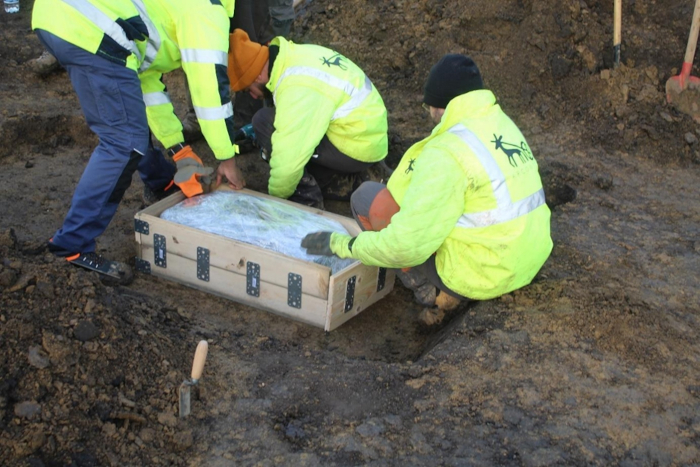
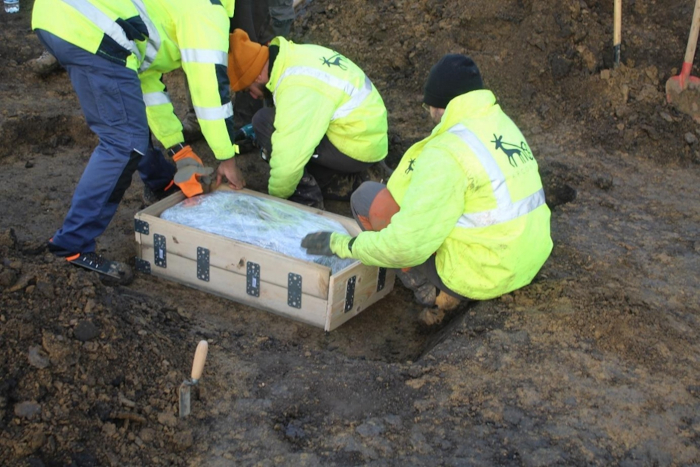
Researchers with a chest full of archaeological finds at the site. (Arcontor Projekt/ Lower Saxony State Office for Heritage)
A Bronze Age Jewelry Hoard Emerges
The most significant discovery came unexpectedly during the preparation of a turbine foundation. Archaeologists identified a tightly clustered group of objects made of bronze and organic material, and recognizing the fragility of the assemblage, specialists carried out a block lifting procedure, removing the entire deposit with surrounding soil for laboratory excavation. The analysis revealed a Bronze Age jewelry hoard dating between 1500 and 1300 BC. The assemblage includes decorated neck collars, arm spirals, sheet metal ornaments, and disc-headed pins – all characteristic of elite material culture in Bronze Age Europe.
At the center of this collection is a necklace composed of more than 156 amber beads, a rare and visually striking element within the broader ensemble. This makes it the largest individual find of amber from the Bronze Age ever documented in Lower Saxony. It represents the first Bronze Age hoard found in the northern Harz foreland since 1967, and notably, the only one excavated under modern scientific standards.
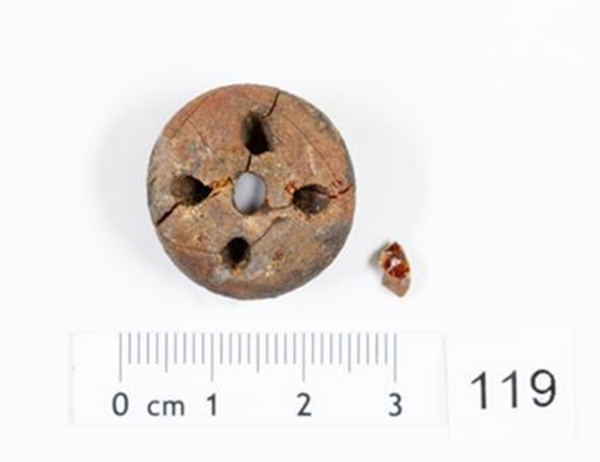
Amber bead with four perforations from the Wolfenbüttel excavation site. (T. Schuck / Lower Saxony State Office for Heritage)
More Than Ornament: Status, Identity, and Exchange
The importance of the find lies not in a single object, but in the coherent composition of the hoard. Such assemblages are widely interpreted as deliberate depositions, possibly linked to ritual practices, social identity, or expressions of elite status. Amber, likely sourced from the Baltic region, was a highly valued material in prehistoric Europe. Research by Aarhus University highlights its role in long-distance exchange networks that connected northern Europe with regions as far as Mesopotamia, including the city of Assur in the heart of the Assyrian Empire. Within this context, the necklace forms part of a broader symbolic and material system in which prestige, trade, and belief intersected.
Ongoing analysis, conducted in collaboration with Clausthal University of Technology, will focus on material composition, manufacturing techniques, and the geographic origin of the amber. These studies may provide new data on trade routes, craftsmanship, and cultural interaction during the Bronze Age. The archaeologists responsible for the intervention maintain that, with a high degree of probability, the burial of these ornaments represents a votive or religious deposition carried out by members of the local Middle Bronze Age elite—not a simple hiding place for valuables.
Layers of History: From Neolithic Farmers to Roman Ritual
Among the most important early discoveries were the remains of two well-preserved houses belonging to the Linear Pottery Culture (Linearbandkeramik), dating to the mid-6th millennium BC. These structures represent the first farming communities in Lower Saxony, offering valuable insight into how early agricultural societies settled, built, and organized their domestic spaces. Associated finds and environmental samples are expected to provide further data on diet, land use, and early settlement dynamics.
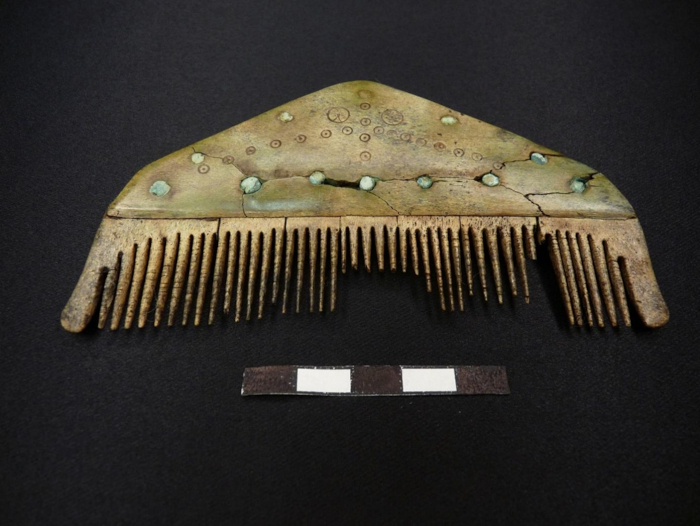
Bone comb from the 4th–5th century CE, decorated with bronze rivets. (T. Uhlig / Lower Saxony State Office for Heritage)
The site also yielded evidence of activity centuries after the Neolithic period. Archaeologists identified several settlement traces from the early centuries AD, including unusual pits containing carefully arranged deposits of dog burials, wheel-thrown pottery modeled on Roman techniques, and metal objects. A particularly rare object from this phase is a nearly complete three-layer comb from the 4th–5th century AD, decorated with circular motifs and bronze rivets. Comparable items are typically found only in fragments due to cremation customs, making this example exceptional. What began as a routine pre-construction survey has evolved into a major archaeological case study, demonstrating that areas without previously recorded finds can still preserve complex, stratified records of human activity spanning millennia.
Top image: Depot find from Ahlum (1500–1300 BC): selection of artifacts including neck collars and fragments, amber beads, a spiral hair ornament, needle fragments, and parts of an arm spiral. Source: C. Wehrstedt Lower Saxony State Office for Heritage
By Gary Manners
References
Altuntaş, L. 2026. Bronze Age Jewelry Hoard and Prehistoric Settlements Discovered During Wind Farm Construction in Germany. Arkeonews. Available at: https://arkeonews.net/bronze-age-jewelry-hoard-and-prehistoric-settlements-discovered-during-wind-farm-construction-in-germany/
Carvajal, G. 2026. A triple bone comb of the Late Roman Germanic elite and a necklace of 156 Baltic amber beads from the Bronze Age, discovered in Germany. LBV Magazine. Available at: https://www.labrujulaverde.com/en/2026/04/a-triple-bone-comb-of-the-late-roman-germanic-elite-and-a-necklace-of-156-baltic-amber-beads-from-the-bronze-age-discovered-in-germany/
Niedersächsisches Landesamt für Denkmalpflege. 2026. Bernstein aus dem Niemandsland? Bronzezeitlicher Depotfund beim Bau eines Windparks nahe Wolfenbüttel. Available at: https://denkmalpflege.niedersachsen.de/aktuelles/nachrichten/bernstein-aus-dem-niemandsland-249829.html
