
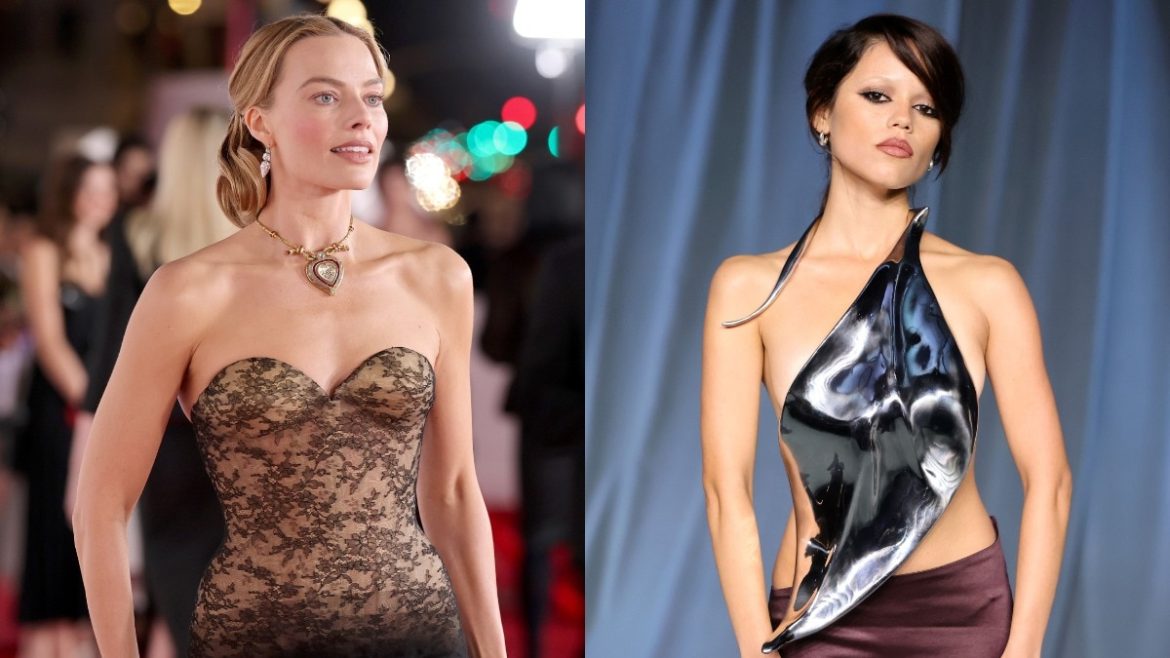
For years, jewellery was treated as punctuation. You got dressed, built the look, and then (almost instinctively) added the finishing touches: a necklace, a ring, something to complete it. But that order feels increasingly outdated.
On recent runways, it’s unmistakable. At Saint Laurent, oversized earrings cut through sharply tailored silhouettes. At Schiaparelli, surreal, sculptural pieces feel closer to objects than ornaments. This wave has hit red carpets too – clean gowns punctuated by a single cuff, a pendant, or an earpiece that holds the entire look together. For the more experimental, breastplates and metal corsets are having a major moment.
From Kiara Advani and Alia Bhatt’s Gaurav Gupta moments to Bella Hadid’s bronchial Schiaparelli necklace, maximal jewellery has stood the test of time. Even bridal styling is moving in this direction, with statement earrings replacing necklaces altogether. The message is clear: jewellery isn’t being layered on anymore, it’s being built around.
Closer home, labels like Outhouse, MISHO, Bhavya Ramesh Jewellery, and Anatina aren’t just responding to this shift; they’re shaping it. Across them, a shared language emerges through sculptural forms, clean silhouettes, and pieces that feel collected rather than styled.
Suhani Parekh, founder of MISHO, has always approached dressing this way. “I put my jewellery on first. Everything else comes after… the jewellery does the work. It holds the look, it gives it intention.” Most days, she admits, it’s just a white shirt and denim. The jewellery carries everything else. It’s a way of dressing that feels instinctive and also precise. Strip things back, and let one piece do enough. That idea (of a single piece anchoring the look) is what defines the current moment. Across fashion, the shift is towards fewer elements, but stronger ones. The kind that don’t need support.
At Outhouse, founders Sasha and Kaabia Grewal see this as a broader shift in how we approach dressing. “Jewellery is no longer an afterthought; it is increasingly becoming the point of departure,” they say. What’s driving it is a more intentional wardrobe overall. “People are choosing fewer elements, but with far more intention.”
Anatina’s founder, Aakanksha Kotawala, echoes this. “It’s the first decision in 2026. We’re seeing people build their looks around a piece rather than adding it at the end.” One strong piece, she says, can carry an entire look. That shift is changing how jewellery itself is being designed. Scale still matters, but not in the obvious way. It’s less about size, more about presence–how a piece sits on the body, how it changes posture, how it holds space. “It has to change how you carry yourself–the posture, the movement…,” Parekh explains.
Which is why so much of what we’re seeing right now feels closer to art. Jewellery is being approached less as an accessory, more as an object–something you collect, something that exists beyond the outfit. Most collectors define their pieces as artefacts. Something that feels discovered, storied, and significant. In a moment that is otherwise so digital, physicality feels important. Jewellery is one of the few things you actually feel: its weight, its movement, its presence on the body. It also explains the return of symbolism: charms, talismans, zodiac motifs… pieces that carry something beyond aesthetics.
“People are craving meaning again… Symbolism, charms, stories, they give jewellery a layer beyond aesthetics,” says Kotawala. The Grewal sisters see it as a response to the pace of everything else–jewellery becoming “memory, protection, belief, or intention.” Parekh puts it simply: “They express something more personal. Identity, belief, memory… something that stays with them.”
And that’s really the shift. Jewellery today feels less tied to occasion and more to identity. It’s not about dressing up; it’s about recognition. In a landscape driven by images (scrolling, saving, consuming) jewellery offers something tangible. You feel it. It moves with you. It anchors the look.
So instead of asking “what completes an outfit?” The question has changed: “What is the one piece that defines it?” Because right now, the most compelling way to get dressed isn’t to build a look and accessorise it. It’s to start with something that already says enough and let everything else fall into place around it.
Lead image: Getty
Also read: From Neeta Lulla to Tarun Tahiliani, the veterans shaping Indian fashion’s lasting legacy
Also read: The H&M X Stella McCartney collaboration celebrates nostalgia and embraces a conscious future
