
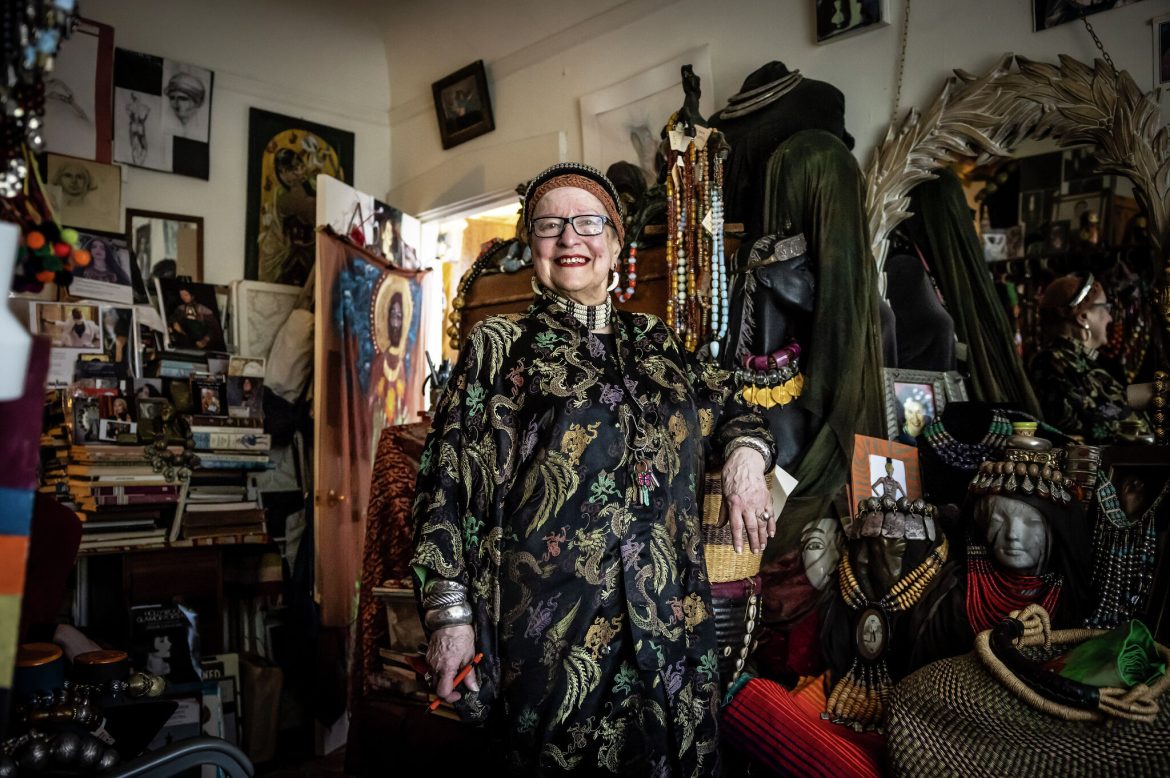

Ukrainian jewelry artist Masha Archer in her studio in San Francisco on April 30, 2026. Archer, who for years has sold her bold, bright wares at the War Memorial Opera House during opera productions, was recently and suddenly informed San Francisco Opera is discontinuing the shop.
For decades at San Francisco Opera, there have been other, not-so-secret performances happening offstage.
Patrons are the usual cast members, but sometimes it’s sopranos and bassos, too. The shows are much smaller scale, but still eye-popping and grand — even operatic — for their platform, which is the human body.
From a longtime perch in a shop in the War Memorial Opera House’s mezzanine, designer Masha Archer has sold statement jewelry with the heft of body armor and beads like berries or cherry tomatoes bursting with juice.
Article continues below this ad
Retired mezzo-soprano Frederica von Stade a favorite of the Opera from the 1970s to the 2000s, described Archer’s pieces as “magnificent” and “absolutely divine.” She owns two necklaces.

A piece titled “Hadyuchka” (little snake) by artist Mykola Mukhin, father of Ukrainian jewelry artist Masha Archer in San Francisco on April 30, 2026.
Now, though, that’s all come to an end.
With the January retirement of Opera Shop manager Jay Stebley, Opera General Director Matthew Shilvock reassessed the “economic realities” of operating the store, he explained in an email to subscribers on May 7, noting, “Many of you have been asking for more audience spaces in the Opera House.”.
Article continues below this ad
To that end, the company announced plans to put a new “patron space” with food and beverage partner Global Gourmet in the shop area next season. (Archer is not affiliated with the San Francisco Ballet, which uses the War Memorial differently when it’s in the venue.)
He added, “We deeply value the connection we’ve had with Masha over many years.”


(L) An African-inspired piece by Ukrainian jewelry artist Masha Archer in her studio in San Francisco on April 30, 2026. Archer, who for years has sold her bold, bright wares at the War Memorial Opera House during opera productions, was recently and suddenly informed San Francisco Opera is discontinuing the shop. (R) African beads used by Ukrainian jewelry artist Masha Archer in her studios in San Francisco on April 30, 2026.
Carlos Avila Gonzalez, S.F. Chronicle(L) An African-inspired piece by Ukrainian jewelry artist Masha Archer in her studio in San Francisco on April 30, 2026. Archer, who for years has sold her bold, bright wares at the War Memorial Opera House during opera productions, was recently and suddenly informed San Francisco Opera is discontinuing the shop. (R) African beads used by Ukrainian jewelry artist Masha Archer in her studios in San Francisco on April 30, 2026.
Carlos Avila Gonzalez, S.F. ChronicleArcher, 85, told the Chronicle she felt “rage, sadness and disbelief” at the decision. At the time, she didn’t even know autumn’s “The Monkey King” would be her last production selling at the War Memorial.
Her daughter Larissa worried that her mother will have less occasion to get dressed up and go out now. While she and her mother are obviously biased, she pointed out how special the shop was. “I don’t know how many major institutions give so much visibility to local artisans,” she said.
Article continues below this ad
Even as Masha Archer’s starting a new, straitened chapter, her story of eking out an existence as an artist in San Francisco, part of yet separate from the city’s grandest arts institution, has the kind of serendipity and whimsy that feels like part of a bygone era.
Archer made her own showtime out of the Opera’s preshows and 22-minute intermissions, and she has an ingenious try-before-you-buy method that doubles as a billboard — “swanning,” she calls it.

Ukrainian jewelry artist Masha Archer in the bead room of her studio in San Francisco on Thursday, April 30, 2026.
She’d invite a passerby to try something on, then add, “If it works, you can wear it in the house for the rest of the evening and bring it back at the end.”
The tags would still be attached, which other patrons might point out, trying to be helpful, only to to turn Archer’s window shoppers into models. Suddenly they were getting talked to and photographed in a glamorous setting, directing other potential customers to the shop, where they could model, too.
Article continues below this ad
Not every woman pictures herself as the type to sport a giant lion head with mini alligators dangling from it or a black-and-white carte de visite hanging ascot-style from a necklace-qua-breastplate. But Archer could bring out the daring that many repress.
While each item is as heavy as it looks, Archer distributes the weight with an engineer’s savvy. It’s a little bit like wearing a weighted blanket, or armor.
Now that attendees of this summer’s “The Barber of Seville” and “Elektra” are no longer Archer’s models, the Kyiv, Ukraine, native still plans to sell her wares online.

Larissa Archer holds a piece of Masha Archer’s jewelry in their studios in San Francisco on April 30, 2026.
The adjoining Hayes Valley apartments she and her daughter Larissa share are stacked full of them. There’s barely room to walk. Necklaces bedeck not just mannequins but also horse sculptures created by Masha Archer’s father and shells of violins. A long hallway is nicknamed the “wall of beads,” with little baggies of orbs spanning continents, the color prism and materials — resin, silver, brass, turquoise.
Article continues below this ad
Wherever there isn’t jewelry, there are stacks of fabric. Archer likes to wear long robes fastened with a binder clip. Her family fled Kyiv in 1942 for Germany, settling in Philadelphia in 1949. With a sculptor father and painter mother, it “was very normal for me to make things,” she recalled, her bangles clacking and rattling with every gesture.
The family thrilled to “this big thing going on in America called thrift shops,” she explained. When she moved to New York to study at the Pratt Institute, many of her art and design materials were free sidewalk finds.
“Oh, the things they had in New York in the trash!” she effused.

African beads used by Ukrainian jewelry artist Masha Archer in her studios in San Francisco on April 30, 2026.
She came to favor a stone called milk glass, also known as opalite or opaline. From her training as a painter, she learned, “Everything is about light.” Milk glass, with its cloudy interior, kept playing with the sun as she rotated it at different angles. “It’s just so wildly beautiful,” she said.
Likewise, when she enthuses about her favorite color combination — her “beloved” red and green, in all their permutations — it’s like she’s pining for a paramour.
First arriving in San Francisco in 1961, and moving permanently to the city by 1967, the artist was already an opera fan. She asked herself, “How do I get to go to the opera all the time, for free? Usher.”
Accordingly, her daughters grew up handing out programs in the War Memorial. Larissa even wrote an essay about it for Broke-Ass Stuart, calling herself the “‘Eloise’ of the San Francisco Opera,” referring to the Kay Thompson children’s book series.
Eventually, the jewelry Archer wore ushering caught the eye of Opera merchandising associate Gabrielle Harmer. By the late 1980s or early ‘90s, Archer was selling in the shop’s Grove Street location, then following it inside the War Memorial to what’s now a donor lounge and eventually to the mezzanine.

Jewelry pieces by Ukrainian jewelry artist Masha Archer in her studio in San Francisco on April 30, 2026.
Susie Hanson, a 45-year Opera patron from Walnut Creek who owns seven Archer pieces, described the works as “highly textured jewelry representative of a true artist.” Modeling during performances, she’d sometimes switch necklaces during intermission.
Judy Miner of San Francisco owns “at least 30” Archer designs, treating herself to a new one each opera season. She calls them “wearable art.”
Among Archer’s most prized possessions are photographs of favorite opera stars in her work, including Plácido Domingo, Anna Netrebko and especially Samuel Ramey, who posed bare-chested.
Clothing wears out, she said, but “Jewelry goes on and on.”
So does opera. Archer still plans to visit the War Memorial during productions, watching on the monitors in the lobby with staffers she’s long known. Even if her shop is gone, her enthusiasm for the singers is undiminished, unhesitant.
“It’s just gripping to be able to see them,” she said wistfully.
