
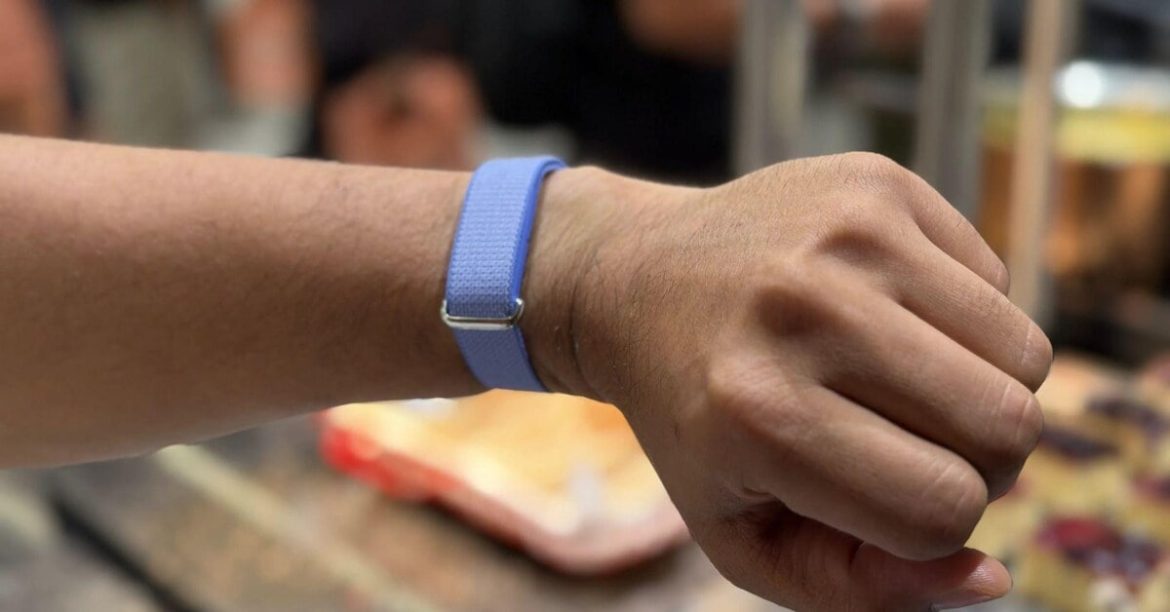
Screenless fitness wearables are making a comeback, with Google, Garmin and Amazfit among the companies betting on devices that track health and fitness without putting a display on the wrist. Bloomberg has reported that Apple is also exploring a screenless wearable as part of a broader rethink of its Watch lineup.
The timing is telling. Global wearable band shipments dropped 2 per cent year-on-year in Q2 2026, per market tracker Omdia. Screenless devices, however, accounted for more than 15 per cent of shipments in the basic band category, which Omdia calls a distinct growth area within an otherwise declining segment.
From Fitbit Flex to Whoop, screenless never really disappeared
Fitbit’s Flex, launched in 2013, had indicator lights instead of a display — activity and sleep data lived in the companion app. But the market went the other way. Displays became the selling point, as notifications, calls, apps, music and GPS piled on. The basic band got squeezed between affordable smart bands and increasingly capable smartwatches.
Screenless found its second wind through Whoop. The company built its product around continuous tracking rather than the smartwatch playbook. The absence of a screen was deliberate, with the wearable designed to collect physiological data continuously while the smartphone app handled the analysis.
Whoop initially built much of its identity around professional and elite sports. Athletes like Cristiano Ronaldo, LeBron James and Michael Phelps were seen wearing them, while it partnered with professional sports teams including Scuderia Ferrari HP Formula One team.
Google, Garmin and Amazfit are betting on less hardware
Google’s Fitbit Air is perhaps the clearest indication that the screenless format is moving back towards the mainstream. The device, launched globally in May, weighs 12g with its band and has no display. Instead, health information is accessed through the Google Health app.
Google’s own positioning is telling. The company said that the Fitbit Air is aimed at people who find conventional smartwatches too heavy, expensive or distracting. The company is effectively separating the sensing hardware from the screen, leaving the phone to handle the visualisation and analysis.
Amazfit took a similar route earlier. The company launched the Helio Strap in June 2025 as its first screen-free fitness, recovery and sleep tracker. The device continuously monitors heart rate, sleep and other health metrics and works with the Zepp app rather than providing information on a display.
Garmin has now entered the category as well. Its Cirqa Smart Band has no screen, supports 24/7 health monitoring and automatic activity detection, and offers up to 10 days of battery life. Garmin also positions it as a tracker that works without a subscription, with data available through the Garmin Connect app.
That makes the current crop of screenless devices considerably different from the early fitness bands. The hardware may look simple, but the sensing capabilities and software behind them are much more sophisticated.
The wearable market is splitting in two
Omdia’s Jason Low described the market as having two clear winners: minimalist, screenless trackers that can be worn continuously and feature-rich sports watches designed around accuracy and advanced training data. Basic watches and mid-tier smartwatches, by comparison, are being squeezed.
This distinction matters.
Screenless trackers are not necessarily reviving the smart band market. They are creating a different segment within it. The product is no longer being sold primarily as a cheaper alternative to a smartwatch. Instead, it is being positioned around continuous monitoring, comfort, battery life and reduced interaction with the device itself.
Why remove the screen now?
The obvious question is why consumers would deliberately give up one of the most useful parts of a smartwatch.
One answer is that the screen is also the part of a smartwatch that demands attention. A wrist notification turns a fitness tracker into another interruption. It also drains more power and sets an expectation that the device should do more than just monitor health.
Take the screen away, and the relationship changes. The band stays on through workouts, work and sleep; the phone becomes where you actually check in on the data.
Battery life backs this up. Fitbit Air claims up to seven days, Garmin’s Cirqa up to 10. Garmin’s Index Sleep Monitor — a screenless band worn on the upper arm — claims up to seven nights.
No display also makes it easier to design for sleep and continuous wear, which matters more as health tracking shifts from single workouts to longer-term signals: sleep, recovery, HRV, stress.
Omdia’s research on smart rings backs this up too — 43 per cent of respondents in a 2025 survey didn’t own a wearable band at all, citing discomfort with all-day or overnight wear and frequent charging as the main barriers. Smart rings prove the same point: a wearable doesn’t need to act like a mini smartphone to earn its place on your body.
Apple may be watching the shift
What matters isn’t whether Apple ships a screenless wearable — it’s why the idea is even on the table. Apple already dominates smartwatches: Counterpoint puts its Q1 CY 2026 global share at 21 per cent, up 21 per cent year-on-year. But the category itself is expanding past the conventional smartwatch. Smart rings are growing, Whoop has built a screenless subscription business, and Google, Garmin and Amazfit are all now shipping their own screenless bands.
