
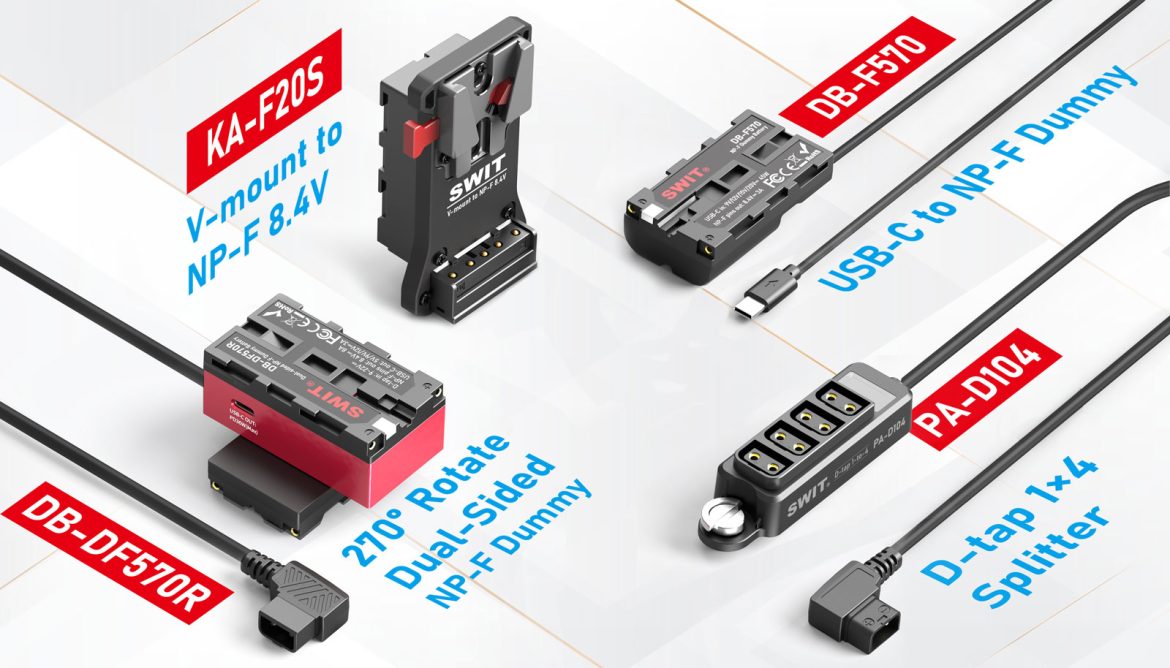

SWIT is broadening its NP-F power ecosystem with four new products: the DB-DF570R, a 270-degree rotatable dual NP-F dummy battery with USB-C output; the DB-F570, a compact USB-C NP-F dummy; the KA-F20S V-mount to NP-F conversion plate; and the PA-D104 D-tap 1×4 splitter hub. All four are slated for availability through SWIT’s global distribution network in Q2 2026.
SWIT has been steadily building out its power accessories lineup over the past year. Following the USB-C dummy battery line launched in mid-2025 and the PowerCell OEM-grade replacement battery series unveiled at IBC 2025, this latest expansion targets a specific but common pain point: making NP-F power more flexible, scalable, and compatible with V-mount and USB-C workflows simultaneously. For shooters running NP-F-powered monitors, wireless receivers, or cameras alongside larger battery systems, these four accessories address some real-world rigging frustrations. Let’s break them down.

DB-DF570R: the rotatable dual dummy
The headline product in this expansion is the DB-DF570R, an upgraded version of the existing DB-DF570. The defining change is a 270-degree rotatable body, which allows the unit to reorient its connector angle without repositioning the entire battery plate. That matters in practice because NP-F plate layouts vary significantly between devices. Some run horizontal, others vertical, and on tightly packed rigs where a monitor and a wireless receiver share NP-F slots, cable routing becomes a genuine problem. The DB-DF570R addresses this directly.

In terms of power delivery, the unit takes D-tap input in the 9–22V range and converts it to dual NP-F outputs at a regulated 8.4V, with a combined output capacity of 8A across both channels. An additional USB-C PD output supports 5V, 9V, or 12V at 3A, meaning the accessory can simultaneously feed two NP-F devices and charge or power a third device via USB-C. An LED display shows real-time input voltage, and built-in protection circuits guard against over-current and short-circuit conditions. The DB-DF570R is priced at €45 and weighs 170g, with dimensions of 12x8x5.5cm.

DB-F570: USB-C directly into an NP-F slot
The DB-F570 is a more straightforward proposition: a compact dummy battery that slots into a standard NP-F plate and accepts USB-C input in the 9–20V range, outputting regulated 8.4V at up to 3A. The practical application is simple: connect a USB-C power bank, a USB-C V-mount battery, or a USB-C power adapter and run your camera or accessory continuously without swapping batteries.
What sets this apart from generic USB-C dummy solutions is a built-in digital power management chip that communicates with Sony ENG camcorders. Specifically, it replicates the data exchange of a native battery, displaying remaining power information in the camera’s viewfinder just as an original pack would. Confirmed compatible devices include the Sony HXR-NX100/200, HXR-NX5R/NX3, HXR-MC2500, HDR-FX1000/1000E, AX2000, Blackmagic Design BMPCC 6K Pro and 6K G2, and the ZCAM E2 series, in addition to any device that accepts a standard NP-F plate. At €24 and 70g, it sits at an accessible price point for what it does.

KA-F20S: V-mount capacity, NP-F output
The KA-F20S is a step-down conversion plate that mounts a V-mount battery and delivers regulated 8.4V at 4A to any NP-F-equipped device. The concept is useful for operators who want to run NP-F-powered accessories from a high-capacity V-mount pack rather than swapping smaller cells throughout the day. SWIT describes a height-differential step-down design that lowers the V-mount battery’s center of gravity when mounted on a cart or stand, which should translate to improved balance in those configurations.
The housing is all-metal, and the unit accepts V-mount input from 12–16.8V. At 200g and €45, the KA-F20S sits alongside similar conversion plates from brands like Bebob and Core SWX, though independent testing will determine how it compares in real-world voltage regulation and heat management under continuous load.

PA-D104: one D-tap becomes four
Rounding out the release is the PA-D104, a D-tap splitter hub that takes a single D-tap input and distributes power to four independent D-tap outputs, supporting a total load of up to 10A. Each output has its own LED voltage indicator, and a 1/4-inch screw mount allows the unit to be secured to a camera cage, cheese plate, or any standard rig component. SWIT targets use cases such as simultaneously powering monitors, wireless receivers, LED lights, and other on-set accessories from a single battery tap.

The PA-D104 accepts and passes through D-tap voltage in the 12–16.8V range. It weighs 100g and measures 16.5×10.5x3cm, keeping it compact enough to tuck into most rig configurations without adding meaningful bulk. Pricing is €24, which positions it as a cost-effective alternative to branded D-tap distribution options from companies like Hawk-Woods or IndiPRO Tools.
Pricing and availability
All four products are scheduled for availability through SWIT’s global distribution network in Q2 2026. Pricing as announced:
- DB-F570 (USB-C NP-F dummy): €24
- PA-D104 (D-tap 1×4 splitter): €24
- DB-DF570R (rotatable dual NP-F dummy with USB-C): €45
- KA-F20S (V-mount to NP-F plate): €45
Full product details are available on SWIT’s website. For more on SWIT’s broader power lineup, including the VOLTA PRO 9kWh modular power station for larger productions, our previous coverage has you covered.
Are any of these four accessories solving a rigging problem you’ve run into on set? And does the DB-DF570R’s rotatable design change how you’d approach a multi-device NP-F setup? Don’t hesitate to let us know in the comments below
