
Jody Craven heats up a small band of copper with a blowtorch in his classroom at Nauset Regional High School as his student Alex Mince looks over his shoulder. The two are trying to solder a small star onto a bronze hairband.
After the metal cools a bit, losing its fiery color, Craven picks it up with a pair of tongs and drops it into a bowl of water. The star drops off.
“To solder the two pieces together, you have to bring up the temperature evenly,” says Craven. Since the star is much smaller, it’s heating up more quickly. They’ll try again later by increasing the overall temperature, but in the meantime, Craven instructs Mince to drop the metal in a pickle — an acid bath that removes oxides.
Mince is a sophomore taking advanced metals and jewelry, her third class with Craven. The handful of other students in this class are also well versed in the terminology and craft of jewelry making. “They’re learning pretty sophisticated techniques and doing college-level work,” says Craven.
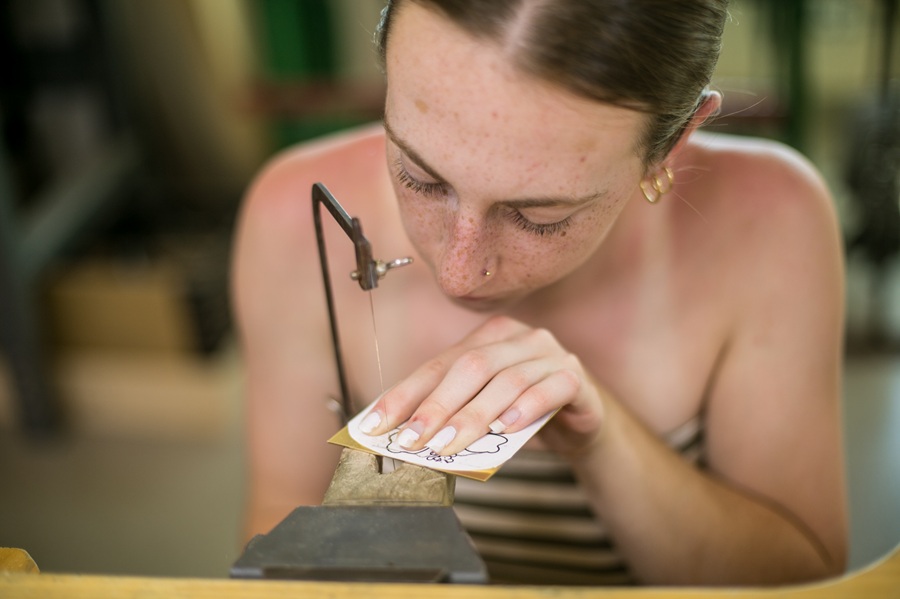
The school’s metals and jewelry program is a rarity. It’s the only one on the Cape and one of only perhaps five such programs in the state, Craven says. The program started after Massachusetts phased out study halls as part of the high school curriculum. Craven, who graduated from Nauset in 1985, started working at the school in 1997 as a student teacher in the English department. There were no English teaching jobs available at the time, so the principal offered him a position leading the fledgling metals program, despite his lack of experience.
“It was very serendipitous,” says Craven. “I got more experience as I cultivated my students’ skills.” Outside the classroom, when he’s not occupied by his summer gig as a head lifeguard at White Crest Beach, Craven makes his own jewelry, working with rare gemstones and high-karat gold, to create nature-inspired forms. He sells his pieces at Adorn in Orleans, a shop owned by Molly Avellar, a jewelry designer and maker and a former student of Craven’s.
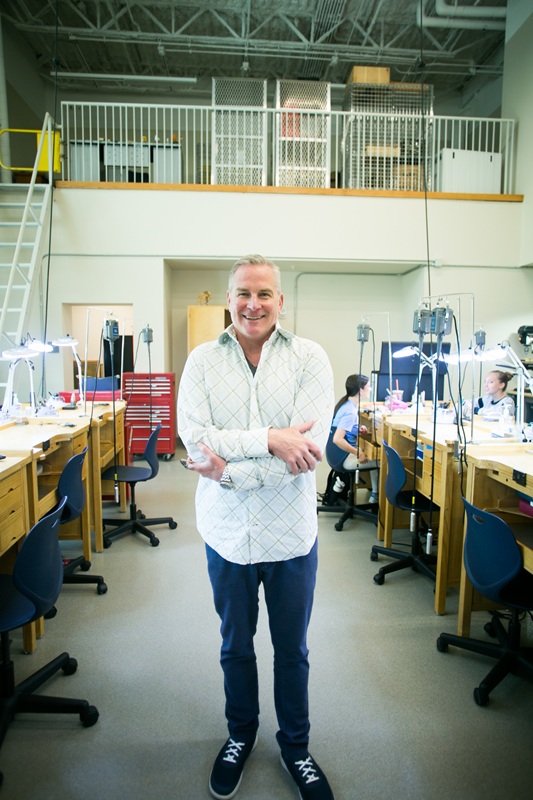
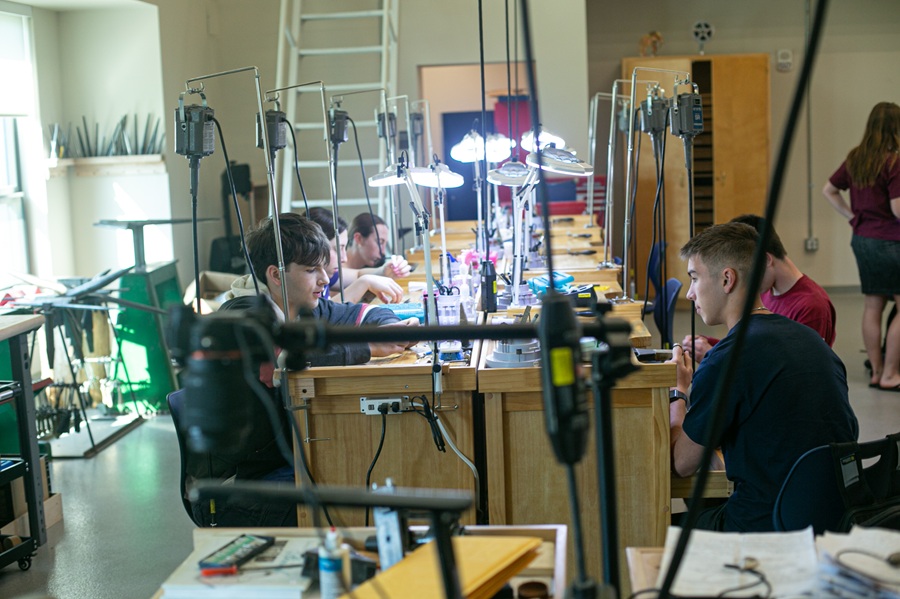
The atmosphere is hushed during the morning class. Students work patiently on individual projects along rows of workbenches, each with its own set of tools and overhead lights. The space is cavernous, with high ceilings and stations with specialized equipment spread through the room.
Caleb McLaughlin, a senior, is working on a machine that looks like a high-tech toaster. It’s actually a rotary machine for finishing and a pneumatic engraver. He’s using one of the various engraving tips on a practice piece.
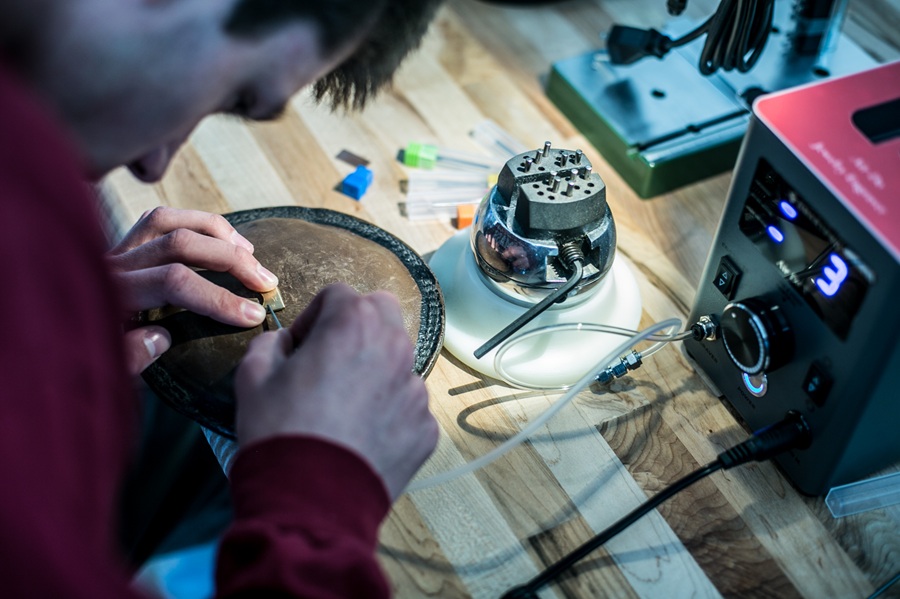
The machine was purchased with funds allocated for equipment during the renovation of the school, which was completed this year. The renovation was also an opportunity to redesign the classroom. “The building project has been a shot in the arm to the program,” says Craven. “My infrastructure is much better suited for jewelry and fine metals applications.” Craven was on the school building committee and consulted with the project’s architects, working to replicate what he had seen in private jewelry studios and at the New Approach School for Jewelers in Tennessee.
Large quantities of gold, however, are not something the budget covers. Most student projects use copper or bronze and occasional gems from donated materials, often leftovers from jewelry makers with whom Craven has relationships. Students in his advanced class who want to use gold and fine silver must purchase it themselves.
Madison Bartleman, a senior from Yarmouth Port, is working on a cuff bracelet. The silver band is straightened, and she’s using tweezers to place bits of gold leaf into a design of flowers that she stamped onto the surface of the silver. Next, she takes the band and places it on a burner, heating the surface to about 900 degrees so that the 24-karat-gold foil will fuse to the silver. “This is the process of keum boo,” Bartleman says, describing the ancient Korean gilding technique. “It’s a way to mix metals and use gold without breaking the bank.”
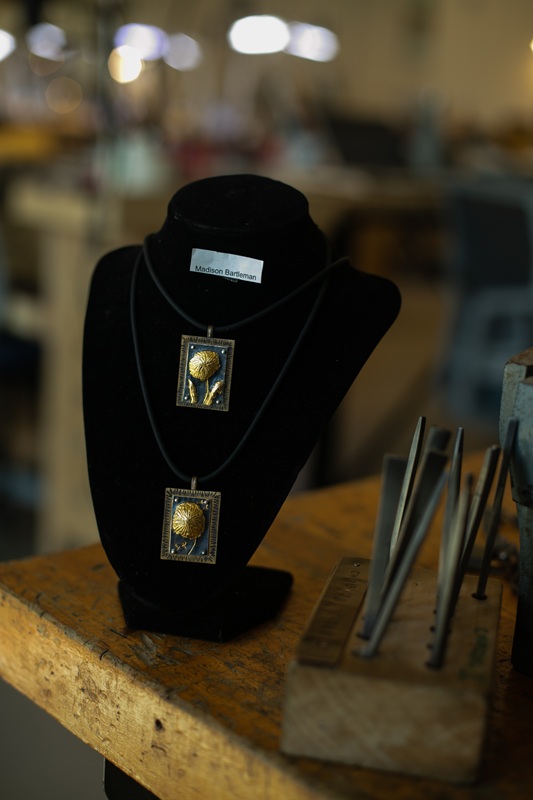
Bartleman displays two necklaces that were in a recent showcase of fine and applied arts at the school. The pendant necklaces each contain an image of a dandelion protruding from the rectangular base. Bartleman used chasing and repoussé techniques, hammering the malleable metal to create the low relief. The project took about six months and required a range of other techniques: creating a dark patina on the bronze backing, riveting miniature silver balls around the edges, and adhering gold leaf to fine silver.
It’s not unusual that Craven’s students take a long time on a single project. He points out a silver chain necklace made by Mataya Valli, a junior from Wellfleet. “Each one of these links is fused, and she’s weaving them together,” says Craven.
Valli’s necklace uses an Etruscan technique. As the students learn each technique, they’re introduced to art history and Korean, French, Italian, and Japanese cultures.
Jakob Baerga, a senior from Brewster, learned the Japanese technique of mokume-gane to make a ring. Historically, the technique was used for decorative sword fittings, and it involves layering different types of metals.
“I took pieces of copper and silver of the same size, stacked them like a sandwich, and then heated it to 2,000 degrees so that it fused,” says Baerga. Then, he flattened the composite metal with a rolling mill, placed it in a vise grip, and twisted it into a rod about a quarter of an inch thick. After cutting it down the middle, a wood-grain-like pattern was revealed. He then used that to construct a series of rings. “I wear them,” he says.
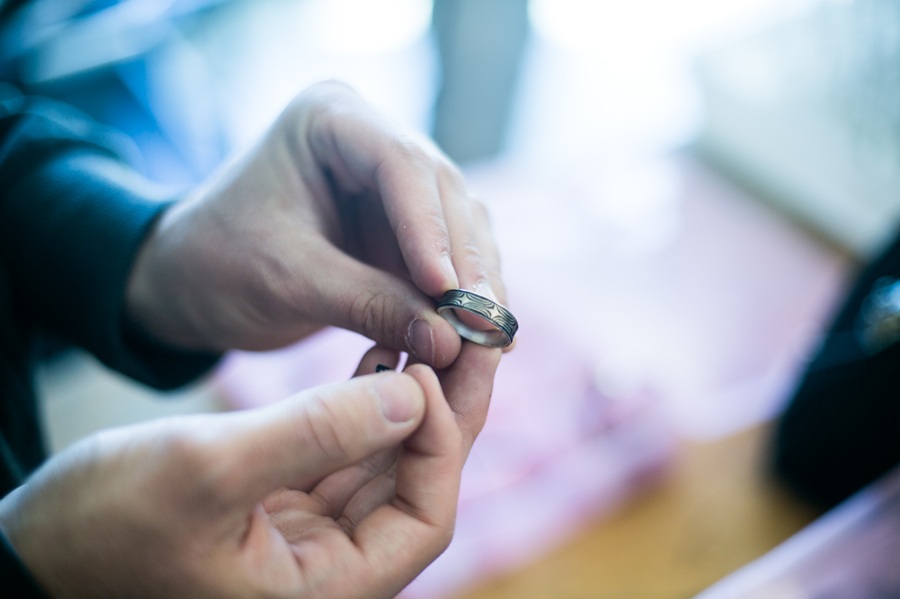
He also made a ring for everyone in his family, including his sister, who had taken the class and recommended it. In the fall, he’ll attend UMass Amherst where he’s considering studying business, but he hopes to continue making jewelry there.
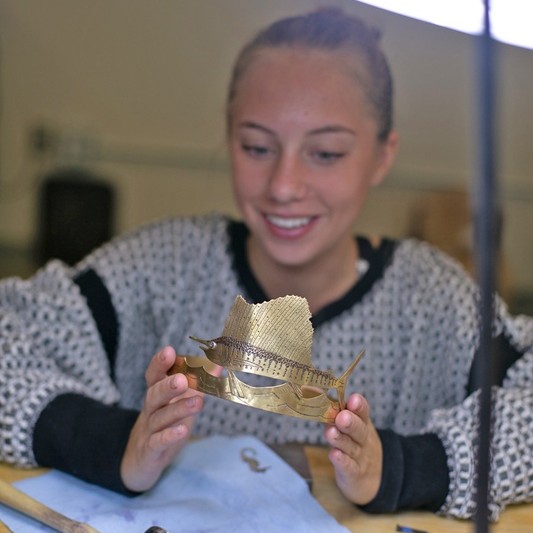
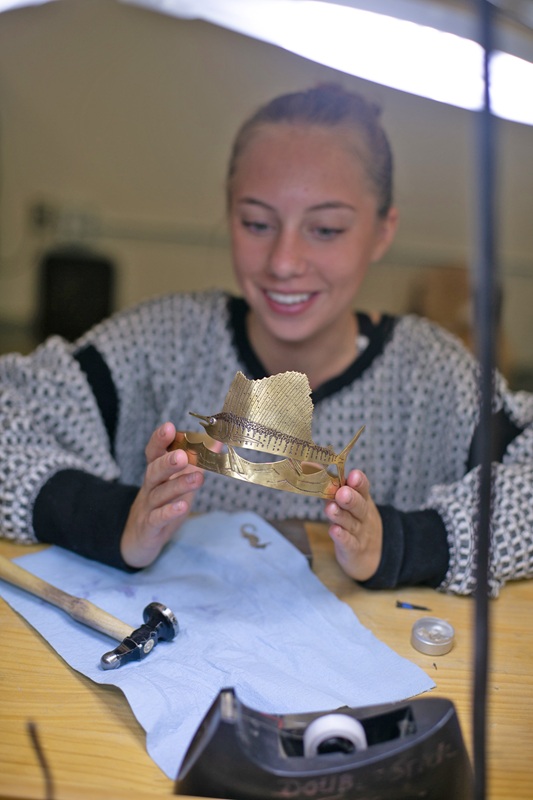
Lola Crisp, a junior from West Barnstable, also wears much of the jewelry she creates. “I like that I can wear something and say I made it,” she says, although there’s one piece she’s not sure will get much use: a bronze tiara with a sailfish stretched across the top.
“My dad is a boat captain, and I’ve been fishing with him my whole life,” says Crisp. The sailfish was something she saw on a fishing trip in Costa Rica.
Crisp’s other pieces further reveal her interest in nature — and her skill at working in fine detail. A seahorse pendant on her desk is rendered with careful attention to each ridge of the animal’s body. Its tail holds a turquoise stone. For a pin of a deer head, she used small marks to suggest the texture of its fur.
“I’m a big deer hunter,” she says. “I made this for my dad, but he doesn’t wear jewelry.”
