
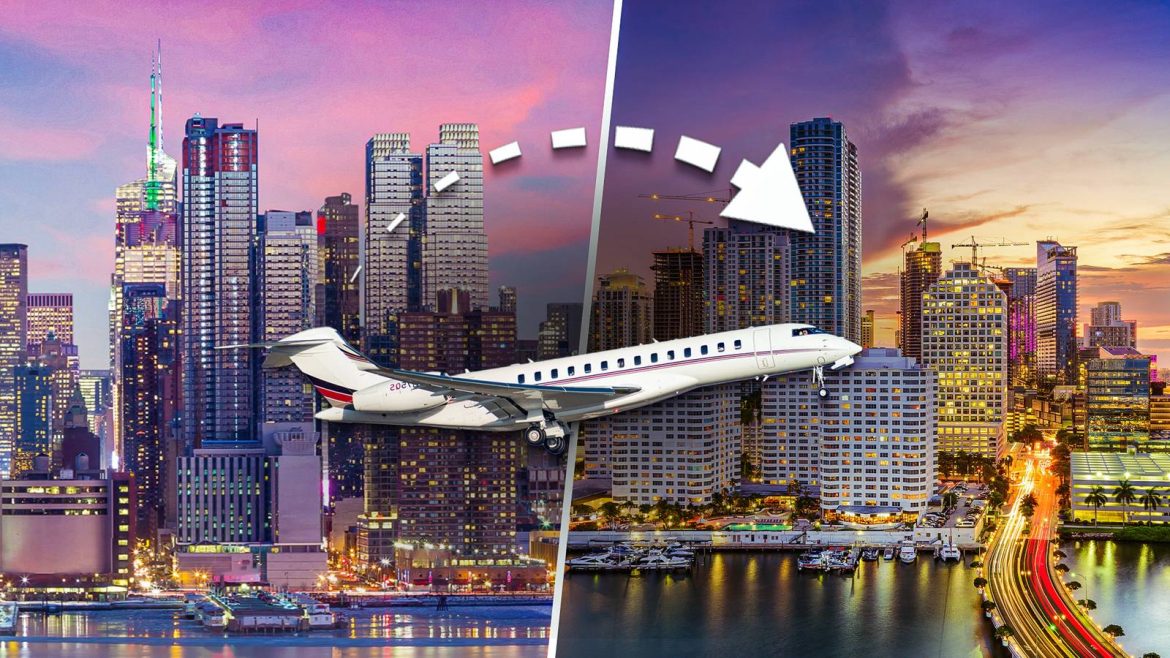
The New York-to-Miami private aviation corridor is one of the most important and heavily utilized luxury air routes in the United States. It connects two major economic ecosystems: New York’s global financial and corporate headquarters with Miami’s rapidly expanding role as a hub for wealth migration, technology investment, international trade, and high-end tourism. The result is a consistent, year-round flow of private aviation traffic that is unusually stable compared with most domestic routes.
By 2026, this corridor has become a benchmark for pricing behavior in the North American private aviation market. It is often used by brokers and operators as a reference route because demand is predictable but highly elastic, shifting sharply with seasons and major events. While entry-level private jets can sometimes be secured in the low five-figure range, premium long-range aircraft frequently exceed mid–five-figure pricing for a single one-way journey, particularly during peak winter demand.
Private Jet Prices Depend Heavily On Aircraft Size

Aircraft size remains the most influential factor in determining the cost of a private charter between New York and Miami, largely because almost every category of business jet can operate this relatively short 2.5–3 hour sector, approximately 1,090 miles (1,754 km). This flexibility creates a wide pricing spectrum, where the final quote is shaped not just by distance, but by cabin volume, passenger capacity, speed, performance, baggage space, and onboard service level. In practice, the same route can be flown on aircraft that differ dramatically in operating cost, fuel burn, and airport handling requirements.
Light jets such as the Citation CJ series or Embraer Phenom 300 class typically dominate this route because they offer one of the most cost-efficient ways to access private aviation for short-haul travel. In 2026, these aircraft generally range from $12,000–$24,000 (€11,000–€22,000) one-way and are commonly used by small corporate teams, executives, or families who prioritize time savings and airport flexibility over cabin size. With typical cruise speeds around 430–460 knots (500–530 mph / 800–850 km/h), they can complete the journey in under three hours while maintaining strong fuel efficiency and lower landing and handling costs compared with larger jets.
At the upper end of the market, super-midsize and heavy jets such as the Bombardier Challenger series or Gulfstream G450-class aircraft significantly expand both comfort and capability, but at a much higher operating cost. These aircraft typically range from $35,000–$60,000 (€32,000–€55,000) or more per one-way flight, depending on demand, positioning, and onboard configuration. They offer stand-up cabins, greater cabin pressurization comfort on longer flights, larger baggage capacity, and, in many cases, include a dedicated flight attendant and premium catering service. Their higher fuel burn and airport service requirements also contribute to increased pricing, even on relatively short sectors like New York to Miami.
Catch what other flight trackers miss
Emergency squawks, holds, NOTAMs — live signals, no signup.
Open tracker
Catch what other flight trackers miss
Emergency squawks, holds, NOTAMs — live signals, no signup.
Open tracker
Flight Time Is Short, But Pricing Reflects Operational Complexity

Although flight time between New York and Miami is relatively short at around 2.5–3 hours (approximately 1,090 miles/1,754 kilometers), the pricing structure reflects a much broader set of operational variables than simple airtime. The route is one of the most frequently flown private corridors in the United States, which increases scheduling pressure on both aircraft and airports.
Private jet operators calculate pricing using FAA-regulated operational costs, aircraft depreciation, crew duty limits, maintenance reserves, and fuel price volatility. Additional factors, such as one-way repositioning flights, where aircraft must fly empty to pick up the next passenger, can significantly increase costs. Even high-utilization aircraft must adhere to strict maintenance cycles governed by aviation authorities, which further affects pricing.
Even when base hourly rates sit near $6,000 (€5,500), the final invoice is often substantially higher due to landing fees, ramp handling charges, de-icing in winter months, overnight crew accommodation, and airport congestion surcharges. The New York–Miami route is particularly sensitive to these variables because both regions experience heavy private aviation traffic throughout the year.

Here’s How Much A Private Jet Charter From New York To London Actually Costs In 2026
Discover 2026 private jet costs on the New York–London route, aircraft types, pricing drivers, and why demand stays structurally high.
Airport Selection Has A Direct Impact On Cost

Private aviation in New York rarely operates through major commercial airports like JFK or LaGuardia due to congestion, slot restrictions, and air traffic prioritization. Instead, most private flights use dedicated general aviation airports such as Teterboro Airport (TEB) in New Jersey, which handles a large proportion of the United States’ business jet movements despite its small physical size.
Other commonly used airports include Westchester County Airport (HPN), Morristown Municipal Airport (MMU), and Republic Airport (FRG) on Long Island. These facilities are designed specifically for business aviation, offering fixed-base operators (FBOs) that provide private lounges, customs clearance, rapid fueling, and minimal turnaround times, often allowing passengers to board within minutes of arrival.
Catch what other flight trackers miss
Emergency squawks, holds, NOTAMs — live signals, no signup.
Open tracker
Catch what other flight trackers miss
Emergency squawks, holds, NOTAMs — live signals, no signup.
Open tracker
In South Florida, Miami-Opa Locka Executive Airport (OPF) and Fort Lauderdale Executive Airport (FXE) serve as the primary gateways for private aviation traffic. These airports are strategically located to avoid congestion at Miami International Airport (MIA) while providing faster access to Miami Beach, Palm Beach, and surrounding luxury destinations. Demand spikes at these airports during peak season can directly influence charter pricing due to limited parking and runway capacity.
Empty-Leg Flights Offer The Most Significant Discounts

Empty-leg flights occur when a private jet must reposition without passengers after completing a one-way charter or before positioning for its next booked trip. Because these sectors generate no direct revenue, operators often sell them at a steep discount to recover part of the fixed and variable operating costs, including fuel, crew duty time, airport handling fees, and positioning logistics. In practice, these flights represent unused capacity in an otherwise tightly scheduled aviation system.
On high-traffic routes like New York to Miami, empty-leg availability is relatively frequent due to the constant north–south flow of aircraft serving seasonal demand patterns. Jets often fly south during winter peak season and return north for maintenance cycles or subsequent bookings, creating a steady stream of repositioning legs. Discounts can range from 25% to 75%, depending on aircraft category, departure timing, and how urgently the operator needs to align the aircraft with its next paying charter.
In some cases, particularly when operators need to reposition aircraft quickly for high-value, time-sensitive bookings, one-way empty-leg flights can drop below $10,000 (€9,200). However, these opportunities remain inherently unpredictable, and inventory is released with little notice, often requiring passengers to commit within hours and align with fixed departure windows, making flexibility the key trade-off for the lower pricing.

How Much Does It Cost To Charter A Private Boeing 737?
One could reasonably expect to end up paying hundreds of thousands of dollars.
Seasonal Demand Drives Significant Price Volatility

The New York–Miami corridor experiences one of the most pronounced seasonal demand cycles in global private aviation, largely driven by the annual “winter migration” of high-net-worth individuals, executives, and seasonal residents. Between December and March, South Florida effectively becomes a secondary base for finance, tech, and media professionals who split their time between the Northeast and warmer climates. This creates sustained, structurally higher demand for one-way southbound flights, with aircraft often repositioning south in advance to match expected utilization.
This seasonal imbalance places continuous pressure on aircraft availability, particularly during peak travel windows such as weekends, early January returns, and pre-holiday departures. As fleet capacity tightens, operators experience higher utilization rates and reduced flexibility in positioning aircraft, which directly feeds into pricing adjustments. In peak weeks, charter rates on this corridor can rise by approximately 20–40% compared to off-peak periods, especially for popular light and midsize jet categories where supply is most constrained.
High-profile events such as Art Basel Miami Beach, the Miami Grand Prix, the Miami Open, and major holiday weekends further intensify this cyclical pressure by creating short-duration spikes in demand that exceed normal seasonal levels. During these periods, pricing divergence becomes especially pronounced: even identical aircraft types can vary significantly in cost depending on departure time (morning vs evening slots), airport choice (Teterboro vs regional alternatives), and booking lead time, with last-minute flights often commanding the highest premiums due to limited remaining availability.
Chartering Remains More Cost-Efficient Than Ownership

While private aviation is often associated with high charter prices, aircraft ownership is a far more capital-intensive long-term commitment. Even in the pre-owned market, midsize business jets such as older Challenger or Gulfstream models typically require several million dollars in upfront costs, often ranging from about $3–$8 million (€2.8–€7.4 million), while newer aircraft can exceed $10–$20 million (€9.2–€18.5 million). Additional upfront expenses for inspections, avionics upgrades, and cabin refurbishment can add further six-figure costs depending on condition.
Beyond purchase, ownership carries substantial ongoing costs that apply regardless of usage. Annual fixed expenses commonly exceed $1 million (€920,000) and can be significantly higher depending on aircraft type and base. These include mandatory maintenance, crew salaries, insurance, hangar fees, training, and certification, alongside fuel costs that fluctuate with usage and can reach 150–300 gallons (570–1,135 liters) per flight hour for a midsize jet.
Because these costs are largely fixed, utilization becomes the key factor in efficiency. Many jets are most economical at around 200–400 flight hours per year, while lower usage drives the effective cost per flight much higher. As a result, many travelers and operators prefer charter, jet cards, or fractional ownership through providers such as NetJets, Flexjet, and VistaJet, which allow access to aircraft without full ownership responsibilities.
