
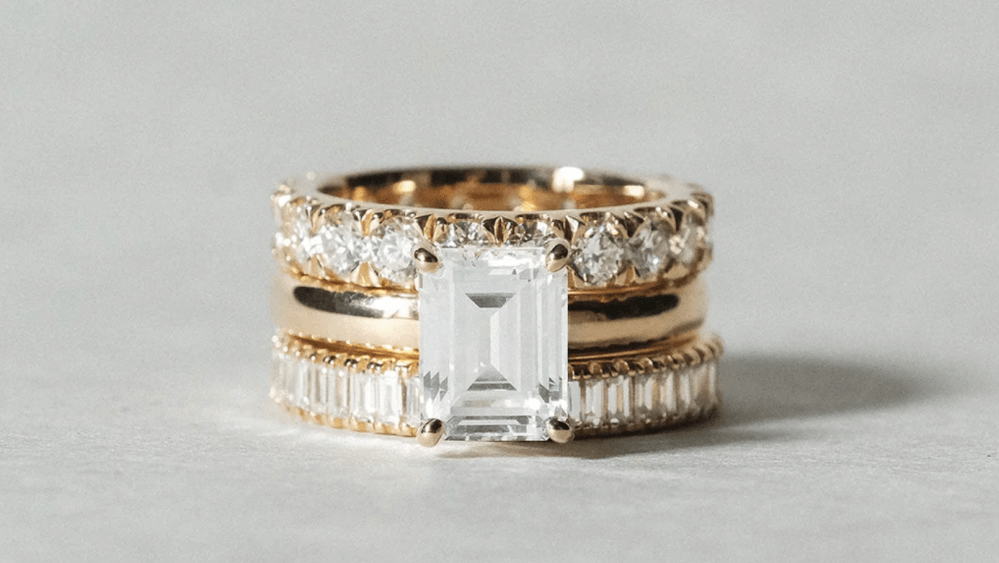
First came the oversized engagement ring. Now, the wedding stack is taking up more real estate on the ring finger. As couples embrace increasingly personalized bridal jewelry, stacked wedding bands are becoming another sought-after way to customize the look, turning the engagement and wedding ring set into a layered expression of individual style.
What exactly constitutes a wedding stack? Anything that goes beyond the traditional pairing of an engagement ring and wedding band. While some stacks feature just three rings, others extend across much of the finger with multiple bands layered together.
“It’s really shifted the category away from this idea that your engagement ring and wedding band is a finished set you have to get right all at once,” Jillian Sassone, founder and creative director of Marrow Fine Jewelry, told WWD. “Now people are thinking about it more as the start of a stack that can evolve over time. The engagement ring is still the anchor, but the wedding band isn’t the final step — it’s just the first layer.”

Marrow’s Hazel oval solitaire engagement ring with stacked bands.
Courtesy Marrow
While every wedding ring stack is unique, many follow a similar pattern, with new bands added to mark significant milestones. Anniversaries, births, career promotions and other major life events often inspire additions to a stack, turning it into a visual timeline of the wearer’s life. Others take a more fashion-driven approach, using the engagement ring as a foundation for an evolving, layered look that embraces a more-is-more mentality.
“There’s this sense that each piece is meant to symbolize something, not just add to a look. And even when the motivation is more aesthetic, it still comes from that same place of intention — wanting the stack to reflect where they are right now, not just what’s trending,” Sassone said.
Simon Zhang, cofounder of Holden, echoed the sentiment that more couples are viewing the engagement ring as the foundation of a future stack rather than a stand-alone piece. As a result, the brand often works with clients to plan how additional bands will fit together from the outset.
“Low-profile engagement rings have become incredibly popular, and open bands are a favorite way to achieve a flush fit,” Zhang said. “By adding one or two open bands as spacers, couples can seamlessly stack eternity or solid bands with a low-set engagement ring.”
Zhang added that many couples in Holden’s custom and bespoke program are now designing wedding bands alongside their engagement rings, allowing for a more cohesive look and additional opportunities to incorporate personalized details such as colored gemstones, textures and other bespoke design elements.
From diamond bands in a range of cuts to solid gold, cigar bands and sculptural styles, wedding stacks can take countless forms. When it comes to building the perfect stack, however, both Sassone and Zhang agree that individuality matters more than any set of rules.
“Some people gravitate toward matching bands and diamond shapes, while others love mixing metals, textures and finishes,” Zhang said. “One of our favorite parts of the appointment experience is seeing customers arrive with a very specific vision, only to completely change their minds once they start trying different combinations on.”
Sassone encourages clients to embrace a more intuitive approach. “Mix textures, profiles and design details, and don’t worry about everything matching perfectly,” she said. “Not every ring needs to sit flush — a small gap can add character and make a stack feel more collected and intentional. Instead of thinking symmetry, think balance. It’s less about doing it ‘right’ and more about building something that feels like you.”
As bridal jewelry becomes increasingly individualized, the wedding stack offers couples a way to move beyond the traditional two-ring formula. The result is a personal bridal look that evolves over the years — one band, milestone and style statement at a time.
