Range anxiety, charging infrastructure, battery reliability, consumer trust – these factors are becoming less of a dealmaker in the electric vehicle market, particularly in the electric scooter space, than earlier.
A new challenge is emerging, and it’s called personalisation.
For Ather Energy, one of India’s pioneer electric scooter manufacturers, the next phase of growth will be less about convincing consumers to switch to electric and more about understanding how different consumers want to use their vehicles.
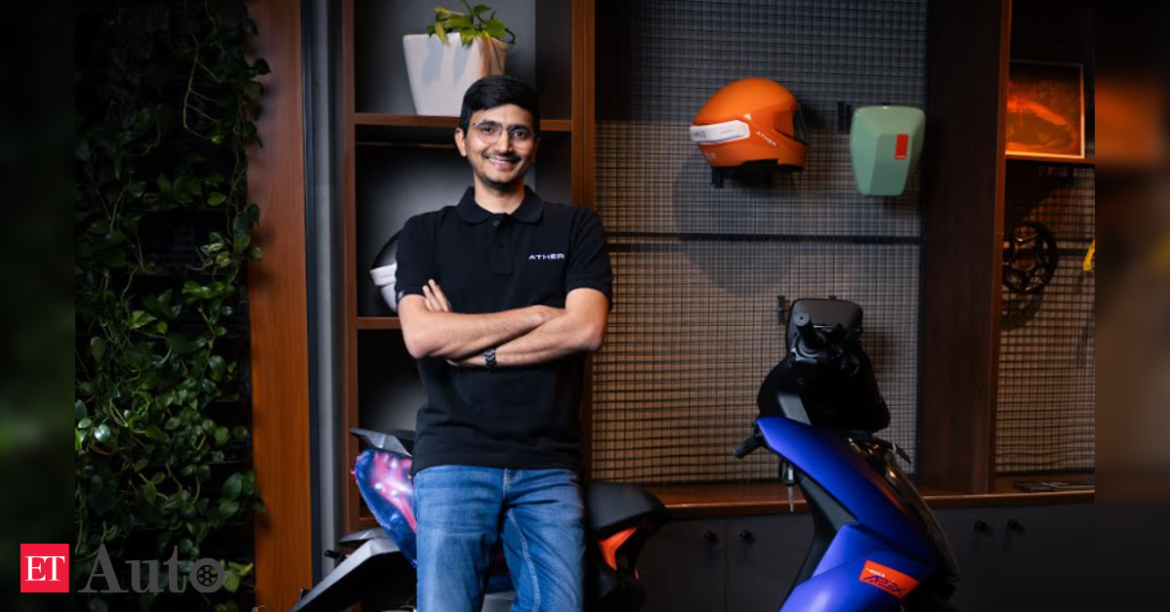
“Initially, we thought a scooter is a scooter,” said Swapnil Jain, Co-founder and CTO of Ather Energy. “But over time we realised that family buyers and performance-oriented buyers are looking for very different things.”
That learning has already influenced Ather’s product strategy. While the 450 range caters largely to enthusiasts seeking performance and technology, the Rizta was developed with family users in mind. The distinction, Jain says, is becoming increasingly important as the EV market matures and customer expectations become more nuanced.
The shift mirrors a broader trend visible across consumer industries, where products are becoming increasingly tailored to individual preferences and use cases.
In Ather’s case, software is emerging as the most powerful tool to deliver that customisation.
Features such as live location sharing, optimised charging, navigation, skid control and traction control are finding favour with different groups of users. Interestingly, Ather’s data shows that not every feature needs to appeal to everyone.
“What we are learning is that a feature may not be relevant to all customers. But as long as every customer finds something valuable for their own use case, that is personalisation,” Jain said.
The insight is shaping how the company thinks about future vehicle development, both in software and hardware.
Building for uncertainty
If personalisation is one major trend influencing Ather’s product planning and design, uncertainty is another factor that’s influencing its technology roadmap.
From geopolitical tensions and semiconductor shortages to raw material disruptions, the automotive industry has spent the past few years navigating an increasingly unpredictable environment.
According to Jain, that reality is forcing manufacturers to rethink how products, organisations and supply chains are designed.
“Earlier, companies optimised for efficiency or lowest cost. Today, you have to optimise for uncertainty,” he said. That philosophy extends well beyond vehicle engineering.
Several years ago, Ather invested in a Manufacturing Execution System (MES) at a stage when its production volumes were relatively small. At the time, the investment appeared ahead of industry norms. Today, Jain sees it as a strategic advantage.
And it will be all the more crucial as Ather Energy builds its new production facility, in Maharashtra’s Shambhajinagar, which will have an installed annual manufacturing capacity of 500,000 units in the first phase.
The software-driven manufacturing platform gives the company greater flexibility to work with multiple suppliers, manage component variations and maintain quality standards without disrupting production.
As supply chains become more complex, visibility is becoming just as important as efficiency.
Ather is now investing in systems that provide deeper insights into supplier networks, including Tier-2 and Tier-3 dependencies that often remain hidden until disruptions occur.
“The issue is rarely at the Tier-1 supplier level. Often the problem starts much deeper in the value chain,” Jain observed.
By analysing supplier concentration, regional dependencies and material sourcing patterns, the company aims to identify vulnerabilities before they impact operations.
The next phase for Indian EVs
Jain believes the Indian electric two-wheeler industry has already crossed an important milestone.
Unlike a few years ago, when manufacturers and consumers were still evaluating whether EVs could work at scale, the conversation has now shifted towards differentiation, customer experience and ecosystem development.
“We are no longer trying to figure out electric mobility,” he said. “As a country, we have largely figured it out.”
Challenges remain, particularly around battery cell manufacturing and semiconductor localisation. Yet Jain argues that India has already built significant expertise across vehicle engineering, software development and EV product innovation.
For companies like Ather, the next competitive advantage may not come from electrification alone, but from how effectively software, data and manufacturing intelligence are combined to create products that feel increasingly personal to every rider.
As India’s EV market enters its next phase, that combination could prove to be the industry’s most important differentiator. And players who engineer that combination well stand a better chance to
ETAuto Tech Summit
As the automotive industry drives through a transformative phase in a disruptive era, deep market insights, and robust technology strategies are extremely crucial for a successful ride. Hear Swapnil Jain, and many other industry and technology leaders discuss and debate about the future of the mobility industry at the 7th ETAuto Tech Summit. For details, please visit https://auto.economictimes.indiatimes.com/auto-tech-summit