
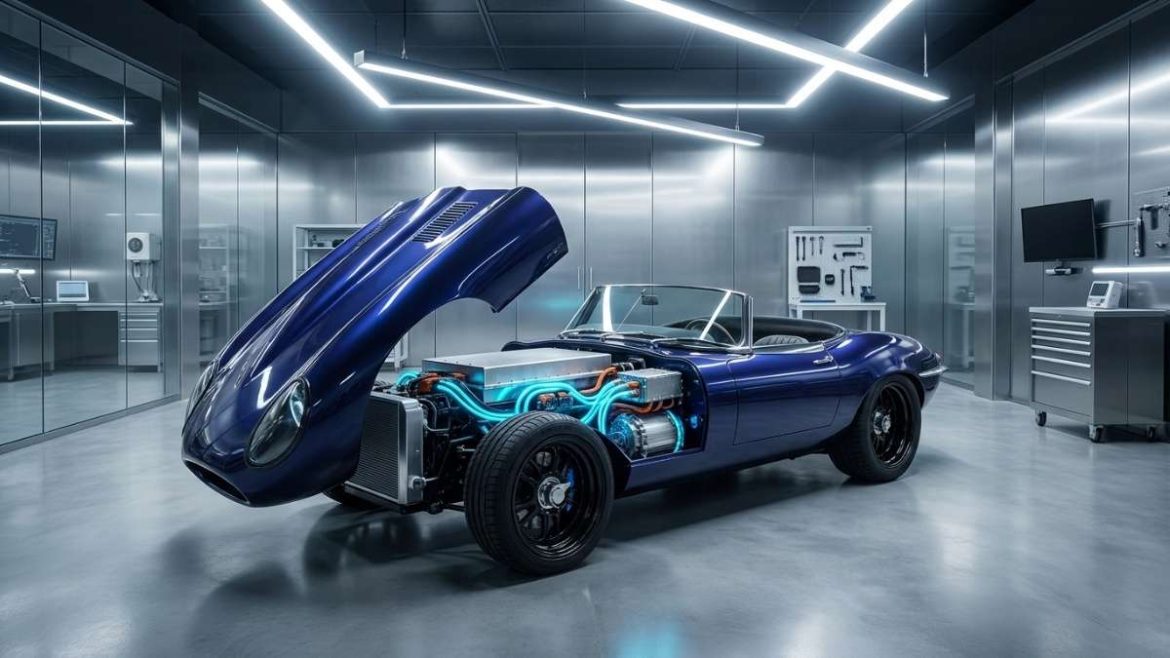
If there is one absolute truth in the consumer technology sector, it is that any hardware relying on highly specialized, bespoke engineering is destined to remain a niche luxury until standardized platforms arrive to democratize it. We have seen this cycle play out in the early days of personal computing, the smartphone market, and the smart home ecosystem. Today, we are watching this exact same frustrating, yet utterly fascinating, dynamic unfold in the automotive world – specifically within the classic car EV conversion market.
For automotive enthusiasts, the appeal of taking a mid-century mechanical masterpiece and infusing it with a modern, zero-emission electric drivetrain is incredibly intoxicating. Yet, despite the massive potential of this enthusiast market, a severe lack of standardized, plug-and-play conversion kits keeps mainstream buyers firmly locked out. The industry is currently stuck in the artisanal phase, where massive costs and agonizingly slow build times are the norm. But as we look toward the horizon of emerging battery technologies and hub motor advancements, a dramatic paradigm shift is entirely predictable. As an analyst who has watched countless industries shift from analog to digital, I can assure you that the classic car market is on the precipice of its own digital revolution.
The Undeniable Advantages of Electrifying Yesterday’s Icons
Before we dissect the systemic failures of the current market, we must acknowledge why the desire for EV conversions is accelerating at such a rapid pace. The fundamental advantage of retrofitting a classic car with an electric powertrain is the absolute eradication of mechanical unreliability. Vintage cars are notorious for requiring constant tinkering. Carburetors flood, distributors fail in the rain, oil leaks become a permanent feature of your garage floor, and vapor lock can strand you on a hot summer afternoon.
An electric motor, by contrast, has roughly one moving part. The advantages extend far beyond mere reliability. An EV conversion offers instantaneous torque delivery, completely transforming the driving dynamics of heavier vintage steel. You gain smooth, linear acceleration that older naturally aspirated engines simply cannot match without heavily modified, temperamental race-tune setups. Furthermore, as environmental regulations tighten across major global cities, an electrified classic ensures that these automotive works of art can actually be driven in zero-emission zones, rescuing them from becoming static museum displays. The growing trend of electric conversions ensuring the future of car components is profound, offering a driving experience that marries the unmatched aesthetic soul of the 20th century with the frictionless technology of the 21st.

The Harsh Reality Keeping EV Conversions Out of the Mainstream
However, the bridge between wanting an electric classic and actually owning one is currently guarded by an insurmountable toll booth of exorbitant costs and complex fabrication. As it stands, there is no “universal” drop-in kit that a competent home mechanic can purchase for a reasonable price. Because classic cars vary wildly in their chassis design, weight distribution, and structural integrity, every single conversion requires bespoke engineering.
If you take a vintage Porsche or a classic Ford Mustang to an electrification shop today, they are essentially reinventing the wheel. They must custom-fabricate battery boxes, adapt transmission plates, upgrade suspension components to handle the massive influx of battery weight, and painstakingly route high-voltage wiring through firewalls never designed for them.
This artisanal approach means that a quality conversion easily exceeds $50,000, and frequently pushes well past the $100,000 mark—excluding the cost of the donor car itself. As a recent, highly critical piece on InsideEVs regarding classic car EV conversion costs correctly points out, the dream of a “cheap” classic car EV conversion is largely a myth in today’s market. The ecosystem lacks the economies of scale required to bring prices down. Until the industry moves away from one-off science projects and embraces modular, scalable architecture, this will remain a playground exclusively for the ultra-wealthy.
My Personal Quest for a Restomod Jaguar E-Type EV Kit
I have experienced this frustration firsthand. For the past year, I have been actively searching for a viable kit to convert my Restomod Jaguar E-Type. The E-Type is famously described by Enzo Ferrari as the most beautiful car ever made, and I completely agree. However, the original inline-six engine, while historically significant, demands a level of ongoing maintenance that I simply do not have the patience for anymore. I want a low-maintenance solution. I want a grand tourer that I can leave sitting in the garage for a month, turn the key, and immediately enjoy a flawless drive up the coast without worrying about synchronizing SU carburetors or nursing a fragile cooling system in stop-and-go traffic.
My goal was to find a standardized, well-documented kit that could seamlessly replace the original drivetrain without permanently destroying the original monocoque chassis. What I found instead was a fragmented industry. The few companies that do offer top-tier Jaguar conversions refuse to sell just the components; they demand you ship the car to their facility for a bespoke, six-figure rebuild that takes over a year to complete. The “kits” that do exist online are often just collections of mismatched, salvaged Tesla components with zero comprehensive integration software, essentially leaving the buyer to figure out the complex battery management systems on their own. It is a terrible consumer experience that highlights exactly why the market has stalled and keeps everyday mechanics sidelined.

How Hub Motors, Next-Gen Batteries, and Flexible Kits Will Fix This
The solution to this market stagnation is technological evolution, specifically in three key areas: hub motors, advanced battery chemistry, and intelligent modularity. When these three pillars mature, the entire conversion dynamic shifts from bespoke coachbuilding to simple component assembly.
Currently, most conversions try to mimic internal combustion architecture by placing a large electric motor under the hood and running power through a traditional driveshaft and differential. This is incredibly inefficient and robs the vehicle of interior space. The future lies in in-wheel hub motors. By moving the propulsion directly into the wheels, you eliminate the need for drive shafts, heavy axles, and complex custom mounting brackets. European engineering firms like Elaphe are already demonstrating the viability of in-wheel technology, proving that you can deliver massive torque directly to the pavement without compromising unsprung mass to an unacceptable degree.
Furthermore, the integration of solid-state batteries—such as the revolutionary ceramic-separator cells currently being developed by QuantumScape—will drastically alter the conversion landscape. Current lithium-ion packs are simply too heavy and bulky, forcing custom shops to hide batteries in the trunk, under the seats, and in the engine bay, which ruins the original weight distribution of a lightweight classic. Solid-state batteries promise greater energy density in a significantly lighter, non-combustible, and smaller footprint.
When you combine lightweight, energy-dense batteries with self-contained hub motors, you create the foundation for a truly flexible kit. A future vendor could ship you four wheels containing the motors, a unified master control unit, and modular battery blocks that can be easily slotted into the existing engine bay using standard brackets. This eliminates the need for bespoke structural fabrication and universally standardizes the software integration, finally allowing the enthusiast to build their EV in a home garage.

The 4,000 Horsepower Jaguar E-Type Thought Experiment
If we fast-forward to a world where high-performance hub motors are the standard, the performance possibilities become delightfully absurd. Let’s apply this to my Jaguar E-Type. Imagine outfitting this classic, sweeping British roadster with four advanced hub motors, each capable of generating 1,000 horsepower.
Driving a 4,000 HP, all-wheel-drive Jaguar E-Type would be an experience bordering on the surreal. Because hub motors allow for absolute, independent torque vectoring at each wheel, the car’s handling dynamics would be supernaturally precise. The onboard computer could calculate traction limits milliseconds before the tire slips, independently adjusting power to each corner and allowing this vintage 1960s chassis to corner with the ferocity of a modern Formula 1 car.
Aesthetically, the vehicle would look completely original—a gorgeous, unblemished mid-century silhouette. But the moment you pressed the accelerator, the sheer physical force of 4,000 electric horsepower would violently warp your perception of space and time. You would have the ultimate sleeper vehicle: a car that looks like it belongs on a concourse lawn at Pebble Beach, but possesses enough immediate, terrifying thrust to embarrass a modern hypercar on a drag strip. While 4,000 HP is a theoretical extreme that borders on dangerous for public roads, it perfectly illustrates the ceiling of what localized, intelligent electric propulsion can eventually offer to the restomod community.
[Image Prompt 3: Location: Inserted here to visualize the extreme performance thought experiment. Prompt: A dynamic, action shot captured at dusk of a vintage Jaguar E-Type accelerating furiously off a starting line. The tires are smoking slightly, and the sheer force of the acceleration causes the sleek front end to lift slightly. Subtle, futuristic electrical arcs or a motion blur effect should surround the wheels, hinting at the massive, hidden electric power propelling the classic vehicle.]
Forecasting the Future: Why It Is Wise to Wait
So, when will these standardized, flexible, hub-motor-driven kits finally hit the consumer market? Based on the current trajectory of battery manufacturing scale and the research and development cycles of Tier-1 automotive suppliers, I forecast we are looking at a commercial tipping point between 2028 and 2030.
By the end of this decade, the cost of advanced battery cells will have dropped low enough, and the software management systems will have become standardized enough, for companies to finally offer true, validated “plug-and-play” EV crates.
For the enthusiast currently sitting on the fence, my strategic advice is simple: wait. If you commission a bespoke EV conversion today, you are essentially paying for a custom engineering prototype. You are absorbing the massive R&D costs of a specialized shop figuring out how to make a salvaged EV motor communicate with your specific vintage analog gauge cluster. Furthermore, the heavy lithium-ion technology you spend $100,000 installing today will look agonizingly obsolete in five to seven years when lighter, safer, and more powerful solid-state, hub-driven kits become available for a fraction of the cost. The smart money remains parked in the garage, waiting for the technology curve to flatten and the economies of scale to take over.
Wrapping Up
The classic car EV conversion market is currently a frustrating paradox. It represents the perfect marriage of timeless automotive design and reliable, thrilling modern technology, yet it is crippled by high costs and a complete lack of standardized, consumer-friendly kits. My own search to reliably electrify my Jaguar E-Type has proven that the industry is still trapped in a phase of expensive, bespoke fabrication where true DIY solutions are virtually non-existent. However, the horizon is incredibly bright. The inevitable commercialization of in-wheel hub motors, highly dense solid-state batteries, and intelligent modular platforms will ultimately shatter these financial and technical barriers. Within the next five to seven years, we will transition from an era where an EV conversion is a rare, six-figure luxury to a reality where any enthusiast can seamlessly bolt massive, maintenance-free power directly into the chassis of their favorite automotive icon. Until that standardized, verified future arrives, the wisest move is to keep your classic in the garage, keep the oil changed, and let the early adopters foot the bill for the industry’s expensive growing pains.
Disclosure: Images rendered by Artlist.io
Rob Enderle is a technology analyst at Torque News who covers automotive technology and battery developments. You can learn more about Rob on Wikipedia and follow his articles on TechNewsWord, TGDaily, and TechSpective.
Follow us today…


