
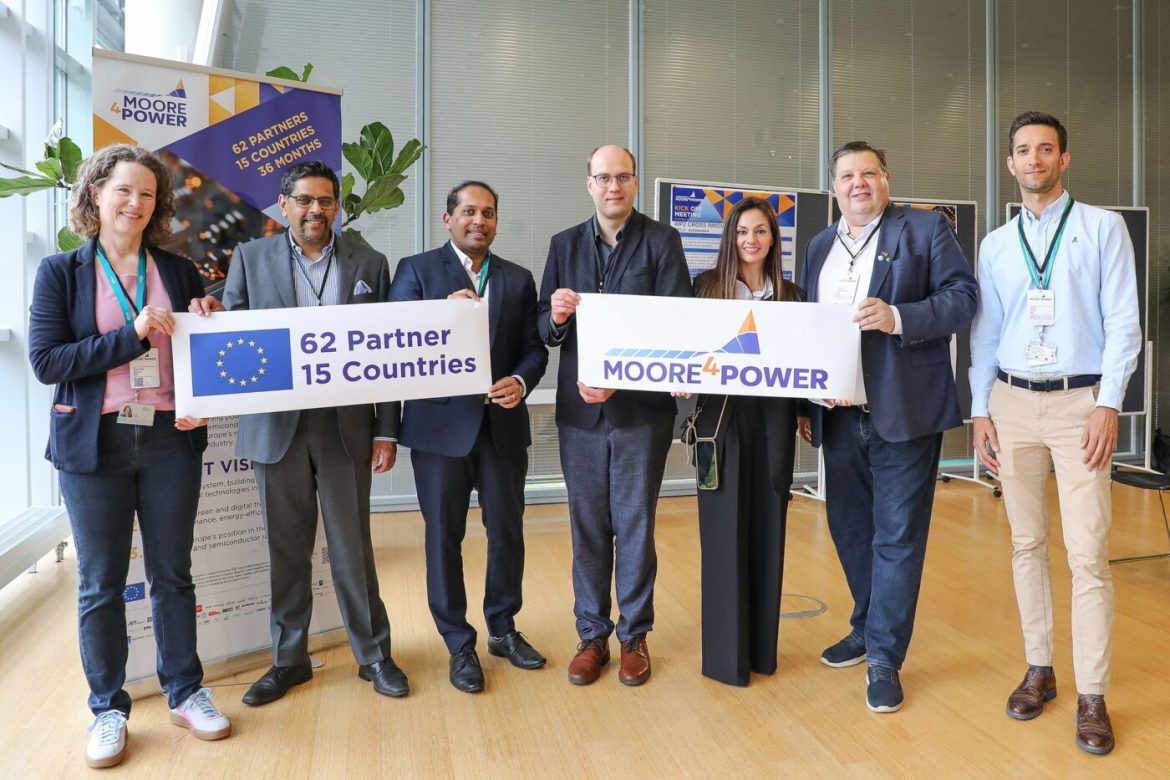
Led by Infineon, the initiative brings together large companies, SMEs and research institutes from 15 European countries. Moore4Power follows the so-called More-than-Moore approach, combining heterogeneous and functional integration beyond conventional semiconductor scaling. The partners aim to move beyond optimising individual components and instead focus on innovation at the system level.
The project name stands for ‘More than Moore for Disruptive Innovations in Power Electronics.’ Moore4Power receives funding from participating countries as well as the EU’s Horizon Europe programme.
With a total project volume of 91 million euros, Moore4Power is scheduled to run for three years and is expected to ‘deliver breakthrough innovations that strengthen Europe’s technological sovereignty and sustainability in the field of power electronics,’ according to Infineon. The semiconductor company believes that combining technologies, materials and functions in application-oriented systems will enable major advances in efficiency, reliability and power density.
Power electronics are playing an increasingly important role in electric vehicles and charging infrastructure. The semiconductors used in this field enable new electrical/electronic (E/E) architectures that form the basis of next-generation vehicle platforms. Infineon already holds a strong position in this market. The German technology group is among the leading automotive semiconductor suppliers and, for example, provides numerous components for BMW’s Neue Klasse platform.
Semiconductors are also becoming increasingly important in charging infrastructure, particularly in the area of bidirectional charging.
According to the consortium, Moore4Power targets key industries “where power conversion drives cost, CO₂ reduction and reliability.” Alongside electric mobility, the project partners identify wind energy and rail applications as core areas of focus.
Technologically, the project will concentrate on the heterogeneous integration of semiconductors by combining different technologies such as silicon (Si), silicon carbide (SiC) and gallium nitride (GaN) with sensor, control and communication functions in tightly integrated systems. “Each technology is used exactly where it performs best, enabling higher efficiency, improved reliability and more compact designs,” the project leaders stated.
A cornerstone of the project is the chiplet concept, essentially a modular chip design that enables scalable architectures and more flexible product variants. The foundation for this was laid in the predecessor project PowerizeD, a large-scale initiative funded by Chips JU, which concluded in 2025 and ‘delivered outstanding advances in efficiency and reliability,’ as Infineon emphasises.
From now on, AI-driven models, digital twins, and automated processes are expected to ‘radically shorten’ development cycles. Hardware and software will be developed in parallel to reduce simulation times while increasing accuracy.
“The time from first fab samples to a validated datasheet release can be reduced to just one week, compared to several weeks today. This acceleration lowers costs, speeds up industrialisation, and strengthens Europe’s industrial competitiveness. First scalable demonstrators will be tested under real-word conditions,” Infineon explains.
A key innovation is the Digital Product Passport (DPP), which will be embedded directly into power modules with wireless access. The DPP will provide relevant data throughout the entire lifecycle, such as operating conditions, status information, and remaining service life. This transparency will improve predictive maintenance, extend product lifespans, and enhance reusability.
“Power electronics are a decisive enabler for energy efficiency and sustainability. With Moore4Power, we are setting the next level of smart integration to achieve significantly higher energy and resource efficiency,” says Jochen Koszescha, Coordination Lead for the Moore4Power project at Infineon Technologies AG. “We are proud to join forces with an outstanding consortium from academia, research and industry to make a decisive contribution to Europe’s Clean Industrial Deal.”
