
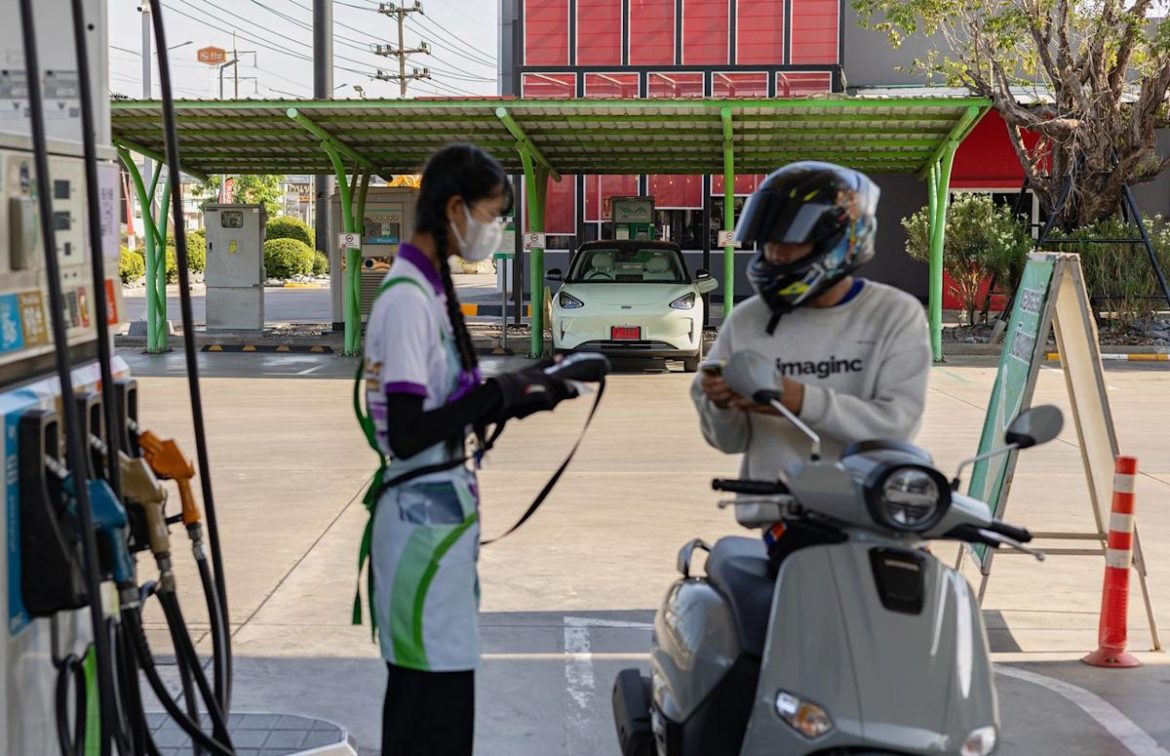
HONG KONG (AP) — The war in Iran has helped reshape the global electric vehicle market, giving Chinese automakers an opening across the developing world as soaring fuel prices push drivers towards electric vehicles, even as charging infrastructure lags behind a wave of imports.
The blockade of the Strait of Hormuz disrupted shipping of about a fifth of the world’s crude oil and liquified natural gas, first hitting Asia — the main destination for the fuels — followed by Africa.
This shock accelerated a trend that was already spreading across the developing world. In April, global exports of Chinese EVs hit a record $9.4 billion, according to an analysis by think tank Ember of Chinese customs data. Shipments surged to countries such as Australia, Brazil and regions like Southeast Asia and East Africa.
China exported about 435,000 passenger EVs and plug-in hybrids in May, more than double from a year earlier, according to the Chinese Association of Automobile Manufacturers.
As fuel costs rise, more drivers are switching to EVs to save money, while governments from Laos to Ethiopia are embracing electrification to curb oil imports and reduce costs of fuel subsidies.
But faster EV adoption is outpacing the expansion of charging networks. Governments and state-owned utilities in Africa are taking a leading role in building them — a model analysts say could help other emerging markets, like Asia, speed the shift away from fossil fuels.
When a nation lacks sufficient charging infrastructure and EV fleet size, it is a “classic chicken-and-egg problem” regarding what comes first, said Paul Gong, head of UBS bank’s China automotive industry research.
“At that stage, government support for infrastructure could help accelerate adoption,” he said.
Fuel shock drives EV use in Asia and Africa
Across the developing world, drivers are looking beyond the gas pump.
In Southeast Asia, imports of Chinese EVs have surged in Thailand, Laos and the Philippines. In May, Laos banned the import of fuel-powered vehicles for the rest of 2026 to cut oil import costs and encourage the EV shift.
Africa imported around 44,000 Chinese EVs in 2025, a 130% jump from the year before, according to Chinese Commerce Ministry data.
Across Asia and Africa, transport is one of the largest household expenses.
Limited public transit, long commutes and a reliance on private vehicles make families vulnerable to volatile fuel prices. In South Africa, transportation accounts for nearly a fifth of household spending, according to a 2024 study by Stellenbosch University in South Africa’s Western Cape province.
