

Listen to this article
Estimated 4 minutes
The audio version of this article is generated by AI-based technology. Mispronunciations can occur. We are working with our partners to continually review and improve the results.
Millions of amphibians and reptiles are displaced and relocated from their habitats because of development projects in B.C., according to a new study. But researchers say there’s no monitoring requirement in place to determine whether the animals survive the move.
The University of British Columbia study, published in the Journal of Wildlife Management, looked at provincial permits issued between 2019 and 2022 for what is known as mitigation translocation.
According to the researchers, the process has been standard practice for more than a decade in B.C. Project proponents are required to obtain a provincial permit before moving amphibians and reptiles off-site as a mitigation measure before breaking ground.
“But after we translocate them to a new location … we have no idea what happens after that,” said Megan Winand, lead author of the study and a recent UBC master of science graduate.

She says that because there’s no legal requirement to monitor outcomes, there’s limited evidence to show whether those relocation efforts actually work.
The study reviewed 629 permits over a four-year period between 2019 and 2022, and found 227 permits that reported relocations involving about 5.1 million animals from 28 species.
The highest number of translocations in B.C. occurred during large-scale infrastructure development. Pipelines, railways, bridges, and water systems were among the leading drivers.
She says the scale of relocation raises questions about B.C.’s priorities when it comes to protecting these species.
“[The number] is so large in comparison to what’s happening in terms of conservation and the amount of funding that goes into actually conserving and protecting these species,” she said.
According to the study, Alberta and Ontario place more restrictions on the relocation of at-risk amphibians and reptiles, while translocation is rarely used or documented in the Maritimes.
But in B.C., mitigation translocation has become “routine” and is used for all 32 native amphibian and reptile species.
The practice gained attention ahead of the 2010 Winter Olympics in Vancouver and Whistler, when the Sea-to-Sky Highway was upgraded and more than 1,000 amphibians were carefully moved out of the construction zone.

But Winand says B.C. has the highest proportion of at-risk amphibians compared to other provinces and territories in Canada, and threats such as habitat loss, climate change and pollution are making survival more difficult.
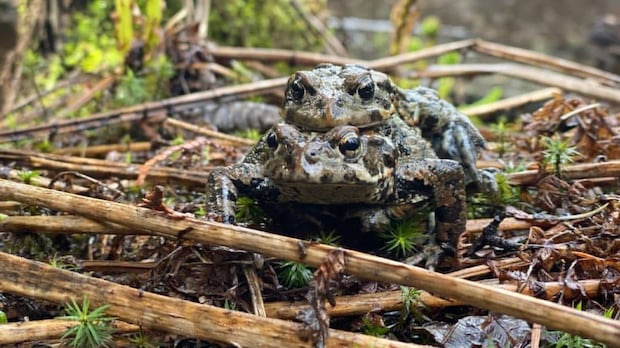
The study found 99 per cent of the animals moved were amphibians, primarily western toads.
Frogs are important because they are an “indicator species,” said Winand.
“[They] are truly the canary in the coal mine,” Winand said. “They are so susceptible to their environment. And if there’s any pollution, they are the first ones to really be impacted by that.”

They also play a key role in the food web, the researcher adds.
They eat insects and other smaller animals, while also serving as food for birds, fish and mammals.
“You’re missing this middle piece if they were to disappear,” Winand said.
Co-author Tara Martin, a professor in UBC’s department of forest and conservation sciences, says translocation should not be treated as the first option.
“Translocation should be a last resort — something you do when avoidance isn’t possible,” Martin said in a statement. “We are making consequential choices for millions of animals without knowing whether they survive.”
The researchers say avoiding habitat disturbance should come first but if animals must be moved, they say B.C. should have stronger planning and mandatory follow-up to track survival.
CBC News has reached out to the Ministry of Water, Land and Resource Stewardship for comment.
