
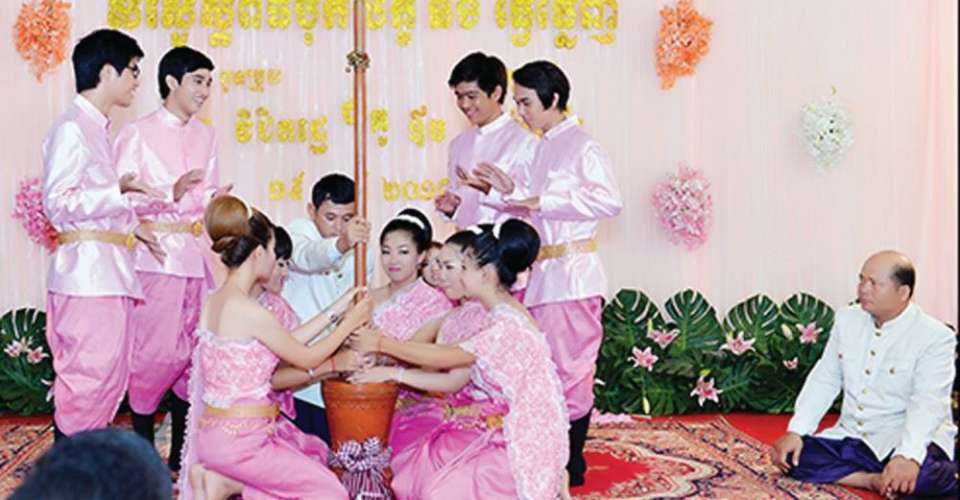
Cambodia is pressing modern young couples to honor traditional Khmer wedding practices in the countdown to a UNESCO decision on an Intangible Cultural Heritage listing.
Authorities say the “telescoping” of key rituals of the separate, generations-old engagement and wedding ceremonies by busy modern couples and a trend for civil servant grooms to wear their ceremonial uniforms to show off are endangering Khmer identity and ancient traditions
The culture and religion ministries have jointly spoken out over the increasing number of videos and posts appearing on social media showing traditions being flouted and abused in engagement and wedding ceremonies.


“We urge all wedding planners, musicians, artists and professionals involved in wedding ceremonies to participate respectfully and in accordance with the law and regulations,” they said in a joint statement.
The full wedding ceremony, known as Pithi Ptem or Kar, is three days and three nights of elaborate rituals and ceremonies, involving Buddhist monks, processions, music, chanting, several changes of ornate Khmer costumes, the presentation of gifts by the groom to the bride and the tying of red strings around the couple’s wrists as they jointly hold a golden sword, a ritual known as Sompeas Ptem — the culmination of the wedding ceremony.
But the decision by some couples to do some of these — especially the string-tying — in the engagement ceremony instead is one of the ministries’ main complaints.
The time, elaborateness and cost of both ceremonies are causing friction between some young couples and their parents.
Sok Chea, a 26-year-old property manager, and his partner, nurse Kren Bopha, 24, are still negotiating their wedding arrangements with their deeply traditional parents.
“This is how they did it. This is how their parents did it, how all their friends did it and most of their friends’ children did it,” Sok told UCA News.
“But three days and three nights? We love our parents. We respect them. But the traditional way is long and complicated. We have busy lives, working.
“We would rather spend the money on finishing building our home.
“And we don’t see the need really for two different, long ceremonies.”
The ministries say they have observed a growing number of ceremonies posted on social media and widely shared that blend engagement and wedding rituals or incorporate symbols of official government status. In some cases, grooms have worn government uniforms and insignia during wedding ceremonies, apparently to show off their positions within the civil service.
Cambodia sought a UNESCO Intangible Cultural Heritage listing for traditional weddings just over two years ago, in April 2024.
UNESCO, the UN’s educational, scientific and cultural organization, is due to announce its decision before the end of this year.
Nominations are not guaranteed of success. In 2014, UNESCO rejected Cambodia’s bid to have its Kun Lbokkator martial art inscribed on the intangible heritage list, citing a lack of community involvement.
It was eventually included in 2022 after Cambodia resubmitted an adjusted nomination.
The wedding ceremony nomination covers a broad range of rituals, including the tying of strings around the wrists of the bride and groom — the most important event — traditional music and songs, ceremonial attire and other practices deeply rooted in Khmer culture.
UNESCO intangible heritage listing can include financial assistance, requires governments to ensure the traditions are continued and protected, and promotes cultural tourism.
Several Catholic traditions around the world have been listed by UNESCO, including the Feast of the Black Nazarene in the Philippines, which centers around a dark wood statue of Christ carrying the cross, and India’s Vailankanni Novenas, which commemorates the nativity of the Blessed Virgin Mary.
According to the two Cambodian ministries, a traditional Khmer engagement ceremony consists of two main rituals: the exchange of rings as a pledge of commitment and the sharing of areca nuts and betel leaves to formalize the engagement. At this stage, the couple is not yet considered husband and wife.
The wedding ceremony itself can come up to six months later.
“That is a long time,” says bride-to-be Kren. “It takes a huge chunk of time.
“We would like the simplicity of a modern wedding with the traditions of Khmer.
“That’s not easy.”
One group promoting and sharing traditional Khmer culture, but using modern platforms, is Phare Circus, based in the cultural and tourist hub of Siem Reap, home to Angkor Wat.
“We use social media platforms like Facebook and Instagram, in both Khmer and English, to spread traditional Khmer culture by sharing dynamic performance clips, behind-the-scenes artist stories, and educational content that highlights Cambodia’s history, folklore, and modern artistic evolution,” Phare’s deputy director of marketing and sales told UCA News.
“A localized digital strategy utilizes several key tactics to promote Khmer heritage, showcasing authentic stories.
“Our performances bring Cambodian folklore, traditional rural life, and modern societal issues to life through drama, live music, and dance.”
So, what would a UNESCO listing mean for Sok and Kren?
“We would be very proud,” says Kren. “We are young. We are modern. But we value tradition.
“We must keep traditions. Respect our elders. But we also have to adapt.”
