
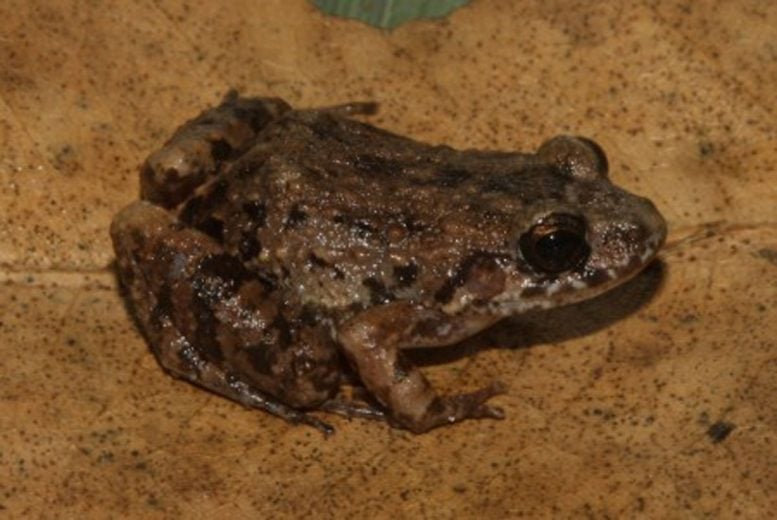
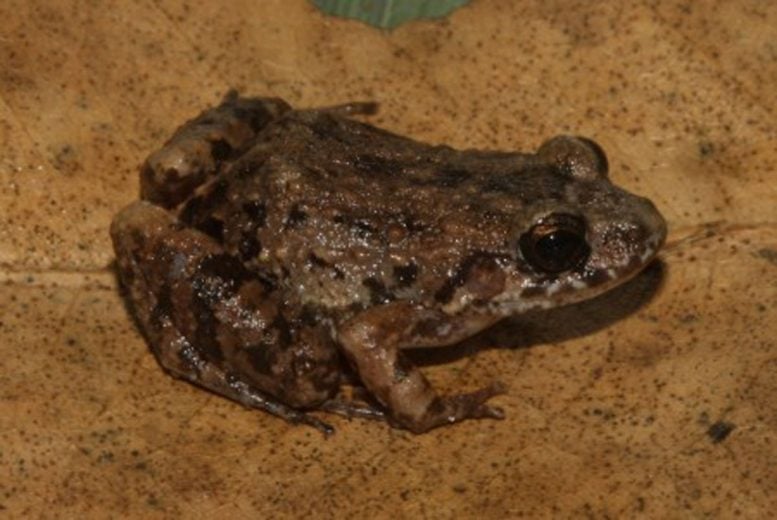
A small frog living in a flooded corner of the Amazon has turned out to be something scientists had never formally recognized before.
Some species hide in remote places. Others hide in plain sight.
In the western Brazilian Amazon, scientists have identified a new frog species, Adenomera varcena, living in forests that are seasonally submerged by rising rivers. The tiny amphibian looks so much like its close relatives that appearance alone was not enough to distinguish it. Its identity emerged only after researchers combined DNA evidence with mating-call recordings, physical measurements, museum comparisons, and details about its habitat.
That detective work revealed more than a new name. The frog appears to occupy an environment that is unusual for its relatives, offering another example of how much biological diversity can remain hidden even within groups that scientists have studied for years.
Amazon Floodplain Frog Discovery
Researchers encountered A. varcena during expeditions in the Upper Juruá River region of Acre, near the Moa and Crôa rivers and the city of Cruzeiro do Sul. Its name refers to várzea forests, the Amazonian floodplains that are periodically inundated as rivers rise.
Other closely related Adenomera frogs are generally associated with terra firme forests, areas that remain above seasonal floodwaters. The new species therefore expands scientists’ understanding of the ecological range occupied by the genus.
Flooding is not simply a temporary disturbance in várzea forests. It is one of the forces that defines these ecosystems, repeatedly changing which parts of the forest floor are accessible to terrestrial animals. For a small frog whose reproduction depends on local environmental conditions, that makes its choice of habitat particularly important.
Hidden Species and Cryptic Diversity
The discovery illustrates one of the persistent challenges of cataloging tropical biodiversity: different species can look remarkably similar.
Scientists call this cryptic diversity. Animals that appear nearly indistinguishable may belong to separate evolutionary lineages, meaning traditional visual identification can miss species that have been hiding in collections or field records for years.
That is effectively what happened here. A. varcena belongs to the Adenomera simonstuarti species complex, a group in western Amazonia that genetic research had already shown contains multiple distinct lineages. Several of those lineages still lack formal scientific descriptions.
DNA and Frog Calls Reveal a New Species
To establish A. varcena as a separate species, researchers brought together DNA data, recordings of its calls, body characteristics (morphology), habitat information, and comparisons with preserved museum specimens.
One subtle physical clue is the absence of a dark marking on the underside of the forearm. Its mating call provides another identifying signature. The frog produces a short call with an unusually slow rhythm and distinctive acoustic properties compared with related species.
For frogs, sound can be especially revealing because mating calls help individuals recognize suitable partners. Differences that seem minor to human ears can therefore help expose evolutionary boundaries that are almost invisible from appearance alone.
The Amazon may contain many more frogs like this
Undiscovered Frog Diversity in the Amazon
The finding adds to growing evidence that the number of Amazonian species visible on paper does not necessarily reflect the diversity actually living in the forest.
Within the A. simonstuarti complex alone, earlier genetic work identified numerous distinct lineages across western Amazonia. The newly named frog resolves the identity of one of them, while others remain undescribed.
A biological population cannot be properly evaluated as a distinct species for conservation purposes until scientists know what it is, where it occurs, and how it differs from its relatives.
Climate Change Threatens Specialized Habitat
The problem becomes more urgent when a species is tied to a specialized habitat.
“Since we don’t yet know in detail the species’ ecological requirements and its natural history [reproductive period and mode], it’s difficult to predict the impacts of climate change, which may alter the seasonal flooding patterns of the floodplain forest ecosystem in this region of the Amazon,” says Thiago R. Carvalho, a professor at the Federal University of Minas Gerais (UFMG).
“Since the species has a preference for this specific ecosystem, it’s possible to suggest that these changes in flood dynamics may influence—though we don’t know to what extent—the species’ reproductive behavior. In a scenario of accelerated loss of natural areas, the formal description of a new species underscores how much more effort we still need to make to advance studies on our biodiversity. Species may become locally extinct even before they’re formally recognized as species through their naming and description.”
Naming Species Can Help Protect Them
Célio F. B. Haddad, a professor at São Paulo State University (UNESP), argues that the pace of habitat loss makes taxonomic work increasingly consequential.
“Currently, the pace of ecosystem destruction outpaces the capacity of taxonomic studies to keep up. Consequently, species that haven’t yet been described are omitted from lists of threatened fauna and remain legally and environmentally vulnerable. Thus, describing new species serves as a tool that aids in their protection. Furthermore, deepening our knowledge of actual biodiversity expands our understanding of the evolution of organisms, consolidating an essential pillar for both pure science and conservation strategies,” he says.
Formal recognition does not automatically protect an animal. It does, however, give conservationists and government agencies a defined species that can be mapped, studied, and considered in extinction risk assessments and environmental decisions. Furthermore, without a scientific name and a clear description, an uncommon species can effectively disappear inside data assigned to a more widespread relative.
Reference: “A New Species of Terrestrial Foam-Nesting Frog (Adenomera, Leptodactylidae) from the Várzea Forests of Western Amazonia” by Marianna S. Borburema, Leandro J. C. L. Moraes, Marcus Thadeu T. Santos, Santiago R. Ron, Célio F. B. Haddad, Ariovaldo A. Giaretta and Thiago R. Carvalho, 15 May 2026, Ichthyology & Herpetology.
DOI: 10.1643/h2025033
This article was supported by Fundação de Amparo à Pesquisa do Estado de São Paulo (FAPESP).
Never miss a breakthrough: Join the SciTechDaily newsletter.
Follow us on Google and Google News.
