
During the recent hot spell, I struggled to exercise my three Labradors to their enthusiastic satisfaction. Showering them with cold water, so that their coats were thoroughly soaked, before we left for a wee wander worked well to keep them comfortable on the not so bad days.
But on the hottest, even in the early evening, the scorching tarmac on the cycle path was capable of blistering pads. And so, with the fields unavailable as they were full of cattle, or sheep, or long grass about to be cut for hay or silage (dog walkers, please remember that grass is every bit as much a crop as wheat or barley), we took to driving to a local pond, where they would swim to retrieve dummies that I had lobbed into the water. It provided both vigorous exercise and safe cooling.
They loved it. Though I guess the fish were none too happy.

I was in that zone, concentrating on getting all three to sit and wait, then send one of them to retrieve by name, while the other two had to remain steady, when, luckily, I saw it.
I stopped mid throw, the canvas dummy still in my hand, the dogs looking to the water where they anticipated it might fall. I shielded my eyes from the sun and started at the surface of the pond.
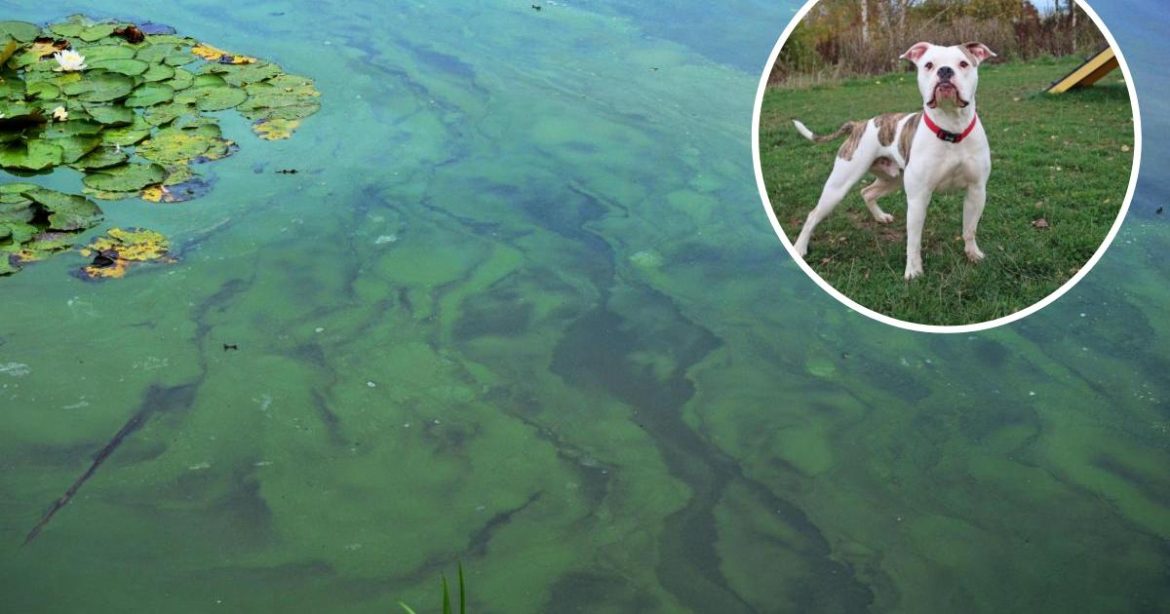
There, indeed, it was; that unusual sheen and reflection that comes from water where there has been a bloom of toxic blue-green algae.
The problem is caused by cyanobacteria, which contain dangerous toxins that can be lethal to dogs.
It appears in relatively stagnant water as a brown- and green-coloured scum and can be swallowed by dogs when it clings to their coat and they lick themselves after swimming.
I was mindful of a dog that died after swimming in June in Loch Awe last year. Blooms have also been reported throughout the central belt of Scotland.
Clinical signs usually become apparent a few hours after exposure to the toxins and include vomiting, diarrhoea, salivation, disorientation, respiratory distress and seizures.
Since there is no antidote (although prompt veterinary attention can improved the chances of survival), it is vital that affected water is avoided.

Where you are concerned that your dog might have been exposed, flushing the coat with water and preventing grooming is really worthwhile. Better still, keep all dogs on a lead near water until you have established whether it is safe or not. If in doubt, don’t let them swim.
And help is at hand. Laurence Carvalho, of the UK Centre for Ecology and Hydrology, says: “The public can play a crucial role in providing a rapid, early warning to pet owners about outbreaks of blue-green algae.
“If people report sightings via the Bloomin’ Algae App with a photograph, we can quickly check if it is blue-green algae or something harmless, with correct and incorrect reports plotted on an interactive map in the app.’
As for me and my dog, that’s just what we did. Then we went home for a nap. Hot. But safe and sound
