
The idea that islands work like simple ecological puzzles has shaped biology for decades. Bigger islands support more species. Islands near continents attract more life.
These principles became central to island biogeography after ecologists Robert MacArthur and Edward O. Wilson introduced the theory in the 1960s.

At first glance, the logic seems convincing. Birds can fly between islands. Plant seeds drift on currents or hitch rides on animals. Mammals sometimes raft across narrow channels.
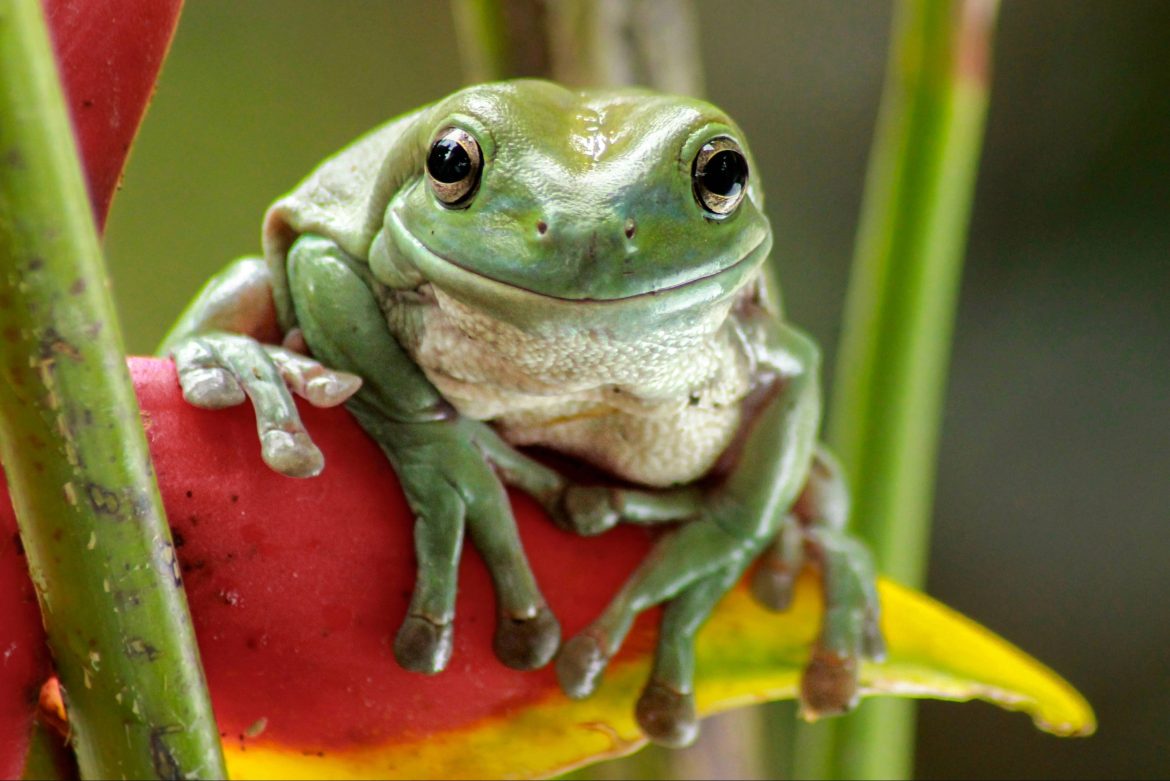
But frogs refuse to follow the script. A new study suggests that frogs experience islands in a completely different way.
Their inability to tolerate saltwater changes the rules of island life so dramatically that one of ecology’s most famous ideas begins to weaken.
Frogs cannot survive oceans
The research team, led by Raoni Rebouças at the State University of Campinas in Brazil, focused on one of the least mobile vertebrates on Earth.
Researchers have successfully used biodiversity models that consider island size, distance from the mainland, and productivity to study plants, birds, and mammals.
However, scientists had never tested those models on anuran amphibians, which cannot tolerate saltwater and therefore cannot cross the ocean barrier.
Frogs depend heavily on freshwater. Their permeable skin leaves them highly vulnerable to salt. Eggs and tadpoles die quickly in seawater, and most adult frogs cannot survive ocean crossings.
For frogs, even a narrow stretch of sea can become impossible to cross.
Largest frog island study ever
To test how frogs fit into island theory, the researchers assembled the largest dataset of island frog communities ever created.
The study covered 3,221 islands worldwide and examined 1,924 frog species, representing nearly 22 percent of all known frog species.
The team measured three forms of diversity.
Measuring frog diversity
The first was species richness, which counts how many species live on an island.
The second was functional dispersion, which measures how different the frogs are in their lifestyles. Some frogs climb trees, some burrow underground, and others reproduce in unusual ways.
The third was evolutionary distinctiveness, which tracks how closely related the species are to one another. That distinction proved important.
Study co-author Matheus Moroti is a professor in the Department of Ecology at The University of São Paulo.
“If there are 200 species on an island, but they all belong to the same family and are all aquatic, then there’s high species richness, but low phylogenetic and functional diversity,” said Moroti.
Distance no longer matters
One result stood out immediately. Distance from the mainland barely influenced frog diversity on most islands.
That finding challenges one of the central ideas of classical island biogeography. Scientists long assumed that islands closer to continents would support more species because they receive more colonists.
For frogs, the equation changes. “But for those that can’t tolerate salt, any marine island is distant,” said Rebouças. “That’s why we had to test this theory with anuran amphibians.”
A frog living 12 miles (20 kilometers) offshore may face the same biological challenge as one living 1,240 miles (2,000 kilometers) away. Both are blocked by saltwater.
Bigger islands hold more
While isolation lost importance, island size still played a major role.
Larger islands generally supported more frog species and more evolutionarily distinct lineages. The researchers found that island size mattered most on species-rich islands.
Climate also shaped the outcome.
“A good example is the world’s largest island, Greenland,” said Rebouças. “Covered in ice for much of the year, it has no frog species. Meanwhile, the second-largest, Borneo, has over 400.”
Size alone cannot support frogs if the environment itself is hostile.
Climate shapes frog lifestyles
When the researchers examined functional diversity, climate became the dominant factor, especially temperature.
Warmer islands supported frogs with a wider variety of lifestyles and survival strategies. Frogs are ectotherms, meaning their body functions depend heavily on environmental heat.
Warm temperatures support higher activity levels and greater ecological specialization. Cold climates create stricter limits.
Habitat diversity also mattered. Islands with varied terrain supported frogs with a broader range of ecological roles.
Tropical frogs evolve differently
The contrast between tropical and temperate islands proved especially striking.
Tropical islands averaged around 10 frog species each and sometimes reached extraordinary numbers. New Guinea supported up to 313 species.
Temperate islands usually hosted only three or four species.
Frog behavior changes worldwide
The frogs themselves also differed. Tropical islands contained many small, daytime-active species that bypass the tadpole stage entirely.
Temperate islands were dominated by larger nocturnal frogs with traditional aquatic larvae.
The researchers found that island distance from the mainland, island size, and productivity all help explain the diversity of anuran amphibians on islands.
However, the importance of those factors changes depending on the climate and the type of diversity being measured, including species richness, functional diversity, and phylogenetic diversity.
Ice age bridges shaped frogs
The study also uncovered traces of Earth’s glacial past.
During the Last Glacial Maximum, lower sea levels connected many present day islands to nearby continents. Frogs spread across these temporary land bridges before rising seas isolated them again.
The researchers found that those ancient connections still influence frog diversity today.
Frogs challenge island theory
The findings reveal that theories built around birds, mammals, and plants may not apply equally to all animals.
Frogs show what island biogeography looks like when movement becomes severely restricted. In that situation, climate and habitat become more important than distance itself.
The study also highlights the limits of relying only on species counts. Two islands may host similar numbers of frogs while supporting very different ecological roles and evolutionary histories.
Nature rarely follows a single rulebook. Frogs make that especially clear.
The study is published in the journal Ecography.
—–
Like what you read? Subscribe to our newsletter for engaging articles, exclusive content, and the latest updates.
Check us out on EarthSnap, a free app brought to you by Eric Ralls and Earth.com.
—–
