
Morocco has not bought a drone; it has purchased the intelligence that pilots it. At the height of the Eurosatory fair in Paris, the Royal Armed Forces have signed a strategic alliance with Harmattan AI, a French tech startup founded by an engineer from Rabat, which in early 2026 closed a $200 million funding round led by Dassault Aviation (unrelated to the Moroccan agreement), to develop autonomous attack and air defense drones. It is not a material contract per se, it is a brain contract.
And this alliance overlaps with another project already underway. Since the December 2024 agreement, Morocco has been building a factory on its territory with the Turkish company Baykar to produce the Bayraktar Akinci, a high-altitude, long-endurance aircraft proven in combat. Rabat does not want to buy drones; it wants to manufacture, program, and, above all, use them. It has been doing so for years in the Sahara, where its unmanned aircraft hit real targets with a regularity that no European army, except Ukraine, can match.
ISR platform
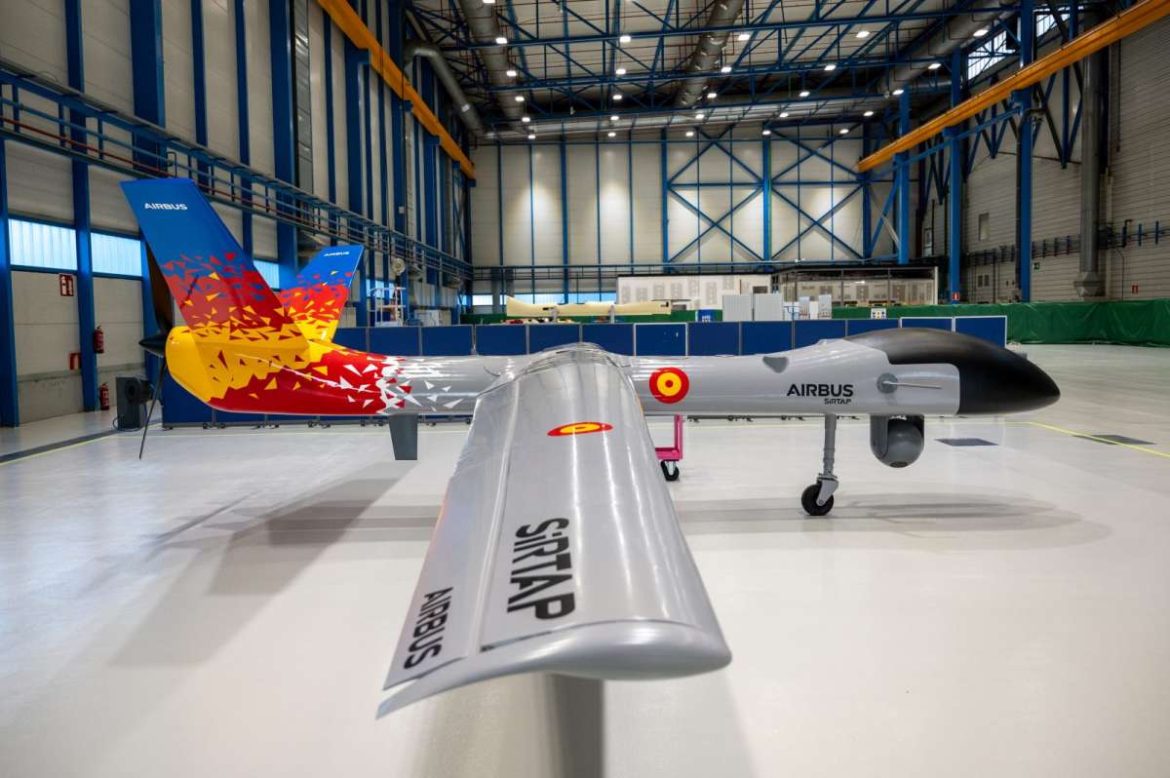
In light of this movement, it is worth asking what Spain has on the table, and the answer is the SIRTAP. The High-Performance Remotely Piloted System developed by Airbus Defence and Space in Getafe is a good device. Seven and a half meters in length, twelve in wingspan, 750 kilos, more than twenty hours of flight, a ceiling of 21,000 feet, and an operational range exceeding 2,000 kilometers. Spain signed the purchase of 27 units for 500 million euros, and on paper, it is a qualitative leap for an Air Force that had been renting capabilities from third parties for too long.
The problem is not the device itself; it’s the clock because the SIRTAP will not begin its test flight campaign until the second half of this year, and the first delivery to the Air Force will not arrive before 2027. And there is a nuance that weighs more than any technical specification: the SIRTAP is born as an ISR platform, for intelligence, surveillance, and reconnaissance, meaning it flies, observes, transmits, but does not shoot. The Army has already requested an armed version with greater range, but that variant does not yet exist beyond a mere requirement on paper.
This is where we can see a fracture with a Morocco that is building an unmanned force designed to attack and trains it in real combat. Spain is building one designed to observe and has not yet made it take off. One accumulates operational experience, and the other, acquisition files. And we have already seen that in the drone war, operational experience is not bought at a fair; it is earned by flying.
Superiority
Undoubtedly, technological superiority remains Spanish, and that is not rhetoric. In sensors, electronic warfare, precision anti-drone systems, the national industry maintains an advantage that Rabat does not have. The Eurosatory itself provided proof: the Spanish UAV Navigation signed an agreement with the American Shield AI to integrate its Hivemind autonomy software (the same that moves coordinated swarms) into Spanish autopilots. It is exactly the piece that the SIRTAP lacks to stop being a pair of eyes and become a combat node.
The question to be asked here is whether Spain is on the right path because while Rabat bets on quantity, AI autonomy, and combat hours, Madrid bets on quality, precision, and technological sovereignty. They are two different doctrines for monitoring the same Strait, and neither comes free: Morocco pays the price of relying on Turkey and France; Spain, the price of arriving late to a scenario that waits for no one.
The Strait of Gibraltar was always a matter of ships, and now it is ceasing to be. Will the armed SIRTAP arrive in time to match in the air what Spain still dominates at sea, or will the southern neighbor have already manufactured its own advantage before the first Spanish drone takes off with a missile under its wing?
Morocco has not bought a drone; it has purchased the intelligence that pilots it. At the height of the Eurosatory fair in Paris, the Royal Armed Forces have signed a strategic alliance with Harmattan AI, a French tech startup founded by an engineer from Rabat, which in early 2026 closed a $200 million funding round led by Dassault Aviation (unrelated to the Moroccan agreement), to develop autonomous attack and air defense drones. It is not a material contract per se, it is a brain contract.
And this alliance overlaps with another project already underway. Since the December 2024 agreement, Morocco has been building a factory on its territory with the Turkish company Baykar to produce the Bayraktar Akinci, a high-altitude, long-endurance aircraft proven in combat. Rabat does not want to buy drones; it wants to manufacture, program, and, above all, use them. It has been doing so for years in the Sahara, where its unmanned aircraft hit real targets with a regularity that no European army, except Ukraine, can match.
ISR platform
In light of this movement, it is worth asking what Spain has on the table, and the answer is the SIRTAP. The High-Performance Remotely Piloted System developed by Airbus Defence and Space in Getafe is a good device. Seven and a half meters in length, twelve in wingspan, 750 kilos, more than twenty hours of flight, a ceiling of 21,000 feet, and an operational range exceeding 2,000 kilometers. Spain signed the purchase of 27 units for 500 million euros, and on paper, it is a qualitative leap for an Air Force that had been renting capabilities from third parties for too long.
The problem is not the device itself; it’s the clock because the SIRTAP will not begin its test flight campaign until the second half of this year, and the first delivery to the Air Force will not arrive before 2027. And there is a nuance that weighs more than any technical specification: the SIRTAP is born as an ISR platform, for intelligence, surveillance, and reconnaissance, meaning it flies, observes, transmits, but does not shoot. The Army has already requested an armed version with greater range, but that variant does not yet exist beyond a mere requirement on paper.
This is where we can see a fracture with a Morocco that is building an unmanned force designed to attack and trains it in real combat. Spain is building one designed to observe and has not yet made it take off. One accumulates operational experience, and the other, acquisition files. And we have already seen that in the drone war, operational experience is not bought at a fair; it is earned by flying.
Superiority
Undoubtedly, technological superiority remains Spanish, and that is not rhetoric. In sensors, electronic warfare, precision anti-drone systems, the national industry maintains an advantage that Rabat does not have. The Eurosatory itself provided proof: the Spanish UAV Navigation signed an agreement with the American Shield AI to integrate its Hivemind autonomy software (the same that moves coordinated swarms) into Spanish autopilots. It is exactly the piece that the SIRTAP lacks to stop being a pair of eyes and become a combat node.
The question to be asked here is whether Spain is on the right path because while Rabat bets on quantity, AI autonomy, and combat hours, Madrid bets on quality, precision, and technological sovereignty. They are two different doctrines for monitoring the same Strait, and neither comes free: Morocco pays the price of relying on Turkey and France; Spain, the price of arriving late to a scenario that waits for no one.
The Strait of Gibraltar was always a matter of ships, and now it is ceasing to be. Will the armed SIRTAP arrive in time to match in the air what Spain still dominates at sea, or will the southern neighbor have already manufactured its own advantage before the first Spanish drone takes off with a missile under its wing?
