
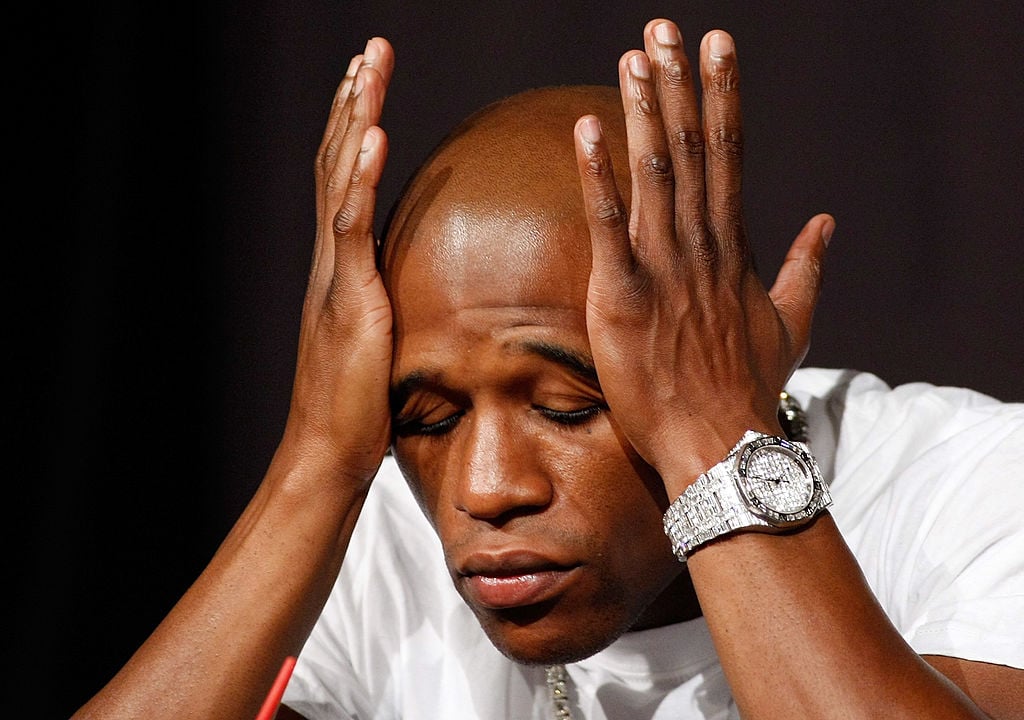
Holy crap. I don’t say that lightly, and in real life, when I first read this latest Floyd Mayweather lawsuit, I definitely used a word other than “crap.” My jaw is on the floor. I am stunned.
But first, let me just remind readers that, financially speaking, it has been a very strange few months for Floyd Mayweather.
This is Floyd Mayweather we’re talking about. One of the highest-paid athletes in history. A man who has earned more than $1.1 billion during his career. A man whose entire public persona is not just being rich, but being impossibly, cartoonishly, performance-art rich. The cash bricks. The private jets. The diamond watches. The Las Vegas mansions. The fleets of cars. The nickname itself: “Money.”
And yet, since the beginning of 2026, a steady drip-drip-drip of lawsuits, liens, unpaid-bill allegations, property disputes, tax issues, and financial oddities has painted a very different picture from the one Floyd has spent decades projecting.
In January, we covered a lengthy Business Insider investigation that alleged Floyd’s post-boxing finances were far more complicated than the public persona suggests. That report described heavy borrowing against real estate, high-interest loans, foreclosures, liens, lawsuits, allegedly unpaid jet fuel and aircraft maintenance bills, and the late-2025 sale of his primary Gulfstream G650 private jet. Floyd’s attorney strongly denied that Mayweather was experiencing financial strain, and Floyd is actively suing Business Insider and one of its reporters for defamation over earlier real estate coverage.
Then, in February, Floyd went on offense with a bombshell $340 million lawsuit against Showtime Networks and former Showtime Sports president Stephen Espinoza. In that complaint, Mayweather alleged that a significant portion of his fight earnings was never properly paid to him and was instead routed through third-party accounts he did not control. The lawsuit claimed that at least $340 million of his career earnings was “missing and unaccounted for,” and that if those funds had been invested conservatively, the lost opportunity could be worth several billion dollars today.
A few days later, another awkward headline arrived. A pair of Miami entrepreneurs sued Floyd over a $100,000-per-month duplex at Manhattan’s Baccarat Hotel and Residences, claiming he stopped paying rent and owed more than $330,000 in back rent and late fees.
In April, it was reported that the IRS had filed a $7.3 million tax lien against Mayweather for unpaid taxes from 2018 and 2023.
And then, just last night, TMZ reported another personal financial wrinkle: Mayweather was legally declared the father of a 4-year-old daughter and ordered to pay $32,850 a month in child support, plus $933,050 in back support. According to TMZ, the court also allowed the child’s mother to place a lien worth up to $2 million on Mayweather property in California to help secure payment.
And now comes the most explosive development yet…
A $175 Million Lawsuit
This morning, Floyd filed a lawsuit in which he claims he was the victim of a multi-year scheme that allegedly siphoned away at least $175 million worth of cash, real estate proceeds, loan money, settlement money, jewelry, aircraft proceeds, and income streams.
The lead defendant is Jona Rechnitz, who the complaint says began cultivating Floyd’s trust around 2017. By 2024, according to the lawsuit, Rechnitz had effectively become Floyd’s investment manager, real estate advisor, and banking liaison, allegedly directing where money was sent, inserting himself into Floyd’s banking and real estate affairs, and helping structure transactions involving several Mayweather-controlled entities.
Floyd claims he did not know, when he first began trusting Rechnitz, that Rechnitz had previously pleaded guilty in federal court to honest-services wire-fraud conspiracy. The lawsuit also notes that a civil judgment in excess of $17.7 million had been entered against Rechnitz in a separate case.
The lawsuit names Rechnitz, Ayal Frist, also known as Ayel Frist, Frist Apex Ventures LLC, New York attorney Alexander Seligson, and John Does 1-10 as defendants. It accuses them of fraud, breach of fiduciary duty, aiding and abetting breach of fiduciary duty, conversion, unjust enrichment, and other claims.
The core allegation is fairly simple: Floyd says Rechnitz used his position of trust to redirect huge sums of money and valuable assets into accounts and entities that Rechnitz and his alleged associates controlled. The details are insane. Let’s start with Floyd’s private jet…
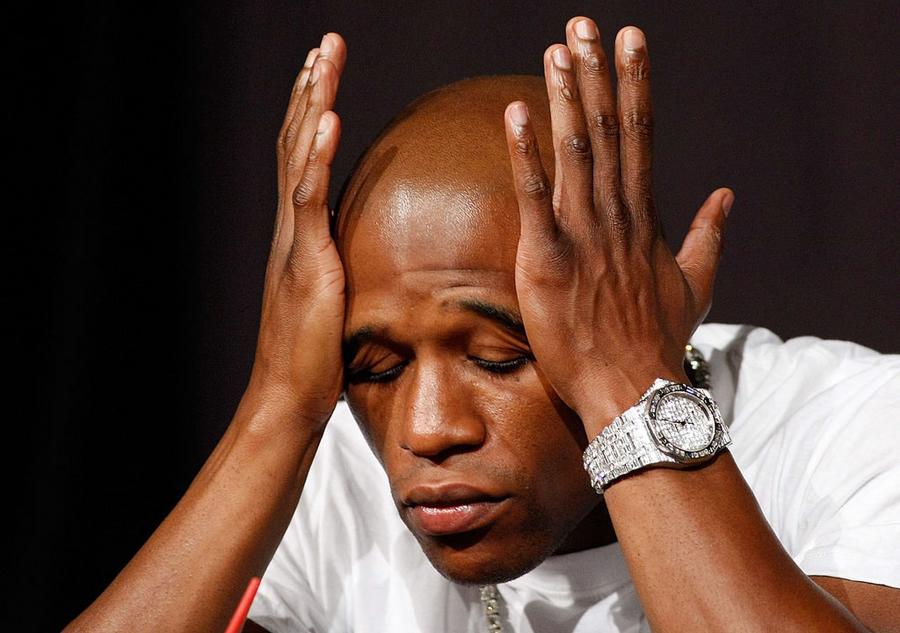
(Ethan Miller/Getty Images)
The Lost Private Jet
This is one of the strangest allegations in the entire complaint.
According to the lawsuit, in July 2024, Rechnitz allegedly arranged a $13 million loan from Hankey Capital. The loan was secured by Floyd’s Miami Beach property, which is located at 288 South Coconut Lane. Of those loan proceeds, $6.5 million allegedly went toward the purchase of a 1996 Gulfstream G-IV aircraft. Only around $4 million, less than one-third of the loan, was made available to Mayweather Promotions.
Then, in November 2025, things allegedly got even weirder.
According to the complaint, Floyd executed an FAA bill of sale for that same Gulfstream G-IV, registration N305DG, on behalf of TBE Aviation LLC. But Floyd claims the purchaser field was left blank. The stated consideration was listed as:
“$1.00 & OVC”
Floyd says he does not know who acquired the aircraft and has received no accounting of the proceeds. The complaint alleges, on information and belief, that proceeds from the aircraft were applied to a Bugatti-related obligation and otherwise diverted to Frist Apex, with no portion paid to Floyd or TBE Aviation.
In plain English: According to Floyd, a private jet was purchased using millions in loan proceeds tied to his real estate. That jet was later transferred away under circumstances he says he does not understand, to a buyer he says he does not know, for proceeds he says he never received.

Floyd and Jona Rechnitz at a Lakers game (Photo by Allen Berezovsky/Getty Images)
The Disappearing $100 Million Jewelry Collection
Then there is the jewelry.
In perhaps the most jaw-dropping allegation in the complaint, Floyd claims that jewelry with an asserted value of approximately $100 million was placed with two Miami dealers, identified in the lawsuit as Joel Vigo Morito and “Moti.”
According to the complaint, the total consideration received in connection with those pledges was approximately $13 million.
That means Floyd’s alleged $100 million jewelry collection was effectively monetized for less than 14 cents on the dollar.
Floyd claims a substantial portion of the jewelry remains in the dealers’ possession, no accounting has been provided, and the proceeds were diverted by Rechnitz rather than paid to him.
The lawsuit also describes an iMessage thread involving Floyd, the two dealers, and Rechnitz. According to the complaint, one of the dealers warned that if he did not receive a large payment on money owed, he would begin liquidating the merchandise. Rechnitz allegedly responded: “Agreed thx.”
Floyd says Rechnitz had no authority to approve any liquidation of his jewelry.
For a man whose public image has been built partly around diamond watches, iced-out chains, and museum-level jewelry flexes, the allegation is stunning: Floyd claims a $100 million jewelry collection was pledged or placed with dealers for a fraction of its asserted value, and that he still has not received a proper accounting of where the jewelry or the money went.
The False $400 Million NYC Real Estate Portfolio
The lawsuit also digs into one of the stranger threads running through Floyd’s recent financial saga. In March 2025, Floyd took to social media to brag that he paid $400 million for 62 apartment buildings in New York City. “All the buildings belong to me. I don’t have no partners.”
But according to the lawsuit, the documented transaction was much, much, much smaller. Floyd claims the only documented acquisition was a 5% Class A membership interest, with aggregate documented acquisition consideration of $31.5 million.
The complaint further alleges that 20% of distributions from the Manhattan residential portfolio were continuously routed to Frist Apex. In a January 1, 2026 email quoted in the complaint, Rechnitz allegedly referred to the Frist Apex Chase account as:
“the usual account at Chase you’ve been sending all distribution to per my direction.”
Floyd claims money flowing from his Manhattan real estate investment was being split 80/20, with the 20% going to Frist Apex, allegedly without proper authorization and in violation of a no-assignment provision in the relevant agreement.
There was also a separate proposed acquisition involving 1196 Sixth Avenue in New York. According to the complaint, Floyd signed multiple versions of a binding letter of intent tied to a proposed $27 million purchase of the property. The deal allegedly required a $1 million nonrefundable deposit upon signing of the sales contract.
Floyd claims that $1 million deposit was diverted at Rechnitz’s direction and paid to Pristine Jewelers NY Inc. The acquisition never closed. Floyd says the money was not returned.
The lawsuit also alleges that Ayal Frist falsely held himself out as “Manager” of Vada Properties and later as “CEO Vada Properties,” even though Floyd claims Frist was never appointed to either role. According to the complaint, those titles were used to create the appearance that Frist had authority in connection with Floyd’s real estate entities.
Other Complaints
The jet, jewelry, and Manhattan real estate allegations are the headline-grabbers, but they are not the only financial claims in the lawsuit.
According to the complaint, on July 1, 2024, Mayweather Promotions wired $7.5 million to Frist Apex at JPMorgan Chase. The wire allegedly included the notation “12 MONTH INVESTMENT.” Floyd claims Rechnitz told him the money would be placed into a 12-month investment vehicle for Floyd’s benefit. Instead, Floyd says no investment was ever made, no return was paid, no documentation was provided, and the $7.5 million principal was never returned.
The lawsuit also alleges that on October 10, 2024, Hankey Capital funded a $16.4 million cross-collateralized loan secured by first liens on four Mayweather properties. According to Floyd, $8,811,463.77 of that loan was wired directly to Frist Apex Ventures, while only $2.5 million was wired to Mayweather Promotions. Floyd says he did not authorize that allocation and has never received an adequate explanation, return, benefit, or accounting.
Another major allegation involves approximately $15 million in settlement proceeds tied to claims involving SL Green Realty Corp. According to Floyd’s lawsuit, those proceeds belonged to him but were transferred to Frist Apex at Rechnitz’s direction without his authorization. The complaint says Alexander Seligson, a New York attorney, verbally admitted to Floyd that he caused the $15 million transfer at Rechnitz’s direction. Seligson also allegedly admitted transferring a separate $2,127,826 in refinance proceeds from one of Floyd’s property entities to Frist Apex.
Combined, the lawsuit says Seligson admitted to disbursing approximately $17,127,826 in identifiable funds to Frist Apex. Craziest of all, in the lawsuit, Floyd revealed he never actually met Seligson!
Floyd is seeking compensatory damages of not less than $175 million, plus punitive damages, pre- and post-judgment interest, restitution, disgorgement, attorneys’ fees, and a full accounting. He is also asking the court to impose a constructive trust over funds and property held by Frist Apex Ventures or otherwise traceable to his money and assets
Putting It All Together
Stepping back, this is where Floyd’s recent financial saga starts to become even more fascinating.
For months, the outside question has been obvious: How does someone who earned more than $1.1 billion during his career, someone whose entire brand is “Money,” end up surrounded by this many lawsuits, liens, loans, rent disputes, tax problems, unpaid-bill allegations, and asset sales?
Floyd’s answer is now coming into focus.
In February, he claimed in a lawsuit against Showtime that at least $340 million of his career earnings was never properly paid to him and was instead routed through third-party accounts he did not control. That is roughly one-third of his reported lifetime earnings. And now, in this new lawsuit, Floyd is making a second explosive claim: that even after all of that, $175 million worth of money and assets he did receive, buy, borrow against, or control was allegedly stolen, diverted, pledged, liquidated, or simply disappeared.
Put those two lawsuits together, and Floyd is essentially claiming that more than half a billion dollars of his financial life is now in dispute.
That does not mean Floyd is broke. It does not mean the allegations are true. It does not mean every lien, loan, lawsuit, or unpaid-bill claim suddenly has one clean explanation. But it does start to crack open a possible explanation for all of Floyd’s recent financial issues. And even if only a fraction of Floyd’s claims are true, the broader picture is staggering.
