
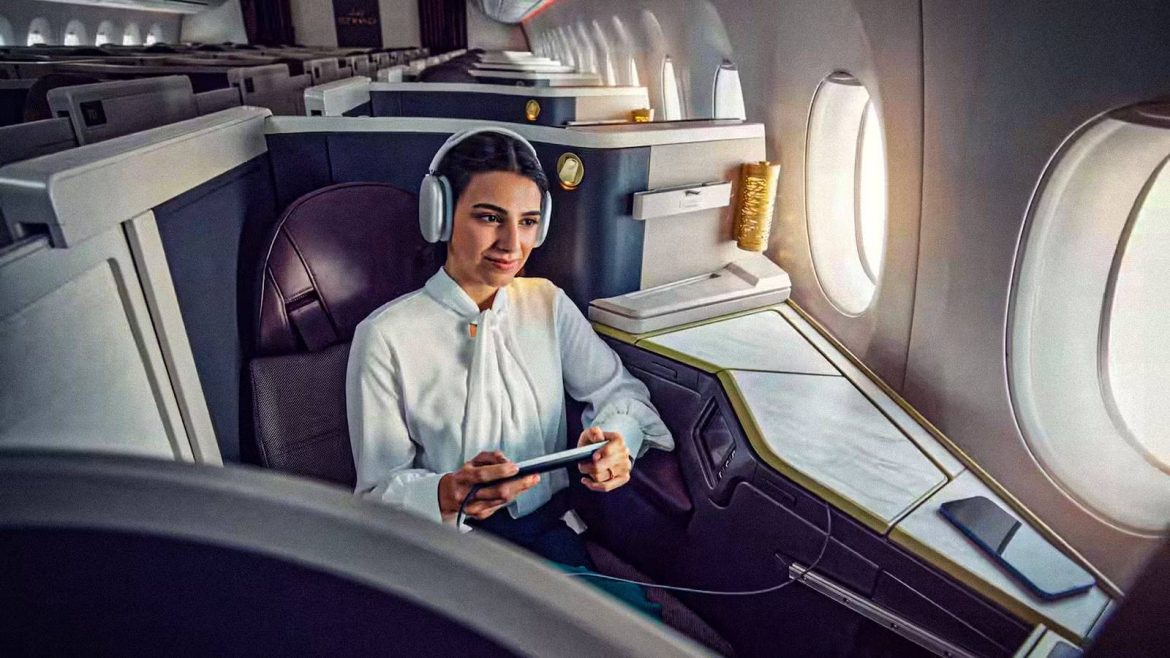
The Airbus A350 is playing an increasingly important role in Etihad Airways’ fleet. Efficient, capable, and spacious, it can be used economically on short, high-demand routes and on some of the airline’s longest routes. There are 12 currently in service, but Etihad also holds orders for 15 more examples. Curiously, all of its A350s are the larger A350-1000, and it has yet to order the smaller, more popular A350-900 variant as of the time of writing, one of the few A350 customers to do so.
Etihad has a fairly dense layout on its A350s, installing 371 seats and 44 business class seats. This means that per-seat costs are extremely low, but the plane still has a large premium cabin, making it ideal for the flagship destinations it serves, such as New York-JFK and Sydney. The A350-1000s have the second-largest business class cabin in Etihad’s fleet, ahead of the 40-seat cabin found on most of its 777-300ERs but far behind the 70-seat cabin on the airline’s Airbus A380s.
What The Etihad A350 Offers Passengers

 Etihad Airways installs 44 business class seats and 327 economy seats on its Airbus A350-1000s, for a total of 371 seats; there is no first class cabin on these aircraft. Etihad still brands the premium seats on this plane as the Business Studios, but they’re different from the custom seats found on the carrier’s A380s and most Boeing 787s. Instead, they feature the Collins Aerospace Elevation for business class, essentially the manufacturer’s ubiquitous Super Diamond reverse herringbone seat with a sliding door.
These seats offer direct aisle access to all passengers, and the 44 seats are spread out across 11 rows configured four abreast within a single cabin. The seat is 21 inches (53.3 centimeters) wide, and offers a bed length of 79 inches (200.7 centimeters). The seat also includes an 18.5-inch (47 centimeter) HD display, as well as USB-A, USB-C, and wireless charging. In addition to Etihad, the Elevation was selected by British Airways, Malaysian Airlines, Ethiopian Airlines, and Philippine Airlines.
The 327 economy seats are based on the Recaro CL3710, the most popular economy seat model for the A350. The seats are configured nine-abreast, and boast the standard CL3710 seat width of 17.6 inches (44.7 centimeters), as the CL3710 is not sold with an 18-inch (45.7 centimeter) option. Seat pitch in economy is the industry standard 31 inches (78.7 centimeters), while there are 45 Economy Space seats located at the front of the cabin configured with a pitch of 35 inches (88.9 centimeters).
Business Class Pricing On Etihad’s A350s

While the Airbus A350-1000 is one of the most capable airliners ever built, Etihad only truly stretches the plane’s legs on its routes to New York-JFK, Sydney, and Atlanta. In addition, the A350-1000 is also deployed on nonstop routes to Casablanca, Amsterdam, Delhi, Mumbai, Bangkok, and Seoul. At 6,621 NM (12,263 km), Etihad’s Atlanta route is the longest to use the A350-1000, with one-way business class fares starting at $4,700. Fares are similar for the JFK route, while Etihad typically charges over $6,000 on the Sydney route.
Catch what other flight trackers miss
Emergency squawks, holds, NOTAMs — live signals, no signup.
Open tracker
Catch what other flight trackers miss
Emergency squawks, holds, NOTAMs — live signals, no signup.
Open tracker
On the route to Casablanca, Etihad Airways typically charges around $2,000 to $2,800 for a one-way business class ticket, while asking around $3,500 on the Amsterdam route, which is also served by the Airbus A321LR. On the route to Seoul, Etihad charges around $4,300 to $5,800 for passengers departing Abu Dhabi, while fares for the return segment from Seoul are much lower, often coming in under $2,000 one-way for a nine-hour flight.
|
Etihad A350 Destinations |
Route Distance (NM) |
Route Distance (km) |
|---|---|---|
|
Hartsfield-Jackson Atlanta International Airport |
6,621 NM |
12,263 km |
|
Sydney Kingsford Smith Airport |
6,510 NM |
12,057 km |
|
New York John F. Kennedy International Airport |
5,967 NM |
11,051 km |
|
Seoul Incheon International Airport |
3,698 NM |
6,849 km |
|
Casablanca Mohammed V International Airport |
3,274 NM |
6,063 km |
|
Amsterdam Schiphol Airport |
2,806 NM |
5,196 km |
|
Bangkok Suvarnabhumi Airport |
2,685 NM |
4,972 km |
|
Delhi Indira Gandhi International Airport |
1,232 NM |
2,281 km |
|
Mumbai Chhatrapati Shivaji Maharaja International Airport |
1,065 NM |
1,973 km |
The route to Bangkok isn’t that long, and the market is highly competitive, resulting in Etihad charging between $2,000 to $3,000, including on the A350 flights. Meanwhile, the routes to Delhi and Mumbai are the shortest to see the A350-1000, with business class fares on the Delhi route ranging from $1,000 to over $2,000. Prices on the Mumbai route can sometimes dip under $1,000 and typically do not rise to $2,000. Note that the A350-1000 does not always operate the same flights on the India route.

From private pods to onboard lounges, Emirates’ A380 business class is the epitome of luxury.
Redeeming Etihad Guest Miles For Business Class

Etihad Guest is not a revenue-based program, as has become prevalent in the industry. Instead, it’s a distance-based program, meaning mileage earnings and redemptions are based on the distance the flight covers as well as the fare class. Award pricing is also not dynamic, which means passengers can find steals for business class award tickets. Award pricing is also dependent on the customer’s status within the program, with five tiers in total: Bronze, Silver, Gold, Platinum, and Emerald.
On the route from Abu Dhabi to Atlanta, a Bronze member will pay 120,000 miles one-way for a Value ticket, 142,500 for a Comfort ticket, and 208,000 miles for a Deluxe ticket, whereas a top-tier Emerald member will pay 108,000, 128,250, and 187,200 miles respectively. To upgrade from economy will cost either 108,000 or 86,400 miles, depending on the fare type. Etihad has the same award pricing on the New York route and Sydney routes, as they’re all a similar length.
On the Casablanca, Bangkok and Amsterdam routes, award pricing varies from 63,000 to 138,750 miles, while the upgrade price is either 50,400 or 63,000 miles. On the Seoul route, award prices vary from 67,500 to 157,500 miles, while the price to upgrade is either 54,400 or 68,000 miles. Meanwhile, on the routes to Delhi and Mumbai, award flight pricing for business class ranges from 29,700 to 78,375 miles, while the upgrade price is either 21,711 or 27,111 miles.
Redeeming Miles With A Partner Airline

Etihad Airways is not part of an airline alliance, but it does partner with 27 airlines for reciprocal mileage earnings and redemptions. American Airlines AAdvantage, Air Canada Aeroplan, and Air France-KLM Flying Blue are generally considered to offer the best value for redeeming miles in Etihad Airways’ business class. AAdvantage does not dynamically price awards on partner airline flights, and one-way flights between the US and the Middle East on Etihad flights typically cost around 70,000 AAdvantage miles, significantly lower than what Etihad charges.
Aeroplan groups destinations into four zones, with the US falling into the North America zone and the Middle East being grouped into the Atlantic zone, while also factoring in distance for award pricing. Etihad flights from North America to Abu Dhabi are within Aeroplan’s 6,001 mile to 8,000 mile category, and award pricing starts at 90,000 miles one-way. However, Air Canada award pricing for Etihad Airways flights is dynamic, and prices are often much higher.
Flying Blue tends to receive access to a large number of award seats on Etihad flights, and prices are usually higher than AAdvantage, but still competitive. Flying Blue dynamically prices award tickets on Etihad, with fares generally under 100,000 miles one-way for flights to or from the US. Note, however, that Etihad tends to restrict partner award availability in advance, typically opening up award seats to partner programs within 30 days of the flight.
Emirates Vs. Qatar Airways Vs. Etihad: Which Carrier Has The Best Business Class?
These carriers all offer their own unique products.
The Business Class Products Offered Across Etihad’s Fleet

The A350-1000 is the only aircraft in Etihad’s fleet equipped with the Collins Aerospace Elevation. Etihad has also been taking delivery of new Boeing 787-9s with the Collins Aerospace Elements, a newer version of the Collins reverse herringbone suite that can support larger monitors, is more space-efficient, features improved storage, and has larger footwells. The two-seat models are quite similar overall, with the Elements being slightly newer and more advanced than the Elevation.
The remaining 787-9s, as well as all 787-10s and A380s, feature the carrier’s previous Business Studio seats, dating back to 2014. This is a custom-staggered seat model that alternates between forward- and rear-facing configurations, manufactured by Stelia Aerospace for the A380, while Zodiac Aerospace (now part of Safran) supplied the seats on the Dreamliners. The 777-300ERs feature the Stelia (formerly Sogerma) Solstys I, an older staggered seat model dating back to 2006.
|
Etihad Business Class Seats |
Number Of Planes Equipped |
Aircraft Type |
|---|---|---|
|
Collins Aerospace Elements |
Seven |
Boeing 787-9 |
|
Collins Aerospace Elevation |
12 |
Airbus A350-1000 |
|
Etihad Business Studio |
49 |
Airbus A380-800 Boeing 787-9 Boeing 787-10 |
|
Sogerma Solstys I |
15 |
Boeing 777-300ER |
|
Stelia Opera SA |
12 |
Airbus A321LR |
|
Recliner seats |
31 |
Airbus A320-200 Airbus A320neo Airbus A321neo |
Most of Etihad’s narrowbody aircraft are equipped with recliner seats for business class. However, the carrier is also taking delivery of new Airbus A321LRs equipped with the Stelia Opera SA for business class, a narrowbody-optimized reverse herringbone seat. There are 16 Opera SAs on each A321LR, and the front row on Etihad’s A321LRs features additional space with an ottoman, which Etihad markets as first class. In addition to the added space, Etihad also provides a differentiated experience through the amenity kits and catering for first class passengers on the A321LR.
