
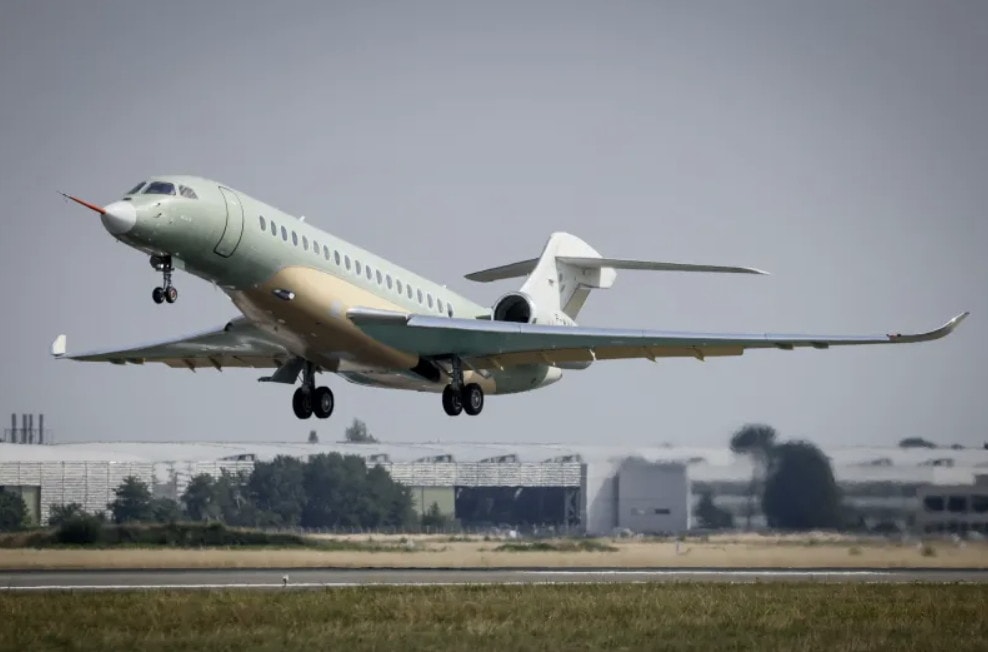
Close to one year later than planned, French aviation company Dassault finally took its most recent and advanced airplane, the Falcon 10X, into the sky. It happened on June 19, in the skies over Bordeaux-Merignac airport, and marked a moment that could redefine the business jet segment.
The Dassault Falcon 10X has been in the works for years now, and it was initially supposed to fly in 2025. For one reason or another, as it often happens in the aviation industry, that didn’t come to pass, so here we are celebrating the accomplishment only now.
Two test pilots were on board the plane, Sebastien Dupont de Dinechin and Fabrice Dougnac, and they both spent two and a half hours in the air. During this time, they tested the plane’s handling qualities and systems at 15,000 feet (4,570 meters) with the gear down, and acceleration at 40,000 feet (12,190 meters) with the gear retracted.
Dassault says the Falcon reached a top speed of Mach 0.82 (629 mph/1,013 kph) during the flight, which is significantly lower than the rated max speed of the plane, which is Mach 0.925 (710 mph/1,142 kph).
Once that was done, the pilots took their aircraft back to the airport, landing smoothly and officially kicking off the flight test campaign that is scheduled to accelerate over the coming months.

Photo: Dassault
The launch of a new aircraft is always a reason to celebrate, but this version of the Falcon, which is part of a family of business jets that was born all the way back in the 1970s, is a bit more special than that: it is the first Dassault aircraft to use engines made by Rolls-Royce – the rest rely on Pratt & Whitney bits of hardware.
The engine is called Pearl 10X, the latest and most powerful member of the family so far. Packing the Advance2 engine core, or, as Rolls-Royce likes to say, the most efficient core available across the business aviation sector, the powerplant makes use of a high-performance low-pressure system that gives it a maximum thrust of 18,000 pounds.
And there are two of them installed on the fuselage, at the rear of the plane, capable of running on 100 percent sustainable aviation fuel (SAF). On top of everything, the engines are tied to a new accessory gearbox, which allows for higher power extraction.
For now, this aircraft is the only one to use this type of engine, which was only installed on the aircraft after more than 4,000 flight hours performed both on the ground and in the air, using a Boeing 747 flying testbed.

Photo: Dassault
But it’s not only the engines that make the Falcon 10X special. The business jet has been advertised from the get-go as the one with the largest cabin in its segment, offering a cross-section larger than some regional commercial jets.
In numbers, that’s 6 feet, 8 inches (2.03 m) tall and 9 feet, 1 inch (2.77 m) wide, which is almost 8 inches (20 cm) wider and 2 inches (5 cm) taller than the widest and tallest purpose-built business jet in operation today.
The generous cabin can accommodate a total of 12 people, four crew and eight passengers. When traveling slower than its maximum speed, at Mach 0.85 (652 mph/1,049 kph), it can transport these people to a maximum distance of 8,600 miles (13,900 km) at top altitudes of 51,000 feet (15,545 meters). In a nutshell, that’s enough to get people from New York to Shanghai in a single flight lasting about 11 hours.
Because this is a business jet and all, the interior is highly customizable in terms of layout, even offering the option to go for a setup with an expanded dining area, a dedicated entertainment area, and a private stateroom with a fixed queen-size bed.

Photo: Dassault
No matter the choice, all Falcon 10X planes come with 38 windows, a cabin partitioned into four zones, high-speed connectivity (including Ka-band networking), and a suite of large monitors.
The pilots flying this plane will also have access to the most modern technologies, including some that are derived from Dassault’s experience in making fighter planes, the likes of the Mirage and Rafale.
The list of such goodies includes the Falcon Digital Flight Control Technology used to make the jet a breeze to handle, and the FalconEye Combined Vision System designed to allow pilots to see even through the worst weather possible.
Before people get to enjoy the plane properly, though, a lot of work lies ahead. The plane that was just flown in France last week will be joined in the testing program by two more, including one outfitted with a full interior that will be used to test systems and cabin functionality.
It’s unclear when the testing program will end (the company talks about several months, at least), and Dassault’s brand-new flagship jet will be ready for operations, but likely there’s plenty of waiting to do. Once it’s cleared for duty, the Falcon 10X will be sold for prices that are said to start at $75 million, making it a serious contender in its segment.
