
Summary
- Flaris LAR 1 is the world’s smallest business jet, with a wingspan of just 8.68 meters. It can be stored in a garage and easily transported to a nearby runway, thanks to its small size.
- Eclipse 550 is a fuel-efficient private jet that can fly at high altitudes and consumes less than 60 gallons of fuel per hour. It can carry up to five passengers and has a wingspan of approximately 11.51 meters.
- Cirrus SF50 Vision Jet is the only single-engine private jet currently certified by the FAA. It has a wingspan of slightly over 11 meters and can accommodate one crew, six passengers, and their belongings.
In recent years, most new-generation private jets have become bigger to entice private flyers with increased range and huge interior spaces. Some commercial aircraft have also been increasingly transformed into private jets as well. The newer, more sizable designs also allow for a more significant symbol of wealth – as the saying often goes, the bigger, the better.
However, some private flyers prefer smaller aircraft for more flexibility with airport accessibility, not to mention the more affordable investment level, particularly where clever design means interior comfort isn’t compromised. Even though there are plenty of small options available in the global market, here are the top five private jets with the smallest wingspan.
1
Flaris LAR 1
Wingspan: 8.68 m (28 ft 6 in)
Key specifications:
|
Crew |
1 |
|
Capacity |
4 passengers |
|
Length |
8.32 m (27 ft 4 in) |
|
Cruise speed |
800 km/h (500 mph, 430 knots) |
|
Maximum speed |
Mach 0.72 |
|
Range |
3,500 km (2,200 mi, 1,900 NM) |
Although the aircraft still awaits certification, the Flaris LAR 1 is already dubbed the world’s smallest business jet. Currently being developed in Poland, this compact cruiser will work via a single-pilot operation and can only host four passengers. To give you an idea of just how small this aircraft will be, the Flaris LAR 1 has a wingspan of just 8.68 meters (28 ft 6 in), which is almost half the width of a Boeing 737-800 horizontal stabilizer (14.35 m / 47 ft).
The small wingspan is further emphasized by the fact that the wings are physically detachable – quite a first, no doubt. This unique feature allows owners to safely and conveniently store the Flaris LAR 1 in a decent home garage instead of paying for an aircraft hangar. Anytime the aircraft needs to be used, hauling it to a nearby runway will be easy, thanks to its small size.
2
Eclipse 550
Wingspan: 11.51 m (37 ft 9 in)
Key specifications:
|
Crew |
1 |
|
Capacity |
5 passengers |
|
Length |
10.21 m (33 ft 6 in) |
|
Cruise speed |
692 km/h (430 mph, 374 knots) |
|
Maximum speed |
Mach 0.64 |
|
Range |
1,528 km (949 mi, 825 NM) |
Powered by two Pratt & Whitney PW610F engines and as the second revision of the Eclipse Very Light Jet, the Eclipse 550 can carry up to five passengers and a pilot, highlighting its small size. Even with a wingspan of approximately 11.51 meters (37 ft 9 in), this small aircraft is still quite the mighty beast.

Often dubbed as the light jet that is light years away, the Eclipse 550 has abilities to fly at high altitudes of up to 41,000 feet at a maximum cruise of approximately 374 knots, all while consuming an estimated less than 60 gallons of fuel per hour, this small aircraft is one of the most fuel-efficient private jets worldwide.
3
Cirrus SF50 Vision Jet
Wingspan: 11.79m (38 ft 8 in)
Key specifications:
|
Crew |
1 |
|
Capacity |
7 passengers |
|
Length |
9.42 m (30 ft 11 in) |
|
Cruise speed |
576 km/h (358 mph, 311 knots) |
|
Maximum speed |
Mach 0.53 |
|
Range |
1,281 km (796 mi, 692 NM) |
Since entering into service at the end of 2016, the Cirrus SF50 Vision Jet is currently the only Federal Aviation Administration-certified single-engined private jet. Given the single-engine, it’s not hard to imagine how small the SF50 Vision Jet is when compared to most business jets in operation today.

Inching just a few meters ahead, this private jet comes second after the Polish aircraft with a wingspan of slightly over 11 meters – or more specifically, 11.79 meters (38 ft 8 in) and can comfortably accommodate one crew, six passengers, and all their belongings. However, due to single-engine performance, the SF50 Vision Jet is only certified to fly at 28,000 feet.
4
Honda HA-420 HondaJet
Wingspan: 12.1 m (39 ft 8 in)
Key specifications:
|
Crew |
2 |
|
Capacity |
6 passengers |
|
Length |
12.9 m (42 ft 7 in) |
|
Cruise speed |
778 km/h (483 mph, 420 knots) |
|
Maximum speed |
781.5 km/h (486 mph, 422 knots) |
|
Range |
1917 km (1.191 mi, 1,035 NM) |
When the Japanese motor giant created an aircraft production subsidiary in 2006, one of the flagship products was a light business jet named the Honda HA-420 HondaJet, with a wingspan of just 12.1 meters (39 ft 8 in). Indeed, the differences in wingspan between the three private jets listed so far are not very significant.

But unlike the small aircraft listed, the design of the HA-420 HondaJet was actually interestingly inspired by Salvatore Ferragamo shoes – which does explain the small airframe. And similar to how shoes are meant for comfort as they are style, this aircraft delivers a spacious cabin that can comfortably house five or six passengers with plenty of legroom.
5
Embraer Phenom 100EV
Wingspan: 12.3 m (40 ft 4 in)
Key specifications:
|
Crew |
1 or 2 |
|
Capacity |
4 – 5 passengers (7 maximum) |
|
Length |
12.82 m (42 ft 1 in) |
|
Cruise speed |
750 km/h (470 mph, 400 kn) |
|
Maximum speed |
Mach 0.7 |
|
Range |
2,182 km (1,356 mi, 1,178 nmi) |
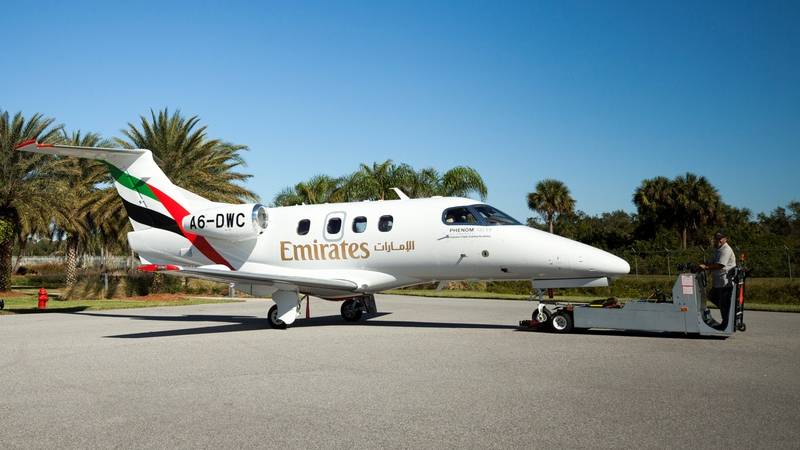
With a barely noticeable difference and a wingspan of 12.3 meters (40 ft 4 in), Embraer’s Phenom 100EV rounds off this list of the smallest private jets boasting the shortest wingspan. For the lack in size compared to new-generation and more preferred private jets these days, the Phenom 100EV compensates with an incredible production and sales record.

More than 390 aircraft have been delivered to various customers worldwide, including Emirates. The aircraft remains highly popular in the ultra-light business jet market, with an adequate range of flying as far as 1,178 nautical miles and reaching a high cruise speed of up to 406 knots. A well-designed cabin also houses four passengers and two crew members.
