

Some new videos on YouTube are using an AI voice-over to portray segments of the used-boat market as being in the toilet, including catamarans. Loose Cannon asked an expert to evaluate those claims. Catty McCatface—he prefers that his real name not be used—fed verified catamaran sales data to Anthropic’s Claude AI platform, which came back with this: Today’s used catamaran market can be described as one that demands patience and capable of inflicting pain. But it’s not in freefall.
The first half of 2026 produced 97 confirmed sail catamaran sales across the Americas, Caribbean and select international markets. The headline story isn’t price collapse—it’s time. The median boat took 180 days to sell, with more than half the
market exceeding that benchmark and 14 percent sitting over a full year before closing. Discounting is real but uneven: the average ask-to-sold gap is 12 percent, but distressed sellers—particularly in the Caribbean and U.S. Virgin Islands—are conceding 25 to 60 percent to get out.
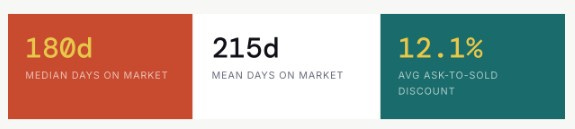
A healthy catamaran market averages 180 days on market. The median for the above dataset is exactly at that line—meaning that half the market is already in distress territory by that measure. The current mean of 215 days signals a significant distressed tail pulling the average well above healthy.
Of 86 sale records with valid days-on-market data (excluding four statistical outliers over 693 days), the distribution skews heavily toward the right. The 180-to-365-day bucket is the single largest cohort—more boats sold in that range than in the first 90 days combined.
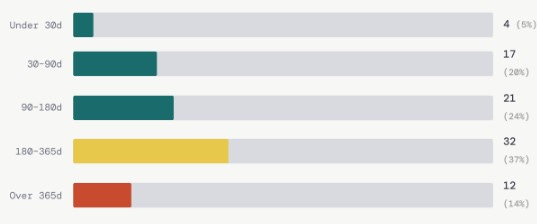
Only 25 percent of boats sold in under 90 days—the range that characterizes a confident buyer market. The dominant cohort (37 percent) is boats that needed six to 12 months to find a buyer, suggesting price discovery is slow and buyers are deliberate.
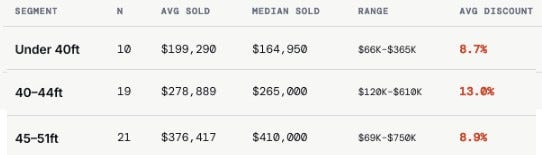
The median discount across all 50 priced transactions is 10 percent—not dramatic in isolation. But 22 percent of boats (11 of 50) conceded 15 percent or more off asking price, and the tail is severe. These are the transactions where carrying costs, market exhaustion or structural concerns forced the hand.
The Lagoon 450 is the single most-traded model during the first six months of 2026 with 14 confirmed sales—more than the next three models combined. It is also the model most visibly under pressure.
Lagoon 450: First Half of 2026 Snapshot
14 sales, model years 2011-2020, across BVI, Caribbean, Florida, Texas, South Carolina and Europe. Days on the market: 258. Average sales price: $390,528. Sold range: $280,000 to $525,000. Average discount: 8.8 percent.
The average of 258 days on the market is 43 days above the overall market mean. One Lagoon 450 Flybridge in Trinidad has sat 652 days without a confirmed close. The spread between best ($525,000 for a 2018 model in Trinidad) and worst ($280,000 for a 2011 model in Europe) reflects a market that is acutely sensitive to model year, condition and geography.
The structural bulkhead concerns affecting 2011 to 2020 Lagoon 450s are reflected in this data. Pre-2015 hulls are consistently selling at or near the bottom of the range regardless of asking price, and several sit on the discount list above.
Florida is the market. The Caribbean is the backlog.
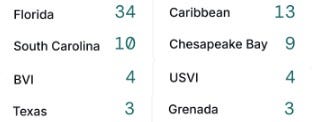
Florida accounts for 35 percent of all sail catamaran sales—more than the Caribbean, BVI and USVI combined. The domestic market is where transactions are clearing. Caribbean listings are selling, but slowly and with deeper concessions.
The Caribbean fleet selling in the first half of 2026 skews older than social media narratives suggest: 56 percent of Caribbean sales were built before 2016, compared to a claim of 73 percent being under 10 years old circulating in YouTube market commentary. The 2010-to-2014 cohort—peak Lagoon 450 production years—is the single largest group moving through the Caribbean market.
Time is the defining variable, not price. The catamaran market in the first half of 2026 is not in freefall—boats are selling. But patience is mandatory. A buyer with financing in place and a 90-day timeline will find limited inventory priced for speed. A seller who needs to exit quickly is facing 20 to 60 percent concessions.
The domestic advantage is real. Florida, South Carolina and the Chesapeake are clearing volume. Caribbean-based listings take longer and close softer, likely reflecting the reduced pool of international buyers willing to navigate importation logistics.
Model year and condition still command premium. Boats from 2018 onward in good condition are trading at or near ask. Pre-2015 ex-charter hulls—particularly Lagoon 450s—are the most price-sensitive segment in the market, with structural concerns and high refit costs suppressing demand.
The market is not collapsing. It is correcting—slowly. Median days-on-the-market sitting exactly at the 180-day healthy threshold, with a distressed tail above it, is the anatomy of a market finding its floor, not one in freefall.