
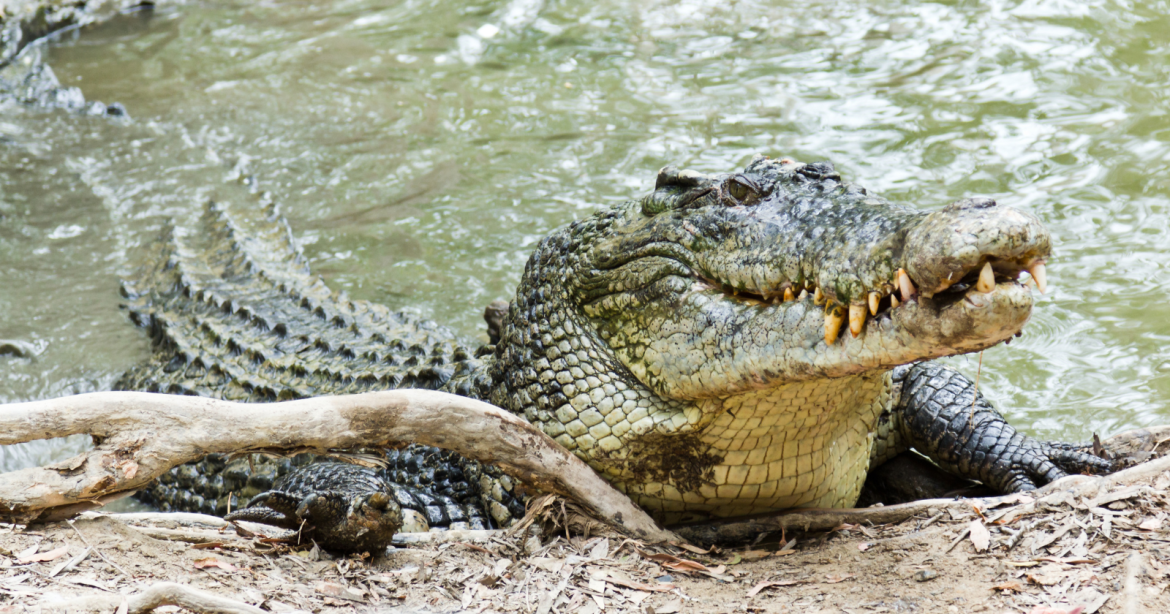
In 1978, a worker at the Turkey Point nuclear plant, on the edge of Biscayne Bay south of Miami, stumbled on something along one of the plant’s cooling canals: a clutch of eggs, buried in the raised dirt bank. They belonged to an American crocodile.
At that moment, the American crocodile was one of the most doomed animals in the country. Decades of coastal development had paved over its nesting beaches, and the entire United States population had collapsed to a few hundred animals, by some counts fewer than 300, clinging on at the very tip of Florida. A University of Florida researcher who spent four years searching the state’s waterways at night in that era caught a grand total of 31 adult crocodiles.
And here was a nest, on the grounds of a nuclear power station.
An accidental Eden
Turkey Point’s two reactors went online in the early 1970s, and they came with a cooling system unlike almost any other: instead of towers, the plant dug 168 miles of shallow canals across roughly 5,900 acres of former wetland, a giant radiator through which warm water slowly loops and sheds its heat.
Nobody thought about crocodiles when they dug it. But the digging piled the spoil into long, high berms between the canals, and by accident those berms were everything a female crocodile needs: well-drained soil that never floods, right beside quiet, brackish water, on fenced industrial land where no humans build, boat or hunt. Just as developers were destroying crocodile habitat everywhere else on the coast, a utility company had unintentionally built the best nesting ground in America.
The crew that says yes
The easy corporate move in 1978 would have been to quietly discourage the animals. Florida Power & Light did the opposite. With the species federally listed and the canals soon designated critical habitat, the company hired biologists and stood up a crocodile monitoring program that has run every summer since, one of the longest continuous wildlife efforts in the country.
The work is hands-on and nocturnal. Each hatching season, crews patrol the canals by night, scooping up emerging hatchlings, weighing and measuring each one, and implanting a microchip before releasing it. The team also engineers the habitat: clearing invasive plants from the berms and digging dozens of small freshwater ponds, because hatchlings need fresh water for their first months while their salt glands develop. In dry years the plant pumps fresh water into the system to keep the salinity where crocodiles like it.
The tally has grown steadily remarkable. By 1985 the canals were producing a tenth of South Florida’s crocodile hatchlings. Today the program has tagged, by recent counts, more than ten thousand hatchlings since that first nest, and the canal system holds the densest crocodile population in North America. Roughly a quarter of the 2,000 or so American crocodiles now living in the United States call Turkey Point home.
No mutants, just crocodiles
The obvious question gets asked so often that the plant’s lead biologist, Mike Lloret, answers it before visitors finish forming it. The cooling water never touches anything radioactive; the canals are a closed loop on the clean side of the plant, and decades of monitoring have found no sign of radiation in the animals. The Turkey Point crocs grow, breed and behave exactly like crocodiles anywhere, except that there are far more of them per mile of shoreline.
They are also not the man-eaters of nightmare. The American crocodile, unlike its Nile and Australian cousins, is a shy, retiring animal that flees people, and South Florida is the only place on Earth where it lives alongside the American alligator, its blunter-snouted and far more numerous neighbor.
What the comeback bought
In 2007, the U.S. Fish and Wildlife Service moved the American crocodile from endangered to threatened, and it named the utility’s canal program as part of the reason. Federal biologists credited the man-made berms with compensating, in real measure, for the natural habitat lost elsewhere on the coast. A species that bottomed out in the hundreds now numbers in the low thousands, and one in four of them hatched next to a nuclear plant.
There is a lesson in that which conservationists have taken to calling reconciliation ecology: the idea that wildlife recovery doesn’t only happen in wilderness, and that the most human-altered landscape on Earth can save a species if someone decides to let it. Turkey Point was built to air-condition the very sprawl that nearly finished the American crocodile. Nearly fifty years on, the plant’s warm canals are the species’ stronghold, patrolled each summer night by a crew with scales, microchips and a running tally that started with one surprising clutch of eggs in 1978.
