
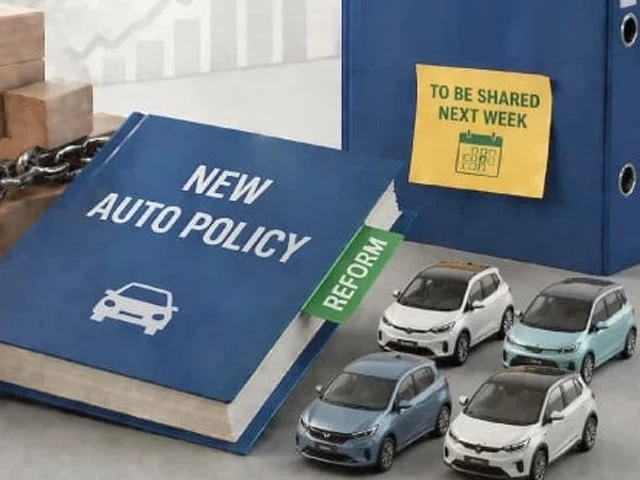
Govt to encourage production of conventional and electric vehicles, phase out petrol-run car imports
ISLAMABAD:
With a clear focus on plans to boost localisation, the government has prepared a five-year auto and auto parts manufacturing policy for 2026-30 that offers major tax breaks to ramp up production of conventional and electric two-, three- and four-wheelers.
In this regard, Special Assistant to Prime Minister on Industries and Production Haroon Akhtar Khan has helped develop consensus among different stakeholders in the industry.
At a time when the government increasingly pushes for raising the production of electric vehicles (EVs), it plans to discourage the import of cars powered by gasoline. As time passes, the import of petrol-run vehicles will come to an end.
The new policy is part of proposals for the upcoming budget for fiscal year 2026-27, effective from July 1, 2026. Keeping in view the global oil crisis amid the US-Iran war, the government has offered major incentives for EVs, which may lead to price reductions of up to 30% from the next financial year. Attention has also been paid to auto parts by slashing duties to pull down input costs and encourage local manufacturing.
Sources told The Express Tribune that the government had finalised an auto policy to eliminate the additional customs duty (ACD) and cut regulatory duty (RD) in accordance with provisions and guiding principles of the National Tariff Policy.
“Customs duty on sub-components/components for manufacturing auto parts under SRO 655(I) 2006 will be reduced to 5% and on assemblies/sub-assemblies to 10% from July 1, 2026,” sources said while quoting the policy.
As RD and ACD would be brought down to “zero”, the items being allowed under SRO 655(i) 2006 would be deleted from the BOM (IOR), resulting in automatic phase-out of the SRO, they said. To promote New Energy Vehicles (NEVs), adequate protection is being given to local assembly vis-a-vis imports in completely built condition, which exceeds limits of the tariff policy. A 1% customs duty has been proposed for NEV-specific parts; however, as per an agreement, the weighted average tariff will remain below 6%. Similarly, according to sources, a gradual reduction in imports of completely built vehicles operating on gasoline has been proposed. Incentives envisaged in the policy will have sunset clauses and shift to the normal regime is targeted at the end of FY 2029-30.
The existing tariff structure is applicable to battery EVs only and it is also being proposed for NEVs including EVs, Range-Extended Electric Vehicles (REEVs), Plug-in Hybrid Electric Vehicles (PHEVs) and Fuel Cell Electric Vehicles (FCVs). Hybrid-specific parts will attract 5% customs duty while sales tax on hybrid vehicles will be 50% of the applicable rate, ie, 9%. For bona fide manufacturers of L6/L7 category vehicles, the Ministry of Industries has proposed the assembly/manufacturing of a maximum of 10 units of the same variant in Pakistan. Subsequently, not more than 100 units will be allowed to each company at 10% customs duty till June 30, 2027.
Customs duty on completely knocked down (CKD) units will be 5% for non-localised parts and 10% for localised parts till June 30, 2028. There will be exceptions for L6/L7 category vehicles.
In the case of two- and three-wheel EVs (NEVs), the import and/or local supply of inputs for the manufacturing of parts may be allowed at 1%. Sources said the local supply of EV (NEV)-related parts by local vendors may be permitted at 1%.
For four-wheel NEVs, the import and/or local supply of inputs for the manufacturing of parts may be allowed at 1%. It has been proposed to permit import of NEV-related parts by Original Equipment Manufacturers (OEMs) at 1%. Local supply of NEV-related parts by local vendors may also be allowed at 1%.
