
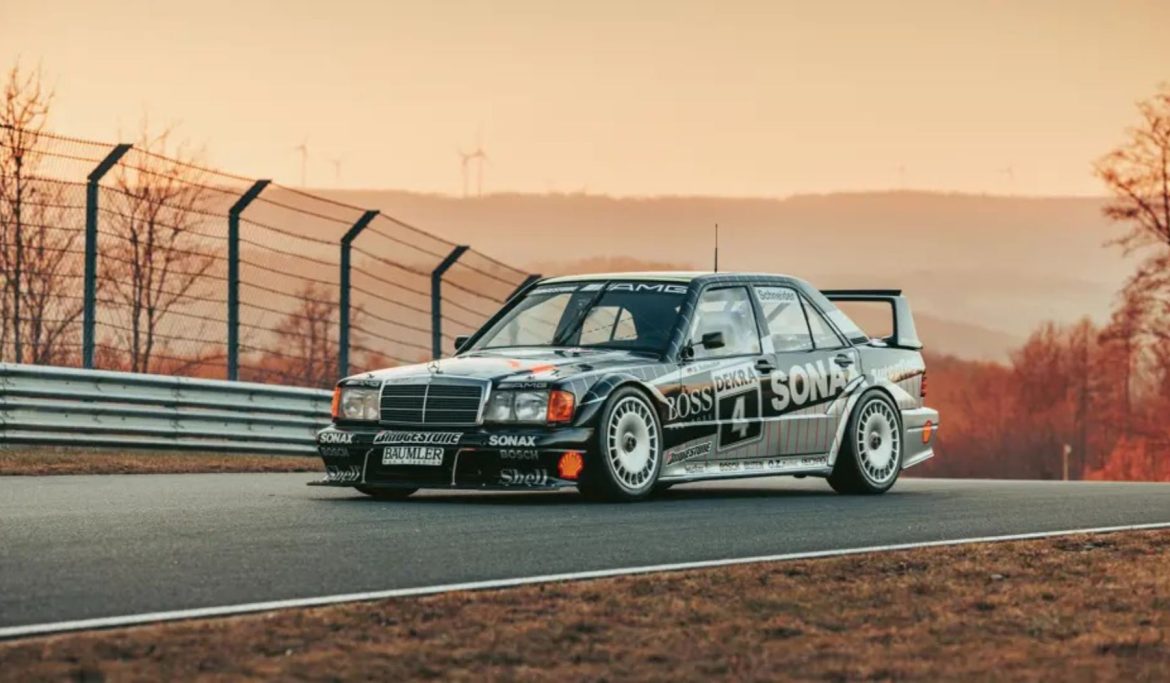
During the second part of the 1980s and the first half of the 1990s, the DTM saw its most competitive period of racing and engineering innovation. The era was marked by fierce rivalries between legendary cars that remain fascinating more than three decades later.
Few racing competitions have started out in such a successful manner as the Deutsche Tourenwagen Meisterschaft (DTM). The competition began in 1984 and quickly became one of Europe’s most popular touring car series.
The DTM saw fierce rivalries between Germany’s finest as well as Ford and Alfa Romeo, with some of the most talented drivers on the continent behind the wheels of legendary production-based race cars.
Among those race cars were the following five models which became motorsport legends. Even today, these impressive rides manage to inspire with their raw, yet sophisticated nature, so let’s take a few minutes to remember and celebrate them.
BMW M3 (E30)

Photo: Invelt Rallied & Raced
For the 1987 season, BMW entered DTM with a completely new challenger, one that went on to become one of the most dominant race car ever built by the Bavarians.
Based on the E30 3 Series, the first-ever M3 was developed by the German manufacturer’s Motorsport division to replace the M635CSi. Not only was it a huge improvement over the M635CSi, but it also managed to bring BMW two DTM titles, the first during its debut season, followed by a second in 1989.
Powered by a masterpiece of an inline-four engine and important aerodynamic upgrades constantly improved throughout the model’s lifespan, the M3 was produced in three distinct evolutions.

Photo: Invelt Rallied & Raced
Each evolution of the M3 was homologated for competition by corresponding road-legal versions. The original M3, as well as the Evo 1, Evo 2 and Sport Evolution variants are now some of the most sought-after BMWs ever conceived.
In race trim, the DTM-bound E30 M3 featured an S14 engine that revved over the 8,000-rpm mark and spat out around 300 hp.
Apart from that impressive engine, the M3 came with a lightweight chassis, great aerodynamics and near-flawless weight distribution, all of which resulted in an impressively nimble car.
The E30 M3 was one of the most prestigious race cars of the Group A era and remains the most influential in DTM history.
Ford Sierra RS500 Cosworth

Photo: Invelt Rallied & Raced
In 1986, Ford Europe began production of the RS500, the ultimate evolution of the Group A-developed Ford Sierra Cosworth.
In the latter part of 1987 season, the iconic touring car entered the DTM and by the end of the 1988 season, it won a Teams’ and Drivers’ championships with Klaus Ludwig earning the latter.
Its dominant overall victory was one of the few by a non-German manufacturer, even if Ford Europe’s motorsport headquarters and a plant were located in Germany.

Photo: Invelt Rallied & Raced
The RS500 managed to be so competitive because of its mix of aerodynamic efficiency, suspension tuning, and lightweight turbocharged inline-four produced by engineering wizards Cosworth, which produced close to 500 hp in full racing trim.
The R500 was also produced in a limited run of 500 examples that featured much of the upgrades of the race version along with a detuned, 224-hp of the turbocharged Cosworth engine.
Nearly four decades after it was triumphant in its first full DTM season, the Ford Sierra RS500 Cosworth remains one of the most legendary vehicles in competition history, and the first turbocharged winner of both titles.
Audi V8 Quattro DTM

Photo: RM Sotheby’s
At the start of the 1990 season, Audi joined the DTM, and the Ingolstadt-based manufacturer had a dream debut season.
Running a cleverly upgraded version of the Audi V8 luxury sedan, it managed to outshine purposefully built homologation specials from traditional rivals BMW and Mercedes-Benz thanks to the efforts of Hans-Joachim Stuck who cruised to the Driver’s Championship.
Even more impressive, the next season another V8 Quattro DTM, this time the one driven by Frank Biela repeated the feat and defend the title for Audi.

Photo: RM Sotheby’s
As its model name implies, this DTM legend managed to be so dominant in an era of lightweight four-cylinders with a lumpy naturally aspirated 3.6-liter V8 that made a smooth 415 hp.
Heavily based on the production model, the V8 Quattro DTM was heavier than the competition but the extra power and fine chassis tuning made it hard to beat.
Because of disagreements with the governing body of the competition over a controversial crankshaft design, Audi decided to withdraw from the DTM during the 1992 season, so the V8 Quattro DTM’s highly successful run was cut short prematurely.
Mercedes-Benz 190 E 2.5-16 Evolution II

Photo: RM Sotheby’s
For the 1990 season, Mercedes-Benz and partners AMG developed the ultimate evolution of the 190 E 2.5-16 with the aim ending archrivals BMW’s the reign of dominance in the DTM.
That ultimate 190 E 2.5-16 was the Evolution II, a drastically improved version that donned arguably the most aggressive-looking body kit of all the cars from the golden age of DTM.
With amply flared wheel arches, a roof-mounted spoiler and a massive, adjustable rear wing, the Evo II meant business and, although not immediately, became a dominant force.

Photo: RM Sotheby’s
The DTM legend was powered by a 2.5-liter DOHC 16-valve inline-four developed in collaboration with Cosworth. Equipped with individual throttle bodies and able to rev up to 10,000 rpm, the naturally aspirated engine produced around 370 hp.
Though it was competitive from the start, the upgraded car had to wait until 1992 for its ultimate moment of motorsport glory. With Klaus Ludwig behind the wheel, the car was unstoppable, bringing the German driver his second DTM Drivers’ title.
For homologation purposes, the Evo 2 was also made available to the public in limited-edition, street-legal form. Less powerful but just as spectacular as the race version, the road-going 190 E 2.5-16 Evolution II remains one of the most impressive high-performance cars ever built by Mercedes-Benz.
Alfa Romeo 155 V6 TI DTM

Photo: RM Sotheby’s
In 1993, the DTM transitioned from the Group A to the Class 1 rules, which favored meant more prototype-level cars than the heavily production-based versions used in previous seasons.
The manufacturers eventually adapted, but the one that came on top immediately surprised a lot of people.
That manufacturer was, of course, Alfa Romeo, who ended up dominating the 1993 season with its impressive 155 V6 TI.

Photo: RM Sotheby’s
An instant DTM legend, the race car was built on a bespoke carbon fiber chassis, featured drastic aerodynamic enhancements, a sophisticated rear-biased AWD system and an impressive 2.5-liter V6 that produced 420 hp.
Driven by the talented Nicola Larini, the 155 V6 Ti won 12 out of 20 races, cruising to the Driver’s Championship and ending the long-standing dominance of German manufacturers.
The Class 1 era didn’t require near-identical homologation version, but Alfa Romeo did build the 155 GTA Stradale one-off in 1992. Developed to celebrate the brand’s success in the Italian CIVT championship, the Stradale was as close to a road-legal version as Alfa ever got.
