
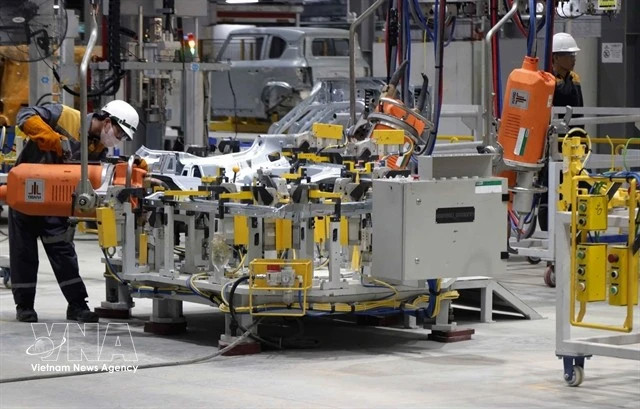
The call comes as the Ministry of Finance drafts a reform plan, including a proposal to remove automobile manufacturing, assembly and import from the list of conditional business lines.
Major players, including Thaco, VinFast and TC Group, have submitted petitions to the Prime Minister and relevant ministries, urging careful consideration given the sector’s strategic importance.
Thaco said that easing investment and business conditions in the automobile sector would be inappropriate because the sector is a foundational industry with broad spillover effects on manufacturing, employment, public safety and the environment.
The maker also noted that vehicles have long life cycles, placing sustained responsibility on manufacturers and distributors, while consumers should be guaranteed access to firms with sufficient capacity to provide warranties, maintenance services and spare parts, as well as product recalls.
Requirements related to factories, production lines and after-sales service infrastructure should therefore not be viewed as administrative barriers, but as necessary safeguards to ensure product quality and accountability throughout a vehicle’s life cycle, Thaco added.
VinFast said that requirements for production facilities and technical capacity reflect a manufacturer’s long-term commitment and seriousness about investing in vehicle production and assembly.
These prerequisites should be maintained to prevent underqualified firms from entering the market, as automobiles are high-value products that involve complex technologies, according to VinFast.
TC Group raised competition concerns, arguing that removing conditions entirely could give importers an advantage over domestic manufacturers that have invested heavily in local production.
If barriers are lowered, importers may enter the market more easily, placing domestic producers who carry long-term investment costs at a disadvantage, the company said.
Division
The proposed reforms have exposed divisions among policymakers, businesses and industry experts.
Some argue that removing conditions entirely could lead to an influx of low-cost imports and weaken domestic production capacity, while others say the current system imposes unnecessary costs and slows innovation, particularly in emerging areas such as electric and autonomous vehicles.
The Ministry of Industry and Trade has previously flagged similar risks, noting that removing current requirements could weaken localisation efforts by encouraging firms to import nearly complete vehicles for simple assembly instead of investing in deeper manufacturing capacity.
The ministry also warned of potential trade risks, including the possibility that surplus production capacity from neighbouring countries could be redirected to Vietnam through low-value assembly projects to avoid tax and put Vietnam at risk of trade defence investigations from other markets.
However, the Vietnam Chamber of Commerce and Industry (VCCI) backed the proposal to abolish the prerequisites for the auto industry.
The VCCI said that all vehicles, whether domestically produced or imported, are already subject to strict technical and environmental inspections before being allowed on the market.
Additional licensing requirements would duplicate oversight mechanisms and increase compliance costs without improving safety, according to the chamber.
Current rules create high entry barriers, limiting competition in the import market and pushing up car prices in the domestic market compared to other ASEAN countries, the VCCI said.
The chamber pointed out that high market entry conditions have not effectively driven domestic industrial growth, citing statistics showing that after more than two decades of development, the local procurement rate remains low, at around 7-10 % for passenger vehicles, compared with 70-80 % in Thailand.
Regarding concerns over trade circumvention, the VCCI said Vietnam already has adequate legal tools, including anti-dumping measures and rules of origin under free trade agreements, to address such risks.
The VCCI also argued that current business conditions are designed for traditional automobile manufacturing models involving welding, painting and assembly processes, and may no longer be suitable in an era of electric and autonomous vehicles.
Such regulations could create unnecessary barriers for new investors entering emerging automotive segments, according to the chamber.
Countries including the US, Japan, South Korea and members of the EU do not require manufacturers to obtain specific production and assembly eligibility certificates. Instead, they regulate the sector through technical standards, mandatory recall mechanisms and product liability rules under civil law.
The chamber called on the Ministry of Industry and Trade and the Ministry of Transport to strengthen technical standards and post-market inspection mechanisms to ensure user and community safety.
A balanced approach
According to Vietnam Automobile Manufacturers’ Association representative Dao Cong Quyet, Vietnam’s auto market remains smaller than Thailand’s or Indonesia’s.
If the market is opened fully, there is a risk that it will become dominated by imports, Quyet said, adding that maintaining business conditions helps guide industrial development and prevent fragmented and inefficient investment.
President of the Ho Chi Minh City Society of Automotive Engineers Do Van Dung said the decision to remove or retain business conditions should be carefully studied, saying that policymakers should avoid abrupt changes.
“The industry is in a transition period, moving from assembly to genuine manufacturing and shifting toward electric vehicles,” he said.
“Sudden policy changes could affect the development of domestic production and supply chains,” Dung added, warning that it could trigger a surge in completely built-up vehicle imports and weaken long-term investment momentum for domestic producers.
“There needs to be a balanced approach. Maintaining core requirements on safety, environmental standards and production capacity is important, but unnecessary administrative procedures should be removed,” he said.
Tran Anh Tung, Head of the Business Administration Faculty at Ho Chi Minh City University of Economics and Finance, said removing business conditions would put the market under intense short-term pressure from cheap imported vehicles and trading firms, while domestic manufacturers continue to bear long-term investment costs.
The issue is not whether to retain or abolish the conditions entirely, but how to redesign them transparently, focused on technical standards, environmental protection, safety, warranty responsibility and genuine production capacity, rather than creating additional sub-licences.
Vietnam’s automobile sector currently accounts for more than 3% of GDP and provides 200,000 jobs.
Domestic production has grown steadily, reaching over 500,000 vehicles in 2025 from 323,890 in 2020 and accounting for roughly 65-75% of total sales.
The country is also home to about 650 auto and parts manufacturers, with more than 400 suppliers meeting tier-one standards, an increase of more than 200% over 2016./. VNA
