
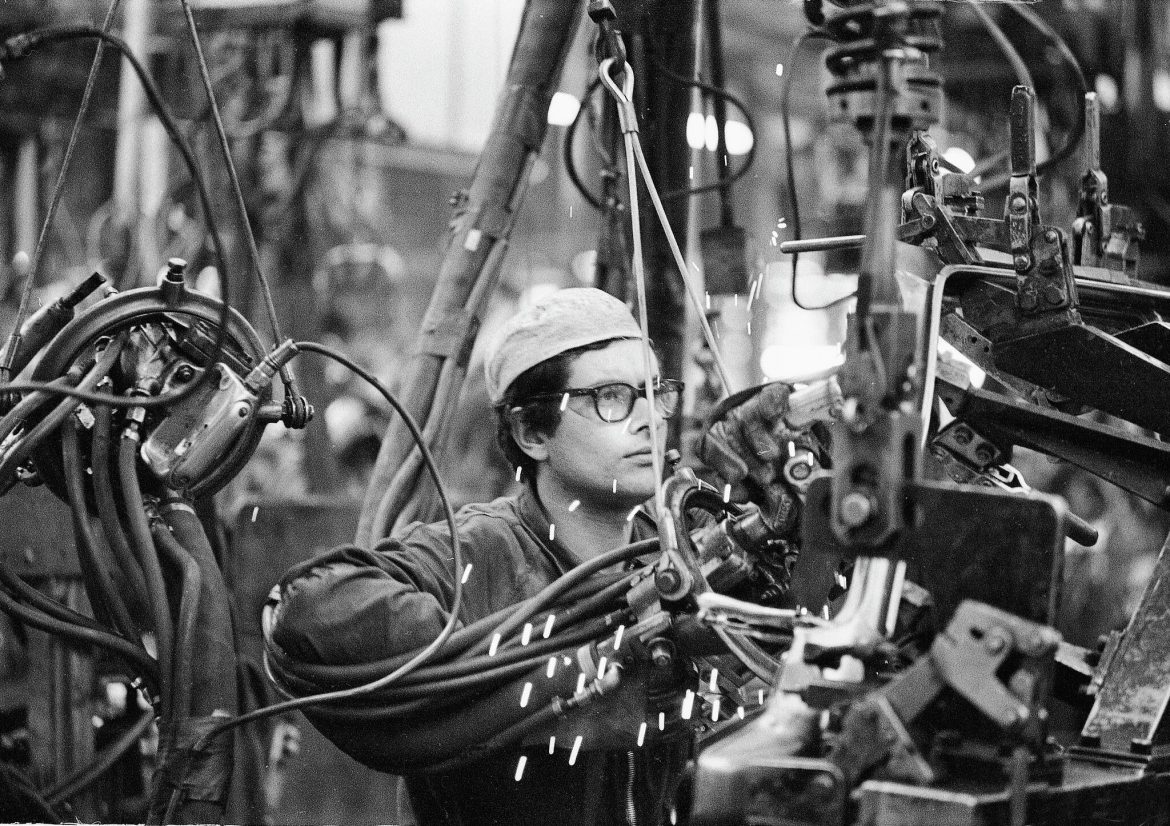

General Motors; assembly hangar; 1969.


For roughly a century, Michigan has been known as the home of automobile manufacturing and innovation.

As America turns 250 years old, the state is positioned to continue as a major player in the auto industry, experts say, even as the industry itself continues to pivot and evolve.
Article continues below this ad
Alan Taub, director of the University of Michigan’s electric vehicle center (EVC) and former vice president of global research and development at General Motors, said both mobility and the vehicle itself are evolving in a way they haven’t in recent automotive history – thanks to innovations like electric vehicles.
“Basically for 100 years, we refined the vehicle, we improved its safety, we improved its fuel economy and improved the styling,” Taub said. “After 100 years of the vehicle being in continuous improvement, we’re reinventing first the vehicle and now mobility.”
The cost of ownership for an EV, which doesn’t need as much maintenance as a traditional internal combustion engine vehicle, is expected to be lower than traditional internal combustion engine vehicles by the early 2030s, according to Taub. From there, he estimates it will take about 15 to 20 years before EVs make up a majority of vehicles on the road.
The auto industry made a bit of a mistake in branding electric vehicles primarily as good for the environment, Taub explained. Automakers should have branded them as “better vehicles, which also happen to be environmentally friendly,” he said.
Article continues below this ad
“Historically, a very small portion of the world population will spend more money to solve a global problem, right? They’ll rate fuel economy highest, but then when they go in the dealership, they’ll choose a better radio system instead,” he said.
“This is a better vehicle that happens to be good for the broader environment. We need to rebrand it that way, and I think part of the backlash you’re seeing against EVs was we branded them incorrectly,” Taub continued.
However, not everyone is as convinced as Taub that EVs are the future.
Elgie Bright, department chair of Automotive Marketing/Management at Northwood University in Midland, doesn’t believe EVs will be widely desirable for a majority of buyers in the near future.
Article continues below this ad
“They’re just not a huge percentage of sales,” Bright said. “They’re a percentage, but not a huge percentage. I think that most dealers that we work with, our alumni dealers, the ones that our students go to do their internships with, it’s an offering, but it’s just not a big percentage.”
To him, artificial intelligence is an innovation that has more potential to change the market, especially on the retail side with dealerships, though he said it will impact manufacturing as well.
“When you’re talking to a dealership in terms of directions and connections and stuff, a lot of times you’re talking to a bot,” Bright said. “Even scheduling on the service side, you’re talking to AI.”
Taub, however, said investing in EVs will be important if Michigan wants to maintain its position as the world’s auto capital.
Article continues below this ad
“The tagline we use is, ‘Make sure we transition to the e-motor capital,’” he said. “…. The transition is inevitable. It’s being driven in China by both government and companies, and already making major inroads, because it’s a better mobility experience. It’ll happen here. It’ll happen in the developed world.”
One of the biggest challenges in the transition to electric vehicles is building up charging infrastructure to make EVs more practical to own. People who have garages can install chargers in their homes, but Taub said larger metro areas pose a bigger obstacle to EV adoption.
Also ongoing are innovations to improve electric vehicles themselves, some of which is being done in collaboration with Midland-based Dow.
Taub said Dow is working with the EVC on new binder materials that hold batteries together; the next generation of polymers for lightweighting, or reducing the weight of the whole vehicle; and improving thermal management materials to manage excess heat generated by batteries, since thermal management is more complex with EV batteries than it is with a combustion engine.
Article continues below this ad
In addition to engineering innovations, the EVC is also involved in training workers for a transition to EVs. A $130 million grant which the University of Michigan used to establish the center in 2023 included about $20 million earmarked for workforce education.
“We are working with not only the universities on master’s degrees and undergraduates in battery engineering, we’re working with the community colleges. We’re setting up certificates, particularly in battery manufacturing,” he said.
Regardless of how the auto industry evolves, Bright said focusing on soft skills will be important for employees looking to keep themselves relevant in a changing workplace.
“The soft skills, the ability to adapt to, you know, work in a team, to be dynamic. I think anytime you can upskill in those things, I mean, it just benefits you, so that when change comes, you know that you’re adaptable and able to change.”
Article continues below this ad
Whatever the future holds, Bright is optimistic about the future of the automotive industry and Michigan’s position within it. He said cars and trucks will continue to be aspirational for people.
“I’m sure Henry Ford back, you know, 100 years ago was saying, ‘Hey, this is going to be around for a minute,’” Bright said. “Well, I’m just saying that looking out 100 years, I think it’s going to be around for a long time.”
