
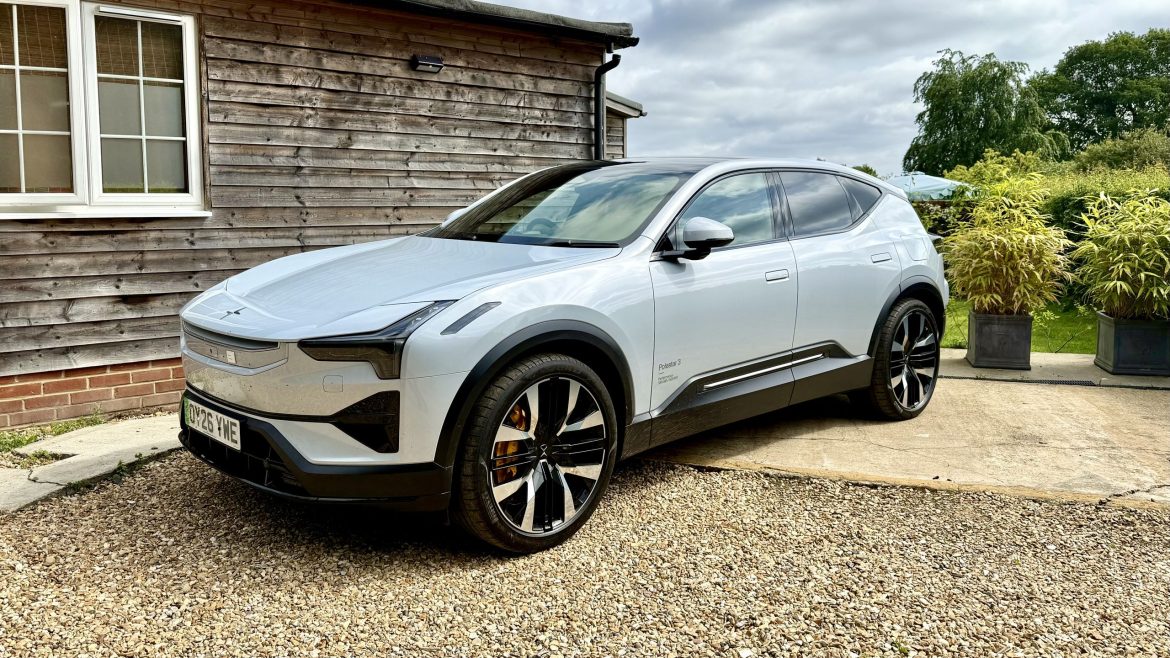
I know what you’re thinking. Didn’t the Polestar 3 only just come out? Well yes, and T3 had its first drive just a year ago, in June 2024.
But 12 months is a long time in the electric car world, and already Polestar has given its biggest car a huge technological upgrade, while keeping the exterior (and interior) practically unchanged.
The big news here is how the car’s electrical architecture has been upgraded from 400 to 800 volts. This allows it to charge much more quickly than before, with the official maximum rate up from 250 kW to 350 kW. Polestar says that’s good for a 25 percent reduction in real-world charge time, and the 10-80 percent time is down from 30 to 22 minutes – but, as you know and as I discovered, this can vary somewhat in what really is the real world.


(Image credit: Polestar)
There’s also a new battery with a slightly smaller capacity but improved chemistry, more powerful motors developed in-house by Polestar itself, and new performance figures across the board. The base model has a single motor driving the rear wheels and a smaller battery (92 kWh) than its dual-motor siblings. Range for that entry-level car has fallen rather noticeably from a claimed 438 miles to 374 miles, but power is up from 295 to 329 bhp and the 0-62 mph sprint has fallen by 1.2 seconds to 6.3.
Both dual motor cars have a 106 kWh battery (down slightly from 111 kWh in the original Polestar 3), but range has increased from 395 to 404 miles in the standard car. Power is also up, from 482 to 536bhp and the 0-62 mph sprint is down from 4.8 to 4.5 seconds. Lastly, the flagship variant, called the Polestar 3 Performance and driven here for this feature, has had a huge power boost, up from 517 to a whopping 680 bhp. That’s taken the 0-62 mph time down from 4.5 to a supercar-bothering 3.8 seconds.
Polestar has upgraded the 3’s computer, too. It’s now the Nvidia Drive AGX Orin processor, which the Swedish carmaker claims boosts processing power significantly, from 30 to 254 TOPS (trillions of operations per second). This 8x increase in computing power will, Polestar says, “enable faster, more intelligent management of active safety systems, battery performance, and sensor data.”

(Image credit: Polestar)
Helpfully, this new computer is available as a free retrofit upgrade to buyers of the original Polestar 3. So, while they’ll miss out on the 800-volt system, faster charger and extra power of the new car, their car will at least get a shiny new brain.
Back to the new car, and I’ve just spent a few weeks with the Performance edition. It’s properly quick – of course it is, given the 680 bhp output – but not intimidatingly so. Polestars have always been engaging to drive, and the latest 3 is no different. It’s a joy to cruise in, but equally enjoyable when you want to press on down a winding road you know well. It has a remarkable amount of composure for such a big car, aided by the relatively low seating position and roofline (again, for such a car), and minimal body roll.

(Image credit: Polestar)
As before, the interior is wonderful. It’s one of those cabins that beckons you in from your first glance through the window, and which you never want to leave. The car I borrowed had Polestar’s optional Bowers & Wilkins sound system – all 1,610 watts and 25 speakers of it, with support for Dolby Atmos and Abbey Road Studios Mode.
The former uses speakers in the headrests and roof lining – and a whole heap of clever software – to surround you in a sphere of sound. It’s a wonderful experience, and possibly the most enjoyable car stereo system I’ve ever experienced. For quality and power it’s on par with the five-figure Naim systems used by Bentley, but with the Atmos tech boosting immersion to another level.
The latter is accessible when not playing Atmos content. It gives you four distinct sound profiles to pick from, each mimicking Abbey Road Studios in differing setups, called Intimate, Open, Energised and Expansive. It’s a fun system to tinker with, especially when playing older records with less production.

(Image credit: Polestar)
One downside of playing high-quality Dolby Atmos tracks through the in-built Tidal app is the size of the files, and how they often overwhelm the car’s 5G data connection. Music frequently stopped playing while it buffered, even when the system showed four bars of 5G data. Disappointingly, this occurred across several days and on journeys through three counties of Southern England, so likely can’t be blamed on a bit of patchy 5G coverage.
Back to the interior, and it’s a seriously nice place to be. The fabrics are lovely, the design is aesthetically pleasing, the seats are comfortable and the whole thing projects a wonderful air of calm. It’s a fantastic place to spend a few hours.
Only an over-reliance on the touchscreen lets it down a little, since you need to tap at the display to adjust the door mirrors and steering wheel, as well as the cabin temperature and almost everything else too. It’s a very good infotainment system, with baked-in Google Maps and one of the best menu designs of any car. But skipping physical mirror controls on a £92,000 car – as the P3 Performance is – is hard to justify.
The Polestar 3’s range was also underwhelming. I know manufacturer’s figures can’t be relied upon, but when the brochure says 373 miles and the car itself says just 250 miles with 90 percent charge, owners would rightly be disappointed. I optimistically blamed this on the car producing a figure based on the lead-foot driving of the previous journalist. But after a week of steady town errands and a motorway cruise between Kent and Surrey, the car estimated just 260 miles would be possible from 100 percent.

(Image credit: Future / Alistair Charlton)
The car calculated this while plugged into a 300 kW charger, where I’d hoped to see it flex its new 800-volt muscles. Since it’s capable of 350 kW charging – and no one else was using the charge – I thought I’d see some big figures. Instead, it only managed to hit 154 kW while charging from 17 to 47 percent, which took 13 minutes. I know the car can do much more, so I’m forced to blame the lacklustre performance on the charger.
As is so often the case in the life of an automotive journalist, I’m left telling readers not to buy the fully-loaded car provided by the manufacturer. Yes, 680 horsepower is an awful lot of horses, and yes, the wheels, gold details, chassis tuning and other trinkets of the Performance model make it hugely desirable. But the range isn’t good enough – especially when the BMW iX3 I drove recently indicated over 500 miles being available – and the price is too high as a result. The dual-motor Polestar 3 (£84,540 and 402 miles) on smaller wheels for a softer ride is probably the better option.
Ultimately, the new Polestar 3 demonstrates what’s possible with a facelift in the EV age. A whole new electrical architecture, new batteries, new motors and a new brain too. But while on paper this translates into more speed, more range and faster charging, in the real world the upgrades are harder to spot.
