
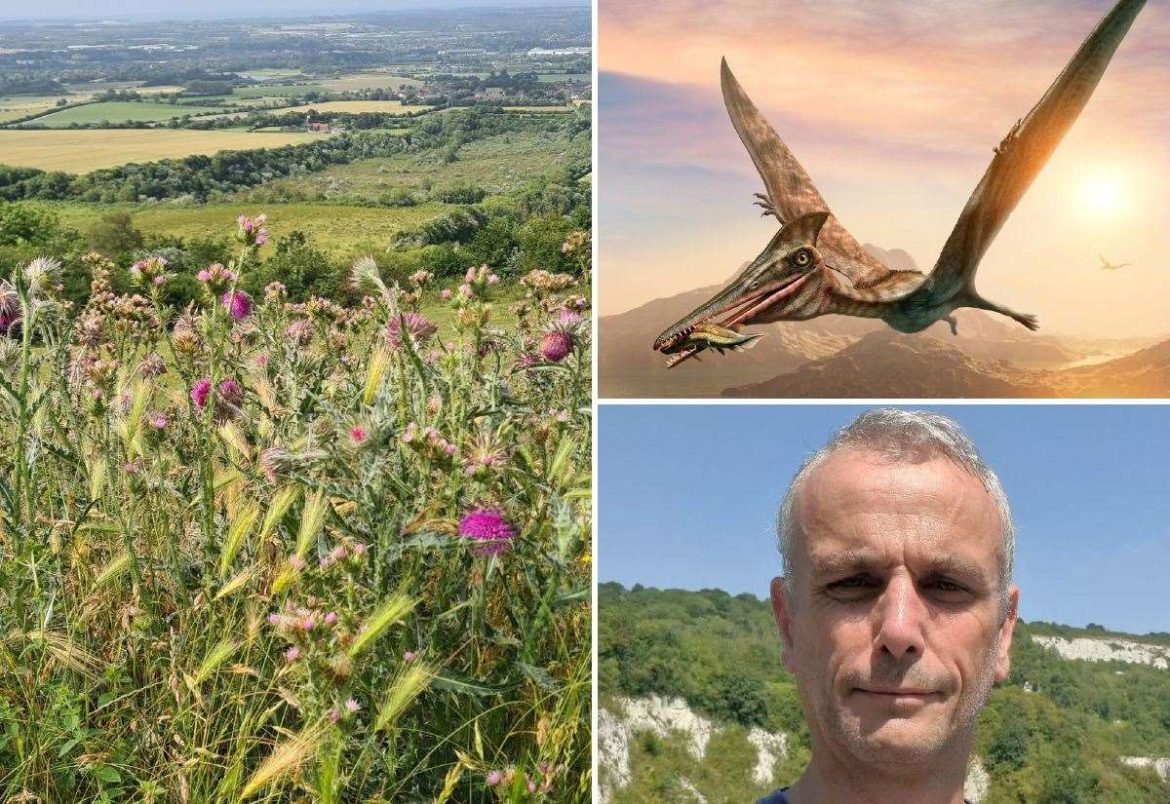
The future of an important nature reserve, once home to flying reptiles, has been secured thanks to the generosity of a mystery donor.
The two Culand Pits, between Blue Bell Hill and Eccles just outside Maidstone, have been managed for decades by the Kent Wildlife Trust.


But the trust did not own the former chalkpits, which are important both for their fossil finds from the Cretaceous period and for their modern day biodiversity.
Instead, the trust had an agreement to manage the land on behalf of Trenport, the development company behind the creation of Peters Village.
Trenport had acquired the land 25 years ago from the Blue Circle Cement company.
Early this year, Trenport decided to dispose of the former chalk pits as being surplus to requirements, and they were marketed with an asking price of £320,000.
The trust was concerned the land could be bought by a developer.
Therefore, it was relieved when a supporter of the trust, who lives locally, bought both the Greater and Lower Culand Pits and donated them to the organisation.

Steven Weeks, the area manager for the Kent Wildlife Trust, said: “We did not have the resources to purchase Culand Pits ourselves, so we are extremely grateful to our very generous donor.
“I cannot say who it is, as they wish to remain anonymous, but they are a long-term supporter of the trust.”
The chalk pits had been carved out to supply the historic brick and cement industry in the area, but have not been worked since the early 20th century. Over time nature has returned in abundance.
Mr Weeks explained that the pits were dug out in a pre-mechanical age by hand, which had enabled the quarrymen to find a wealth of fossils hidden in the 100 million-year-old chalk, including three separate species of pterosaur, warm-blooded flying reptiles.
There were also fossils of plesiosaurs, long-necked marine reptiles, thought to have been the origin of the myth of the Loch Ness Monster, as well as large turtles and fossilised fish.

Today, however, nature has reclaimed the pits, forming a rich chalk grassland that is home to many wild flowers, including several varieties of orchid with fly, lady and man orchids among them.
In turn this has given rise to a large population of butterflies, including the now rare blue butterflies.
There is also an abundance of herbs, including wild marjoram and wild basil.
The pits have been declared a Site of Special Scientific Interest.
Mr Weeks said: “The pits form a significant mark on the landscape.

“Having once been one of the best fossil sites in Britain, they are now a great example of downland wildlife.
“We have been involved with managing the site for 27 years but had no real chance of purchasing it.
“So you can imagine how delighted we are today.”
The gift includes two small adjacent fields that had not traditionally been managed by the trust.
Culand Pits cover 39 acres. There is no public access due to presence of unprotected cliff edges, but the pits can be viewed from the Blue Bell Hill picnic site in Common Road.

Culand Pits is pronounced “kewland” which is how it was spelt on some historic maps.
The trust manages Culand Pits with volunteer work parties, supervised by a warden, who rotate every Thursday between Culand and two other nearby trust sites.
From September, the trust is looking to establish a second work party on Tuesdays. Anyone interested in helping out, should email rosemary.holder@kentwildlife.org.uk
