
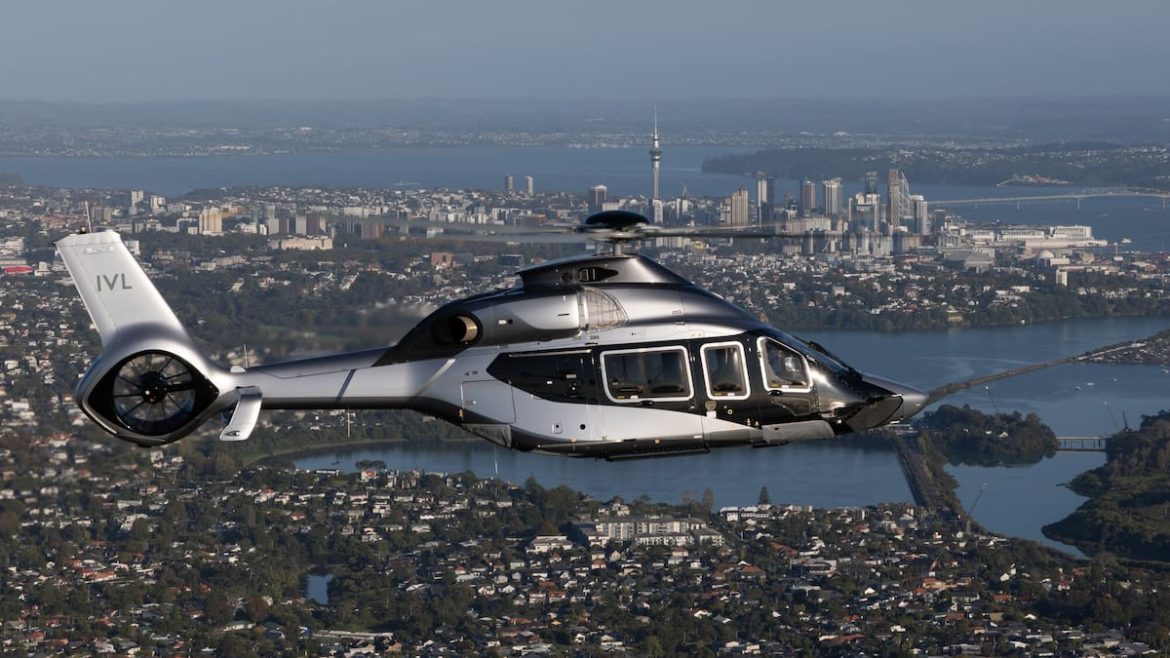
“It also reflects the depth of experience within our team and pilots, who consistently lead the way in operating and supporting some of the most advanced aircraft in the world,” said Keith Stephens, Advanced Flight chief executive and pilot.
The ACH160 variant, tailored for private and business aviation, was designed to accommodate up to 10 passengers.
Advanced Flight chose an eight-passenger configuration, which it said would let travellers get the greatest benefit from the expansive windows and airy cabin.
Airbus said the ACH160 was one of the world’s most advanced medium twin-engine helicopters.
“Customers who have adopted it are benefiting from greater fuel efficiency and quieter operations,” said Christian Venzal, managing director of Airbus’ helicopter business in New Zealand, Australia and the Pacific.
He said the model was the smoothest ride on the market for all applications, from commercial passenger transport to critical missions such as treating medical evacuation patients on board.

Airbus said the H160 operated with 18% lower fuel consumption than previous-generation engines in the same class.
It said the new machine had a 50% reduction in perceived sound, enabling a smaller environmental footprint and reduced noise.
Noise impacts have been cited in public objections to helipads, in complaints from Aucklanders about the police Eagle helicopter and from residents near Whangārei airport about rescue flights.
Last year, an independent hearings panel in Auckland said helicopter take-offs and landings were essentially a residential activity and should be permitted as long as they complied with noise standards in the Unitary Plan.
Airbus said the ACH160 had an advanced Helionix avionics suite with highly intuitive flight controls, vastly improved situational awareness and a lightened workload for pilots.
The aerospace manufacturer has described Helionix as a system displaying only the most relevant details of a flight phase, filtering out unnecessary or distracting information.

It said design enhancements gave H160 operators 100kg more payload or an extra 60 nautical miles (111km) of range compared to what was previously expected for the model.
Airbus said the delivery to Advanced Flight ensured New Zealand joined a small but rapidly growing club of more than 65 H160 helicopters operating worldwide.
In helicopters, Airbus competes with companies including Italy’s Leonardo, Texas-based Bell Textron, and Connecticut-based Sikorsky.
Aviation analytics company Cirium in a March report said the global helicopter market was showing signs of greater stability and maturity, and growing by about 2% a year.
Bell recently acquired an official New Zealand representative in Core Aviation, based on Auckland’s North Shore.
Advanced Flight is based at Auckland Heliport in Onehunga.
It provided charter flights for services including scenic tours, winery lunches and special occasions.
Airbus said the H160 was used in search and rescue, law enforcement and firefighting, newsgathering, and both private and business aviation.
It said the machine had a maximum flight altitude of 6096m, a maximum range of 890km and a recommended cruise speed of 255km/h.
John Weekes is a business journalist covering aviation. He previously covered consumer affairs, crime, politics and courts.
- Stay ahead with the latest market moves, corporate updates, and economic insights by subscribing to our Business newsletter – your essential weekly round-up of all the business news you need.
