
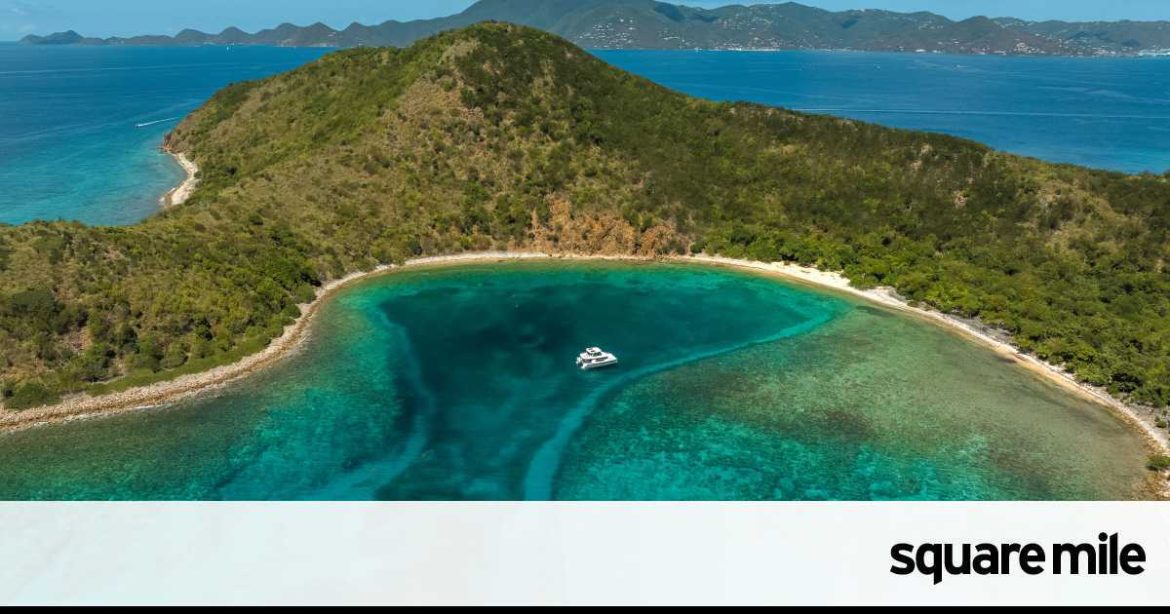
The British Virgin Islands have long been a haven for sailors – from pirates to pleasure-seekers. Aboard a Moorings catamaran, Patrick Dunne discovers their joy
To say the British Virgin Islands is a good destination for sailing is a little like recommending St Andrews as an adequate spot for a golf holiday – it is a wild understatement.
Tropical sunshine, advantageous tradewinds, and an archipelagic layout have drawn both recreational and professional sailors in droves since the industry took off in the 1970s.
Before that, its sheltered coves and natural anchorages made it a haven for pirates in the 17th and 18th centuries, and Norman Island is widely considered to have served as the inspiration for Robert Louis Stevenson’s Treasure Island.
If you’re visiting for leisure, odds are you’ll be chartering a boat from The Moorings, which was one of the first companies to commercialise the sport in the area and offer travellers a chance to explore the islands while piloting their own vessel.
Started by Charlie and Ginny Cary, it began in 1969 with six Pearson yachts in Road Town, Tortola. Soon after, in 1972, the BVI Spring Regatta began – first as just a small local race; now, it’s one of the largest regattas in the Caribbean, and the flagship event of the sailing calendar.
Coincidentally, the regatta is taking place at the same time I’m visiting, as if to perfectly illustrate the different types of sailing on offer here.
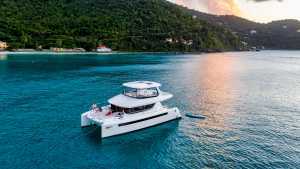
A Moorings power catamaran in the BVI
In another life, I could have been visiting the islands as a competitive participant in the regatta. My parents are both keen sailors, and actually met while members of a club in Cork.
On the surface, it may sound glamorous, but the community-run sailing clubs of southern Ireland in the 1980s are about as far from the Caribbean as possible – the only overlap is the sea and a floating vessel; the similarities begin and end there. Instead of turquoise water, rum cocktails, and catamarans, you have damp prefabs, dinghies, and the dark, merciless Atlantic.
If you want to turn someone off sailing for life, a sure way is to sign an 11-year-old up for a week’s summer camp in relentless grey drizzle. Our way of deriving entertainment was to capsize the dinghy, jump overboard, and watch as the instructor desperately tried to prevent it from floating out to sea.
Instead, I happily take my role as a passenger aboard one of The Moorings power catamarans, which functions like a floating hotel – four en suite bedrooms, a kitchen, and lounging areas across two storeys.
In my limited experience, I’ve found a certain machismo can take over a man on a boat – irrespective of skill or expertise. Simple tasks like rope-pulling, fender-releasing, and direction-giving are all treated with a level of diligence that verges on the performative.
In this environment, admitting your own limitations while being open to tasks is a revolutionary act. Look at it from a captain’s perspective: would you prefer novices to be upfront about the fact their figure-eight knot might need a second look? Or misplaced macho confidence that comes crashing down when you wake up drifting offshore at 3am?
The beauty of a sailing holiday is that you can be as adventurous as you want. Assuming you’re not self-skippering, maybe you want to be less like a guest and more like a first mate to your captain, taking shifts steering and lowering the mainsail. Or maybe you don’t want to touch a rope for the entire week. Most fall somewhere in the middle.
The beauty of a sailing holiday is that you can be as adventurous as you want with it
The Archipelago
The British Virgin Islands are made up of 15 inhabited islands, with a population of roughly 40,000. Of that, around half live in its capital, Road Town on the largest island, Tortola.
It’s from here we set out, first setting sights on Cooper Island. ‘Island’ is a stretch – it consists of a restaurant, beach club, small hotel, rum bar and brewery. In other words, everything you need.
“Island time is real here”, Marco, the head brewer at the Cooper Island Brewery, tells me. As breweries go, this is on the unique side.
Sitting in sweltering heat, no more than ten paces from the beach, are giant fermentation tanks from which an IPA, a lager and a pilsner, plus a few seasonally dependent additions are brewed. They are the only beers served on the island, and are exclusively served on Cooper.
Marco tells me that Richard Branson inquired about getting the beer on Necker Island, but even billionaires can’t disrupt island tradition, and his request was declined.
A rum bar at the end of the beach comes stocked with over 400 different bottles, and is your go-to spot for happy-hour cocktails or history lessons on the difference between English, Spanish, and French-style rums.
“What’s the legal drinking age here?” I jokingly enquire. “When you can reach the counter,” is the response.
You soon learn that each of the islands in the archipelago has a distinctive energy. From the chill beach surroundings of Cooper Island, the next day we head on to Virgin Gorda, which will satisfy the more adventurous island traveller.
On our approach to The Baths, mooring balls are at a premium, so the only option is to swim the 40 minutes to shore. What this is rewarded with is one of the BVI’s most striking natural features – giant granite boulders, some up to 40 feet, scattered across the shoreline, forming rock pools and cavernous passages.
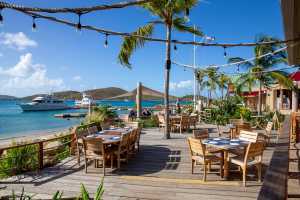
Bitter End Yacht Club restaurant in Virgin Gorda
On the other side of the island sits Bitter End Yacht Club, a sailing mecca where huge, viper-like sailing boats swarm the dock. It’s a resting point for pre-regatta tuning, and there’s a flurry of activity in the water – enough to tempt me on one of the smaller, racing Hobie Cats.
Now, if I had been here as an 11-year-old, cruising around at almost 14 knots with flying fish chasing alongside me, I may have had a better appreciation for marine sport. Parasailers float past, Necker Island lies just within sight, and there’s a golf hole in the middle of the ocean. A hole-in-one will net you a cool $10k; entry costs $10 for three attempts. So far, the man who set it up has made a tidy profit.
In 2017, the British Virgin Islands, along with much of the Caribbean and the east coast of the United States, was devastated by the Category 5 storm Hurricane Irma. As we sail around the coves of Virgin Gorda, large parts of the island that once were packed with houses now lie bare. Mercifully, deaths were low – with four confirmed – but estimated property damage reached $3.6bn, and telecommunications were rendered virtually non-existent, cutting off communities.
Restoration of electricity ended up taking almost five months. The sailing sector was the first back on its feet; some charter operators were accepting guests within weeks of the storm, with the broader tourism industry rebuilding more slowly behind it.
At Virgin Gorda, there are serious signs that the tourism industry is booming again. Ikigai, a 12-course omakase with a changing menu depending on what is caught, is the standout dining offering in the region and will set you back $330 per person.
t’s part of Biras Creek Resort, whose manager, Patrizia, tells me the goal with Ikigai was to create a true destination-dining spot in the BVI. At the other end of the spectrum is the Rum Runner: a man of mythic status with a RIB stocked to the brim with frozen rum cocktails, who zooms around the bay satiating the moored boats with the day’s concoction as the sun goes down.
Hopefully, the signature drink of the BVI, the Painkiller, is on tap – a heady mix of rum, pineapple juice, orange juice and coconut cream.
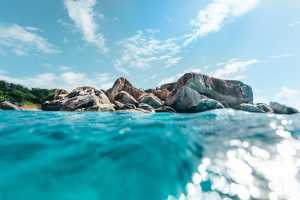
Rocks at The Baths in Virgin Gorda
Outer islands
Most of the islands in the BVI huddle closely together, easily accessible within a couple of hours cruising, but Anegada sits out on its own. Often, touring boats won’t even go there, and when I tell people I’ll be heading over, they act surprised, as if I’ve suggested I was ditching the catamaran and choosing to canoe there.
In truth, its remoteness is only relative, but it feels like the end of the world. Part of that is the island’s flatness, which means it creeps up on you. This, combined with the Horseshoe Reef surrounding Anegada (the fourth largest barrier reef in the world), is a large reason the island has claimed over 300 shipwrecks over the centuries – it is practically invisible until you’re almost upon it.
At only 28 feet above sea level at its highest point, it feels worlds apart from the other mountainous islands, and is a particular favourite for both those seeking true relaxation and among nature enthusiasts. It’s home to native Anegada iguanas, threatened by a feral cat population and the particular concern of conservation efforts, and pink flamingos that wade in the shallows.
As far as fishing goes, conch-diving is the most like the claw machine in an arcade
Conch (pronounced ‘conk’), I soon find, is another main feature on Anegada. Mounds of shells give the island one of its signature vistas, where fishermen have been discarding them for more than 200 years.
We set off on a conch tour – part snorkelling by reefs, part diving for the sea snails. As we dive, I comment to the captain how great it is to swim without having to trigger my crippling fear of sharks. He smiles and decides the end of the tour is a better time to tell me he saw a few reef sharks in the same spot the day before. As far as fishing goes, conch-diving is the most like the claw machine in an arcade – defenceless molluscs plucked from the seabed to be eaten right there on the boat, tasting something like a firm, sweet scallop.
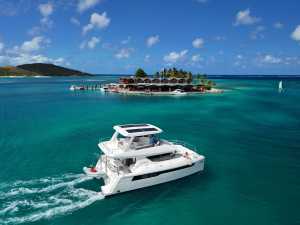
A Moorings 403PC power catamaran pulls up at Saba Rock Resort
Tacking 180 – both literally and figuratively – we head towards Jost Van Dyke the next day. Named after a 17th-century Dutch privateer and pirate, it’s perfect for those keen to engage in the more hedonistic side of vacationing.
It’s here that Daphne Henderson invented the Painkiller in the 1970s. Henderson ran the Soggy Dollar bar, which got its name from the fact that there is no dock, so punters would have to swim ashore with cash.
There is a certain style of Caribbean vacation that this satisfies, while others may want to run a mile. Last year, the BVIs secured the trademark for ‘Sailing Capital of the World’, a title it will hold until 2035. If the judging metric is its ability to turn sceptics into believers, it has a good chance at reclaiming that crown.
On the final day, the youngest member of our crew, after spending the week failing to hook anything aboard with his fishing rod, flings a large parrotfish onto the deck. As it flops around, the 12-year-old fisherman retreats, and it becomes clear that the burden of responsibility to release it back into the ocean falls to me.
Seven years of vegetarianism and an aforementioned aversion to sailing have granted me limited exposure to handling live fish. After a couple of failed attempts – fish are much stronger than they look – I yank the embedded hook out of its mouth, dodging its jagged teeth reminiscent of chain mail.
I feel seaworthy. My bowline has come on in leaps and bounds. Maybe not yet a wily old sea dog, but something approaching a sailor I’ve been made.
See more at moorings.com
